Real Ireland

Oliver O’Connell, Man of the Burren and the Track of Tears.

Ireland is a very popular destination with visitors. And for good reasons. I have met so many who have come here for a week and have rushed around to tick Dublin, Dingle, Cliffs of Moher and Galway off their list and happily report back home that they “did Ireland”. Don’t get me wrong most people genuinely enjoy Ireland, in fact love it. What’s not to love? There is of course wonderful scenery, friendly people, ruined castles, trad music, Guinness, bacon and cabbage, sheep on the road. Everything that brings people here. But very few of those short-term visitors would have tapped into the ‘real’ Ireland.  Ireland’s real treasure is its people. It’s through the people of Ireland you discover the Hidden Ireland.

I spent a day recently with one of these people. Oliver O’Connell may be known to some of you. Perhaps if I say he is Blackie O’Connell’s dad that may twig a few responses or the guy who started a session on an Aer Lingis flight last year, the video of which went viral; but really he should be better known as the great-great-great-great-great-great-great-great-great-great grandson of Maurice O’Connell ‘The Transplanted’. I’ll come back to that.

Oliver lives in an extraordinary spot in the middle of the Burren which is the beating heart of County Clare. Ten kilometres  from Corofin. You look out his kitchen window towards Mullaghmore , across a barren, stark tortured, limestone plain and you cannot see a single house. And at night the only light is the faint reflected glow from Galway City way to the north.

ig3c8720

View across the Burren National Park

Oliver is as much part of the Burren as the megalithic tombs and glacial erratics that dot the landscape. He took me for a little walk to show me a favourite spot of his; the so-called Famine Road. A little used part of the Burren Way walking trail.

Now I thought I knew what a ‘Famine Road’ was.  The walking tours of The Burren will take you to one and tell you these roadways were built as an assistance scheme to keep people out of the Workhouse.  This may indeed be the case but this one is different as Oliver tells it.  This road was here way before the Famine.  Indeed the 1842 map of Clare shows the route as a road in use and on the exact same line as the satellite image.  So it certainly well predated the Famine.

2016-11-04a

Satellite image of Famine Road.  Shown with red arrow.

2016-11-04-1

1842 Map showing same area as satellite image above.  Famine Road is clearly marked.

Oliver explained that it is called the ‘Famine Road’ for a very different reason.  The route was used by a number of families attempting to escape the deprivations of those terrible years but many did not survive. They are buried somewhere along the route in unmarked graves. It struck me as unusual that the road fell into disuse even though it would shorten the trip considerable from Corofin to Kinvara.  Oliver thinks the road has been there for perhaps a thousand years.  If this is true then it is a tribute to the engineering capabilities of the early residents.  It is roughly cobbled and raised in places, the summer grasses partly hide it now but its unique stone walls bounding it still stand proud today. They have regularly spaced jagged vertical stones. The road is straight as a die in places  and it traverses the country peacefully and silently.
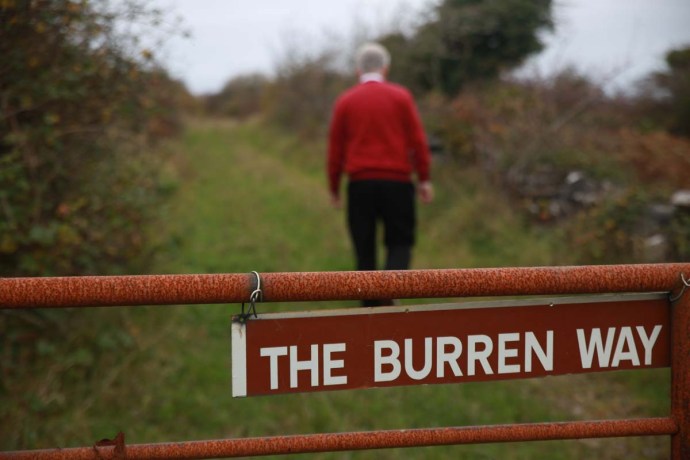
ig3c8604

The start of the Famine Road near Aughrim.  Part of the Burren Way.

ig3c8716

View to the north along the Famine Road
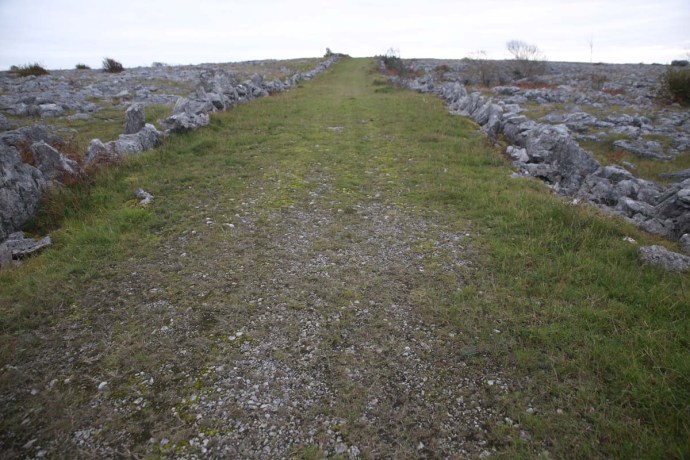
ig3c8655

Cobbles forming the road base

ig3c8664

Detail of cobbling

2016-11-04-3

Detailed satellite view of portion of the Famine Road

ig3c8710

Jagged rocks standing upright form part of a wall along both edges of the road

So why was it no longer used?

Oliver is a poet. One whose poetry is raw, and highly descriptive.  It is personal and it is heartfelt.  It comes to him quickly almost as a stream of consciousness. He doesn’t massage it and as a result it doesn’t sound the least bit contrived.  In a poem he wrote about this road he describes what he calls the Track of Tears, thus:

Here in this place “bothar na muinne, ait ciunas gan uaigness”.

Where silence screams at you but the spirits of our people radiate a comforting presence as they lie here in peace in their final resting place.

You tread on their footsteps and on their tombstones as you weave your way through sacred structures and vertical stone walls in this land of myth and magic.

(‘bothar na muinne, ait ciunas gan uaigness’ translates to a ‘place of silence without loneliness’)

The silence screams. It quite literally does. Not a bird, no wind, no animals Just the sound of our footsteps and our breathing. It’s as if the Gods with quiet reflectance continue to mourn those who didn’t make it. And it is surrounded with a landscape of harsh but tranquil beauty described so well in Oliver’s poem.

It is perfectly fitting that the road is no longer used and it is tempting to think that this was by design as a memorial to those lost.

I was moved by the story of the road and this window into a distant Ireland.  Distant struggles, yes, but it recalls the many battles endured before and since by the Irish people.

But Oliver has a bigger story to tell.

ig3c8736

Oliver with the O’Connell Family Tree
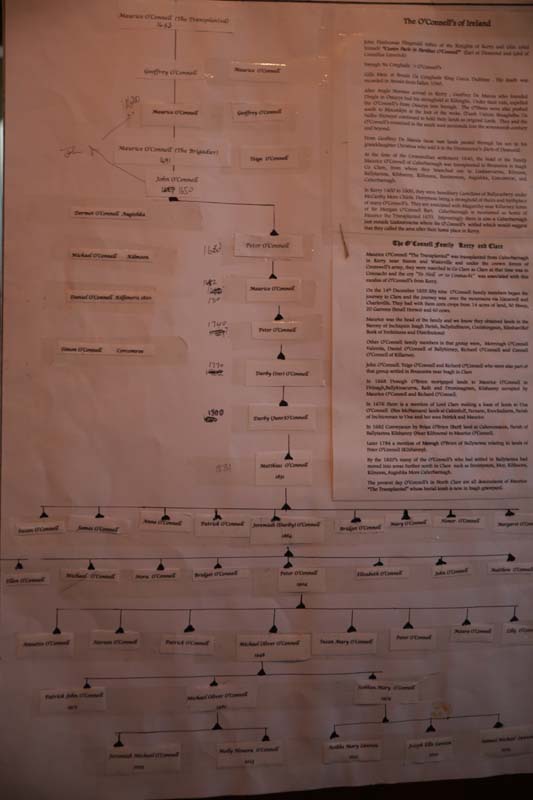
ig3c8741

Detail of portion of the Family Tree

He has spent fifteen years trying to unravel it and his journey has as many twists and turns as a good detective yarn.

Oliver’s forebears have been in Clare since 1653. He has been able to trace them back continuously to Maurice O’Connell (The Transported) who led 59 members of his family from their home in Kerry, from where they were expelled by Cromwell. Those who survived resettled near Inagh and Liscannor. Clare was then part of Connacht and the expression To Hell or Connaught comes from that time and relates to this exodus. The barren plains of the Burren was the equivalent of being sent to Hell. But survive they did and Blackie’s children represent the fourteenth generation of O’Connell’s to live in Clare. But it’s even more interesting than that.

Oliver has managed to trace Maurice O’Connell’s antecedents back to 1340 when they were a well connected and important family in Kerry and Limerick and even earlier to Connaill Gabhra, “Connaill of the Swift Horses”, King of Munster, in the 1100s. What a fabulous heritage. Nearly a thousand years!

What is unique about this story is that documentation exists continuously since the 1300s. As Oliver explained most Irish families can only go back to the 1820s. Prior to that records were kept by the British only for Protestants and Military. The O’Connell’s have a long hsitory of military service so the story is still there for those with the patience and energy to root it out.

Oliver as well as being a poet and raconteur is a musician and has links to a generation of musicians sadly disappearing fast. He is full of stories all told with zest and enthusiasm, such as how Blackie started on the pipes, but I will leave that for Oliver to tell sometime as he surely will.

ig3c8753

How else would you end a day such as this but with some tunes, So I sat on a chair in the kitchen, a chair that I’m sure that Oliver’s old friend Finbar Furey would have sat on and it just seemed so perfectly logical that the fiddle and the box together would shatter that Burren silence.

Oliver has invited me back to see this place in a different mood. When the frosts arrive.

Keep me away.
ig3c8649_1

Categories: My Journey, Real Ireland, Wild Ireland | Tags: , , , , , , , , , , , , | 11 Comments

The Beara Peninsula, Co Cork. My New Favourite Place in Ireland.

I hope my blogs on Ireland aren’t getting too boring. Each time I discover or rediscover a new place I can’t stop scraping up the superlatives.  I’ve blogged recently on the magic of Glencolmcille and south west Donegal, on the spirit of Achill Island, on the beauty of Doughmore in West Clare and West Connemara and many places in between. Recently I visited the Beara Peninsula again for the first time in twenty years. And I’m sorry but I have to regale you with more resplendent words yet again.

The Beara Peninula is one of those wonderful headlands that define West Kerry and West Cork, jutting prominently into the Atlantic and adding a whole lot of extra kilometres to the Wild Atlantic Way.  Many have well known and evocative connotations. The Iveragh Peninsula, better known as the Dingle Peninsula,  and the famous Ring of Kerry are the prime destinations for visitors and do not fail to disappoint. Less well known are the Beara Peninsula, Sheep’s Head and the spectacular Mizen Head.

The attractions of the Beara Peninsula are however becoming better known and I am told by the locals that this summer it was crowded with visitors. I chose to visit in late October. The weather was good (in Irish-speak that translates to ‘no rain’) and it has to be the perfect time. At the western end, the roads are almost deserted and you feel you have this magnificent landscape to yourself.

An obvious draw of this place is that it is more compact than the Ring of Kerry but there is so much variety, so much of interest and so much to fill the shortening autumn days that it was hard to leave.

So what does this little treasure offer?  For a start magnificent vistas are around every corner. You can approach from the Northern Road or the Southern Road but my strong recommendation is you find time to do both.

panorama-beara-3

ig3c3378aig3c3484ig3c3436ig3c3681ig3c3706a

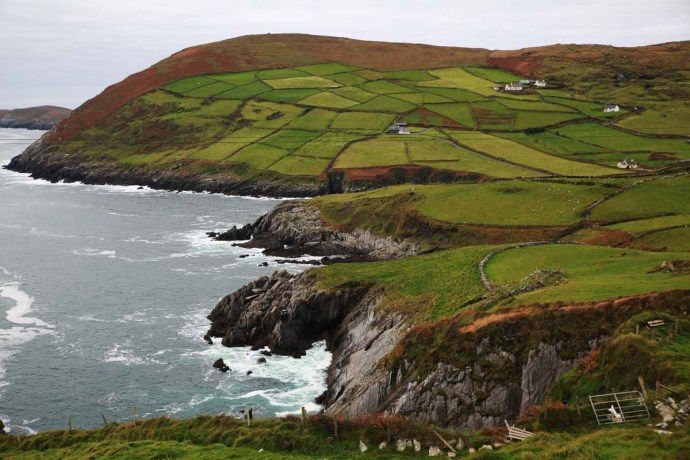
And sometimes you see something that you know could not be replicated anywhere else in the world.  The patchwork quilt and stone walls that say Ireland, Ireland, Ireland.

ig3c4109aig3c4224aig3c4066

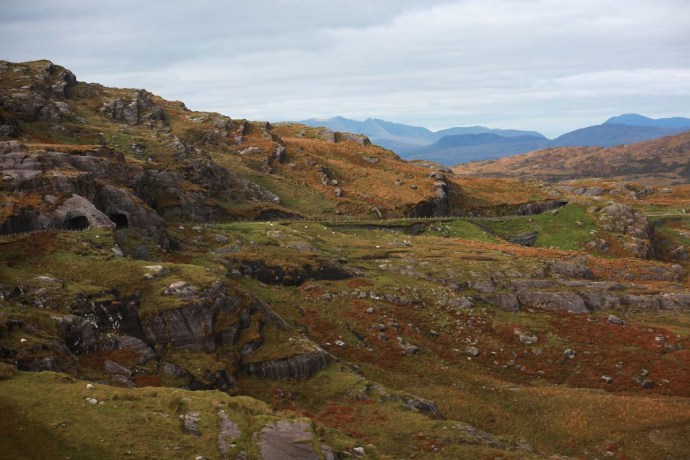
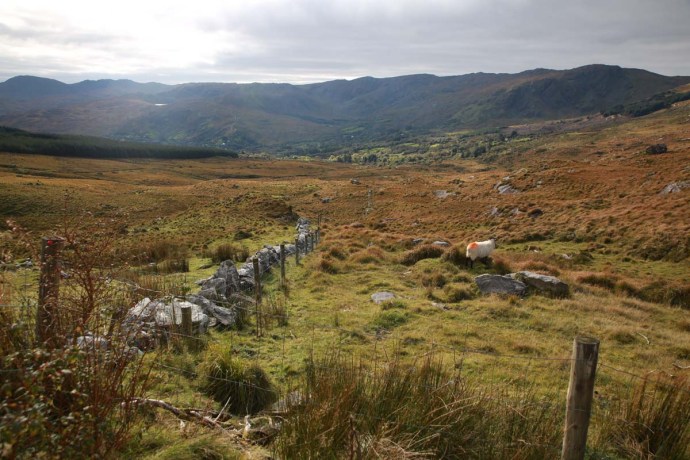
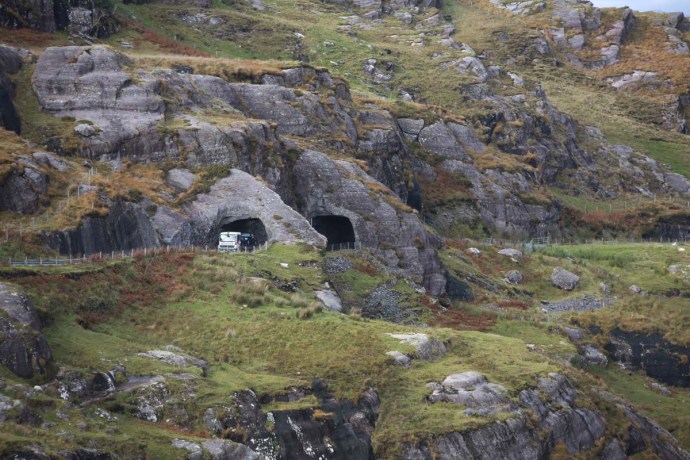
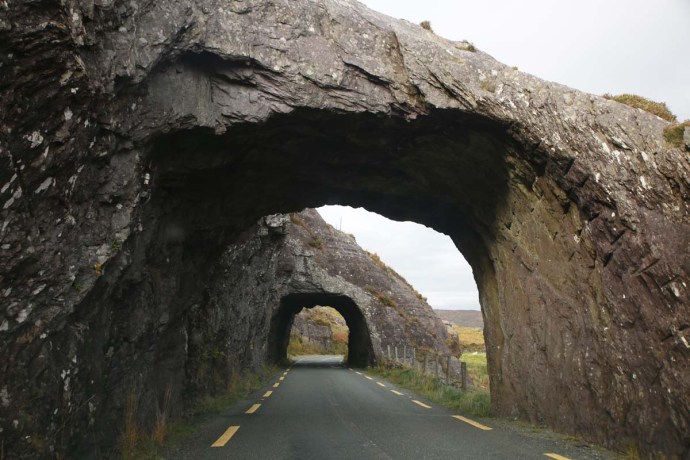
There are a number of mountainous rocky passes. I explored the Caha Pass this time, which links Kenmare with Glengariff. Here there is stunning scenery and four remarkable tunnels (known as Turner’s Rock Tunnels) built in the 1840s when they decided to go through the rock rather than over it. Quite an engineering feat for its day and very unique for road construction as most tunnels in Ireland were built for railways. Indeed the railway construction boom did not start until the 1840s so these tunnels predate any rail tunnel in Ireland.   From this impressive road there are craggy mountains, magnificent pasture and grasslands, and sweeping panoramas. Next time I will do the Healy Pass.

ig3c4805aig3c4741ig3c4801ig3c4826aig3c4731

Elsewhere you will see wild, coastal panoramas, verdant forests, jagged islands or houses perched on grassy knolls with staggering views or nestled into rugged rocky cliffs.

panorama-beara-4ig3c3780ig3c3820

ig3c3635a

ig3c3716ig3c3493

ig3c3916aig3c3841a

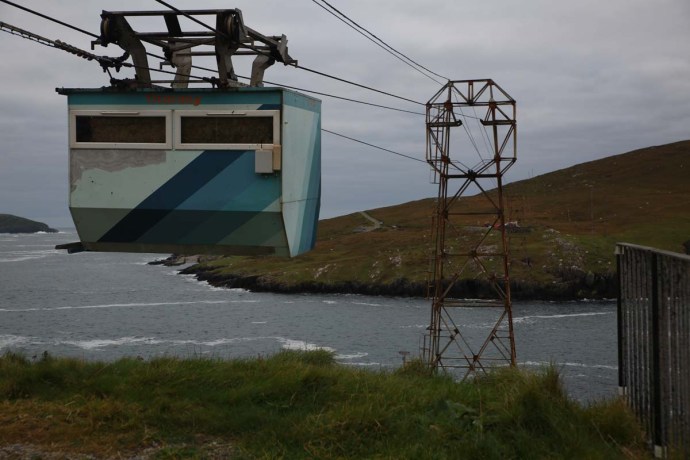
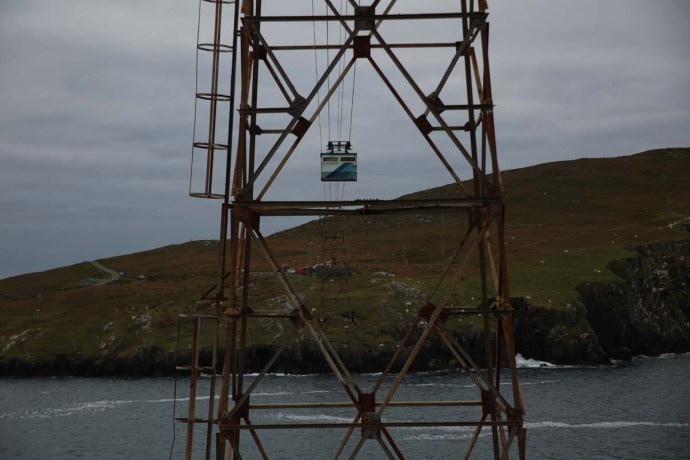
The drive to the end of the Peninsula and Dursey Island is not to be missed. But be prepared for perhaps a little disappointment. Ireland’s only cable car which links the island to the mainland and at this time of the year only runs between 9.30am and 11am was ‘fully booked’ and not operating for transport of people. It was being used for the day by the local farmers to transport hay across the narrow channel. Where else would tourists be turned away, some mind you who had travelled especially, in favour of bales of hay? Only in Ireland. But somehow it didn’t matter, there was so much else to do and it will be there (possibly) next time. You’ve got to admire the ingenuity of the farmers here. I saw an old ‘retired’ cable car in a yard being used as a chook house. Love it.  And love the little insect houses thoughtfully provided by one farmer.

ig3c4000ig3c4016ig3c4034

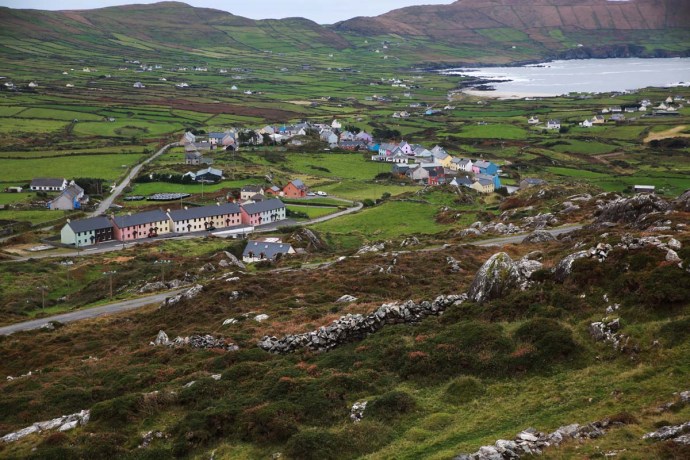
Then there is the colourful palette of the charming village of Allihies, which single-handed may be responsible for keeping alive the paint pigment industry in Ireland. Purples, pinks, indigo and every other colour merged harmoniously into the greys, greens and reds of its rocky backdrop.

ig3c4383a

ig3c4264a

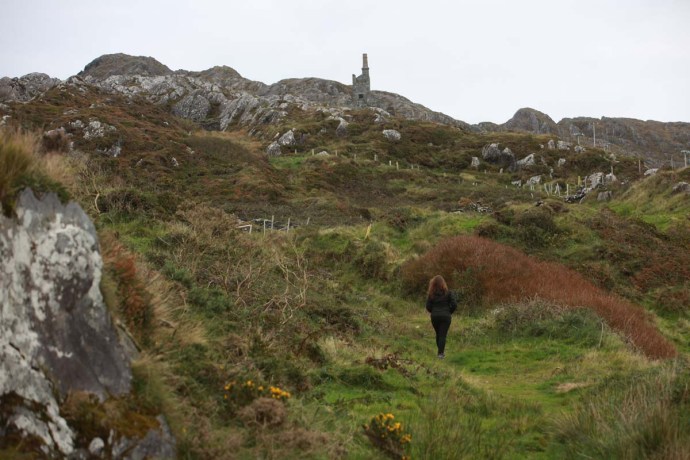
And towering over the town is the architectural masterpiece of the Engine House of the Mountain Copper Mine built around 1810. Maybe you think masterpiece too strong a word  but it is at least the equal from a heritage perspective of the megalithic ruins or the monastic abbeys that populate the tourist guide books.   This is the finest example of an historical mine building I have seen in this remarkable condition. It speaks of the confidence and wealth that the mine brought to this remote outpost as it became one of the jewels of European copper mining during its heyday from 1810 to its closure in the 1920s. There are plenty of reminders of the mining period; old shafts and adits, mine workings, two other engine house ruins, stone walls and in places the tell-tale green and blue staining of copper carbonates.

ig3c4369a

Mountain Mine engine house

ig3c4362ig3c4290ig3c4275

ig3c4321

Chasing the copper


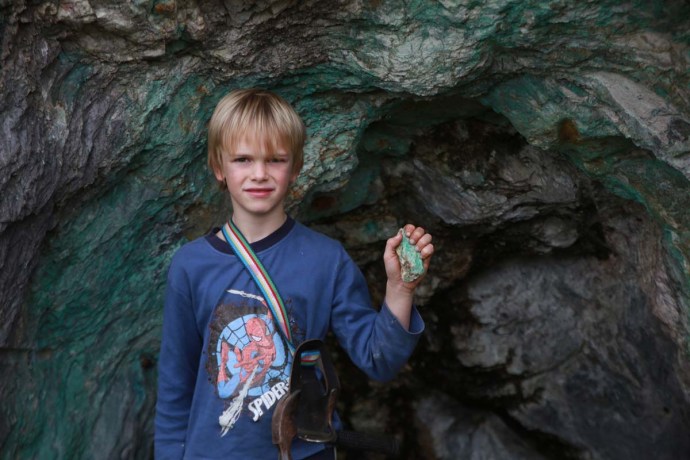
There is a museum which gives a very good account of the mining story but unfortunately it is a bit expensive which turns some away. All aspects of the story are covered including the geology, mining technology and social impact.   As a geologist it was of course fascinating. And even more so for me having met the next generation of miner there, young J and his mum Frances, locals who had come to see if they could find any copper. As it happened I had seen some workings with strong copper on the way up the hill, so I offered to show them and took them there. J’s wide eyed fascination and enthusiasm was enough reward.  Maybe I have helped kick start another geologist’s career.

ig3c4394ig3c4389

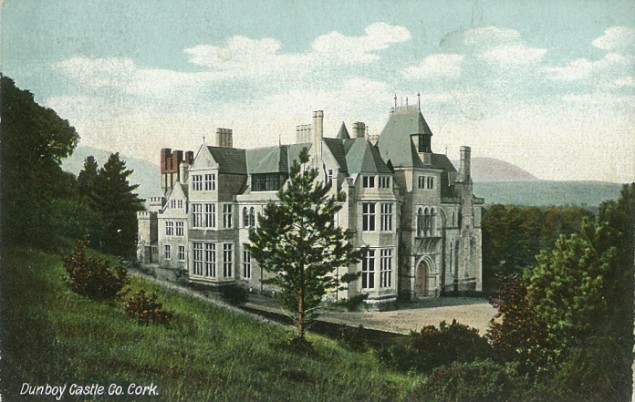
Still on copper, I stopped at Puxley Manor near Castletownbere. Actually the site of the mansion is right near the ruins of Dunboy Castle but more on that later. It would seem that the location is well cursed having witnessed a number of tragedies over the past 4oo+ years.

24_ctb_ah-635x402

Puxley Manor around 1910

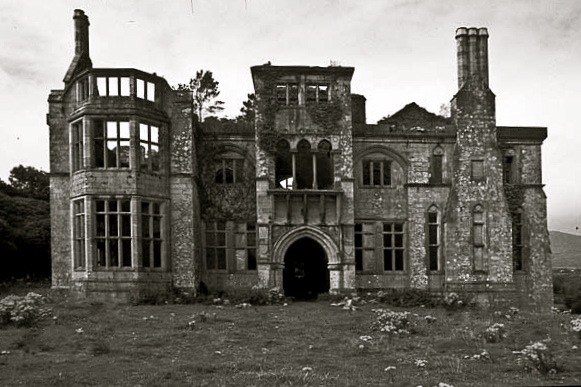
When I first saw the Puxley mansion it was 20 years ago it was a shell of a ruin. It had been the home of the Puxley family since the 1700s. They pretty much owned the copper mining industry here and ended up fabulously wealthy.  As the industry declined so did the Puxley wealth and when his wife died in childbirth Henry Puxley, the last owner, abandoned the castle. Worried that the British Army would take over the abandoned house, the IRA torched it in 1921, destroying it and its contents. The shell was sold at auction in 1927 but remained a forlorn ruin as this photo shows.

b-and-white-puxley

Puxley Manor in the 1990s

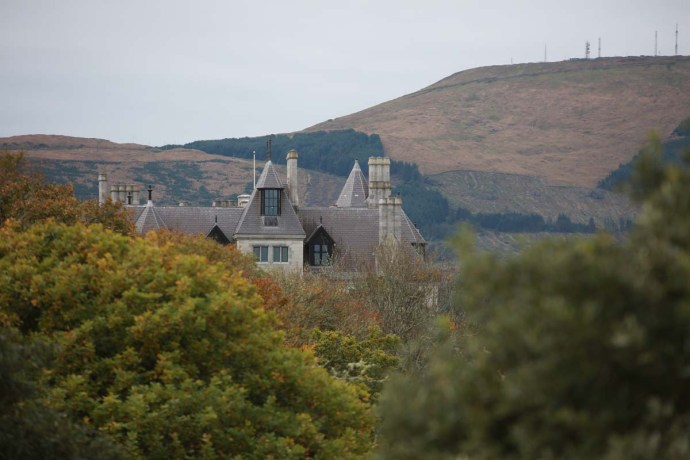
This is what it looked like when I saw it in 1996. It was sold to a developer in 1999 and the Celtic Tiger roared. It was to be transformed into a luxury 6-star resort hotel, the only one in Ireland. Massive restoration and conservation work was carried out and all progressed swimmingly with a soft opening in 2007. That was until the money dried up in 2008 with the GFC. By 2010 the project was abandoned and a mesh fence erected. The bats returned but not the visitors.  This is how it appears today. The rotting hull of a large boat sits in the harbour as if to reinforce the tragedy.  Such a grand vision. The restoration did not however extend to the gate house which stands impressively ruinous.

ig3c4651

Puxley Manor.  restored but empty

ig3c4532a

Puxley Manor

ig3c4496

Gatehouse.  Puxley Manor


I said earlier that Dunboy Castle remains were nearby. This was the ancestral home of Donal Cam O’Sullivan, last of the Gaelic chieftains and a thorn in the side of Elizabeth I during the nine years war which started in 1594.  In 1602 she sent a large battalion of troops to destroy O’Sullivan and the 143 men, who tried to defend the castle, could not withstand the British canon. Surrender was not an option after an emissary sent to discuss terms was hung in full view of the defenders. This ultimate fate awaited all those remaining once the British destroyed it and the castle was never lived in again.

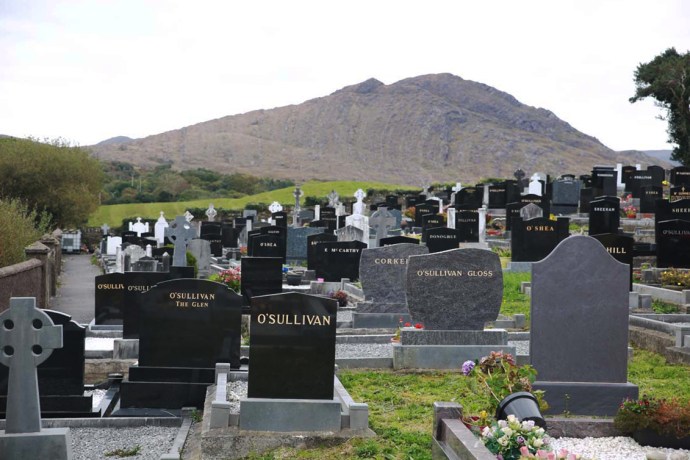
The name O’Sullivan however is everywhere on the peninsula.  You can’t avoid it.

ig3c3538

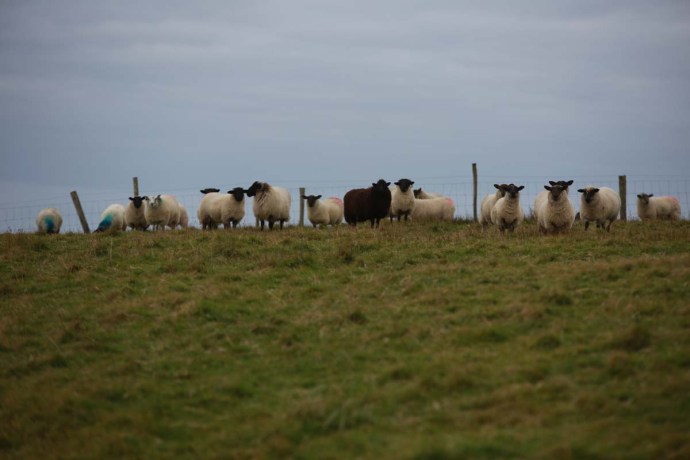
This little enclave of Cork is truly a gem and you could spend a week here or even a lifetime. There are plenty of stone circles, forts, monuments, holy places (such as the Mass Rock) and extraordinary natural wonders to explore and discover.  Oh, and sheep.  And there’s Dursey Island, if the cable car is running.  And if you’re up for it you can walk it all on the Beara Way.

panorama-beara-6

Ring fort

ig3c3756

Mass rock

ig3c4147

The black sheep in the flock

ig3c3540

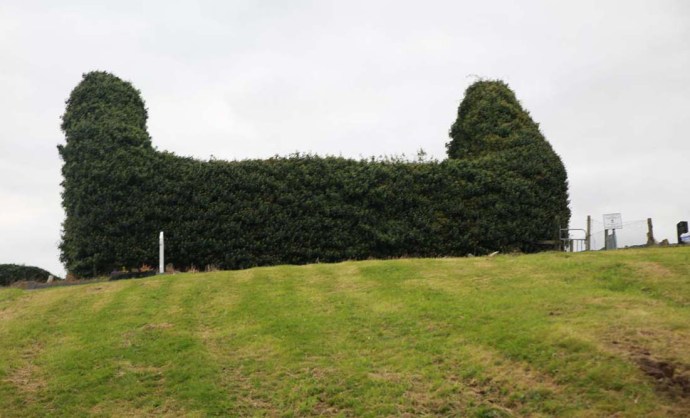
There once was a church

The beauty though is not just in the grand vistas but in a host of other details for me that capture the personality of a place.  Here are a few photos that speak loudly about the struggle for life for both nature and man.

ig3c4151

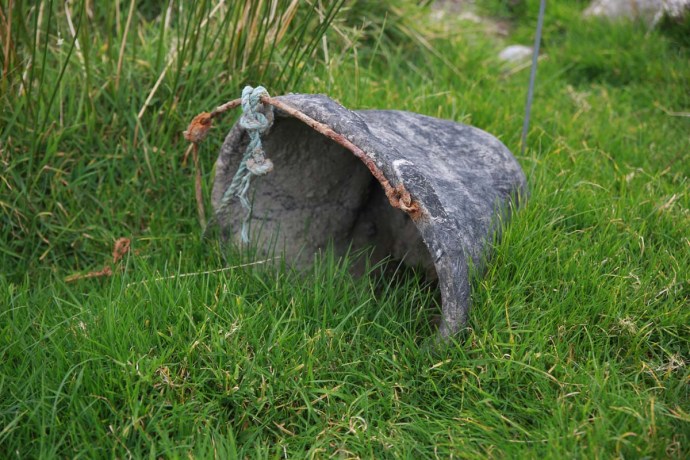
Abandoned bucket near a well.

ig3c3769

Perfect bonsai tree growing wild.


ig3c4080

Window treatment

ig3c4404

Ingenuity

ig3c3556

Maintenance can be a problem

ig3c3519a

Fantastically fertile for funghi


ig3c3434

Life hangs on


ig3c4692

True love

ig3c4547a

Faded hope

ig3c4505

Was this to avoid the window tax?

So that’s it.    I’ll be back and very soon.

Categories: My Journey, Real Ireland, Wild Ireland | Tags: , , , , , , , , , , , , , , , , , , , , , | 9 Comments

Fury. A dog’s tale.

There are many legends and stories in Ireland; the origins of which are often lost in time and who knows whether there is any truth in them or whether there has been serious embellishment over the years.  So, it’s great when one such legend is proved with physical evidence.

img_1678

If you visit Portumna Castle in County Galway you will of course be blown away by the splendour of the building, which in its time was the grandest castle in Ireland, outshining all others. Built around 1610, it is notable as the first building in the Renaissance style in Ireland and cost a massive £10,000. It was abandoned in 1826 after a fire and has been largely rebuilt. I don’t want to talk about the Castle and everything there is to see, the guidebooks and guided tours will show you all of these things, but the highlight for me was the display of the remains of Fury.

Fury was by some accounts an Irish Wolfhound, by others something else. The story was widely told that in April 1797, Fury was asleep on the grass underneath one of the windows of the castle when a young lady of the house, while watching the dog below, fell from the window. She landed on the dog breaking its back which resulted in poor Fury’s death. This though  saved her life by breaking her fall and in gratitude the family placed a plaque on Fury’s grave. Part of the inscription read

Alas! poor Fury.
She was a Dog, Take her for All in All
Eye shall not look upon her like again.

Excavation in 1997 indeed discovered bones of a dog and the skeleton was reconstructed. Analysis of the remains suggested the dog was a Whippet though this could not be conclusive.  A number of vertebrae were missing in the middle of its back and this supported the legend that  the likely cause of death was of a broken back. The presence of nails in each corner of the gravesite indicated that she was buried in a coffin.

img_1694

Sad it is of course, but also quite wonderful that 200 years after the tragic event archaeology confirmed the legend and that Fury’s deed is remembered.

Fury is on permanent display at the Castle. It’s worth a visit.

Categories: My Journey, Real Ireland | Tags: , , , , , , , , , , , , , | 5 Comments

A Visit to Ralahine, Co Clare. A Failed Experiment.

Ireland was a troubled country in the early part of the 19th century. Under the firm rule of the Crown, most Irish land at this time was owned by absentee landlords either in Britain or Dublin. The farms became a hotbed of discontent with tenants living in misery. This prompted organised groups such as the Ribbonmen, who launched deadly attacks on landlords and their tithes. Rural Ireland was not a happy place.

One man decided to try to change this. He believed he could bring peace to the land with a cooperative farm where he would rent the land to the labourers and they would work it under their own authority. This man was wealthy landowner John Vandeleur and a man of considerable influence in Clare.  He had been High Sherriff in 1823.  He found an estate of 638 acres at Ralahine near Newmarket-on-Fergus in County Clare and with socialist backer Englishman Edward Craig running it, started the colony with 40 farmers and their families. They had a school, a laundry and a pooled kitchen. All the capital (buildings, stock etc) was provided by Vandeleur and was communal property. There was no private ownership.  All 4 legged animals, even dogs, were the property of the group.  He charged rent in the form of farm produce.

2016-10-04-5b

Ralahine Estate as shown in the 1842 Survey map.  The location of buildings still standing is marked,

There were strict rules governing the running of the farm. It was no socialist Utopia. New members could only be admitted by ballot. Work was 12 hours per day. There was no gambling and no drinking.  There was however enshrined freedom of expression and religion.  If there was a proposed marriage to someone outside the colony, and the members did not approve, then both were excluded. There was no money. Labour was paid for in Labour Notes which could be exchanged for provisions.

It all seemed to work and the colony expanded after one year to 81. People came from all over the world to see the contented colonists. Then it all came crashing down.

Mr Vandeleur’s wealth was gone. He had lost his fortune, ironically through gambling and drinking. He fled from Ralahine. The arrangement with the members had no legal basis and all the assets were seized and the bold experiment came to an end after two years.

I wanted to see how much of Ralahine was left. It was easy to find; just a short drive out of Newmarket-on-Fergus. I met local farmer Niamh, who pointed out some of the original buildings from 1830 which are still standing. There is the old mill, very much intact and a long whitewashed building, which at first I thought was stables, was the old working mans’ cottages. Each “house” has a single room with a fireplace,  Probably very comfortable for its day. .

ig3c1004

Rear view of the Old Mill

ig3c1148

Front view of the Old Mill


ig3c0993

Workmans’ Cottages


There are a number of other buildings and many walls which also appear to date from the same time but these mostly seem to now be used for storage. And of course looming over it all is the Rathlahine Castle, a previous home of one of the MacNamaras,  possibly looking a little worse for wear now than it did then.

ig3c1064

Ralahine.  View to Rathlahine Castle.


ig3c1143

Rathlahine Castle


The original house, the residence of Vandeleur,  was apparently demolished in the 1940s. Niamh said it was due to the windows tax, but this sounds a little fanciful as the window tax ended in the 1850s.

ig3c1151

Ralahine.  The site of the original Rathlahine House.  Nothing remains. 


I found a few very old apple trees near the mill, laden with fruit and it would be nice to think that these date back to the days of the colony.  So maybe John Vandleleur, if he is looking down on his life’s work from his vantage point above, may take some solace in the fact that among the crumbling ruins of his dream apple trees, his farmers planted 185 years ago, are still bearing fruit.

Categories: My Journey, Real Ireland | Tags: , , , , , , , , , , , , , , | 7 Comments

Doughmore Beach, Co Clare. Walls, Donald Trump, drowned forests and a Man o’ War.

paanorama-doonbeg-1

It was Saturday and I was going to stay home and practice fiddle but  when I looked out the window I saw blue sky. And you have to take advantage of every such day with the Winter SADS not far away.  With Donald Trump on my mind after reading some anlysis of the debate (why do I do this to myself?) I thought I would go and have another look at where he wants to build his new Irish wall.

Doughmore is the location of Donald Trumps Doonbeg Golf resort, It is about ten minutes drive south of my little cottage near Quilty. So you see it’s pretty much my backyard.  You follow the signs with the blue squiggly line because the Wild Atlantic Way actually diverts to the beach.

Trump bought the impressive resort and golf course at a knockdown price of $12 million when the then owners were in difficulty.  An astute purchase?  Of course.

panorama-doonbeg-5

Doonbeg Resort.  Golf course tucked behind the dunes


ig3c0118

Doonbeg resort complex


For those who are not aware, he now wants to tip 200,000 tonnes of rock along nearly 3 km of the beach (that’s a public beach mind you) to build a massive wall up to 4.5m high to stop erosion of the dunes to protect his golf links.   A little bit of science.  Erosion of dunes during a storm surge is a natural event. The event that scared Mr Trump happened in February 2014 and the dunes were cut back around 10m. This was a once in a lifetime happening that caused millions of euros of damage all along the Clare, Kerry and Cork coasts. But hey, erosion of dunes is essential for the replenishment of the sand to the beach. It is temporary as the sand returns to the dunes through wind. That’s how the dunes got there in the first place.  The Dutch understand this and monitor the normal movement of dunes as a natural barrier to inundation of the lowlands. A rock wall will destroy this continuum. Trump proposes to spend millions to save a couple of greens. Well stiff I say. Spend the euros on new greens and fairways. Leave the beach alone.

ig3c0200

Doughmore Beach.  Eroded sand dunes.  Note rapid partial regeneration.

ig3c0321

Doughmore Beach.  200,000 tonnes of rock planned to be tipped against these dunes.


So my visit this day is to see what’s at stake. And see it before it disappeared under a pile of rock.

Oh, and did I say that these dunes are classified as a Special Area of Conservation by the EU.

I was struck immediately by the relatively unspoilt nature of the beach. At the southern end where the resort complex is located is a rock platform, unusual because the shales are steeply dipping unlike most of the Clare coast where the strata is flat lying.  From here a beautiful sandy beach stretches around the bay for about 3 km. In the bright sunshine it is stunning.  The resort stands proud of course but the golf links is tucked away out of sight.  The impression is of pristine wilderness.   I found plenty of reasons to leave the beach as it is.

ig3c0163

Doughmore Beach.  Wide sandy beach at low tide.


ig3c0015

Doughmore Beach.  View towards the north.


ig3c0185

Doughmore Beach.  Another view.


It is very wide and predominantly sandy with only a narrow zone of boulders at the base of the dunes as distinct from many beaches in the part of the world which are boulder rich. This day there were many using the beach but paradoxically it seemed empty.  Most were just Irish families not people from the resort. I  spoke to quite a few. There was a family walking their Labrador, which, by the way, was having the time of his life. Another family, home from Australia, building a sand castle, people walking, jogging and just sitting and staring towards the Cliffs of Moher, visible as clear as a bell in the distance.

ig3c0169

Doughmore Beach.  Enjoy.


There was plenty of bird life. I saw a pair of Oyster Catchers going about their business along the shoreline, there was a Grey Heron and a flock of Mute Swans, really a surprise to see them on the ocean. Could have watched them for hours. A bit of Tchaikovsky would have been perfect.  Perfect synchronicity from one pair as they performed a pas de duex for me.


ig3c0273a

Doughmore Beach.  A pair of Oyster Catchers.  Looking towards Liscannor and the Cliffs of Moher.


ig3c0715

Doughmore Beach.  A Grey Heron with the Cliffs in the distance.


ig3c0663

Doughmore Beach.  Part of a flock of Mute Swans.


Some kind folk pointed out to me a Portuguese Man o’ War washed up on the beach. Alive mind you.  A very rare occurrence as they are usually found in warm water in open ocean. A few have been spotted recently along the west coast of Ireland. So there is a bit of an alert out for them. They are related to the famous Australian blue bottle which though not as deadly as the Man o War, stings upwards of 10,000 people on Australian beaches every year. They are a beautiful and fascinating creature. Not actually a jellyfish, they are a colony made up of a number of different specialised individual animals (called zooids or polyps). They are attached to each other and to a bladder which is inflatable. The bladder, which is filled with gas, has intricate patterns etched in pink and the polyps and tentacle are shades of purple and cobalt blue. They have extremely long and venomous tentacles which is for gathering food and defending itself. They are at the mercy of the ocean currents and travel in schools of over 1,000. So keep a lookout. And don’t touch.

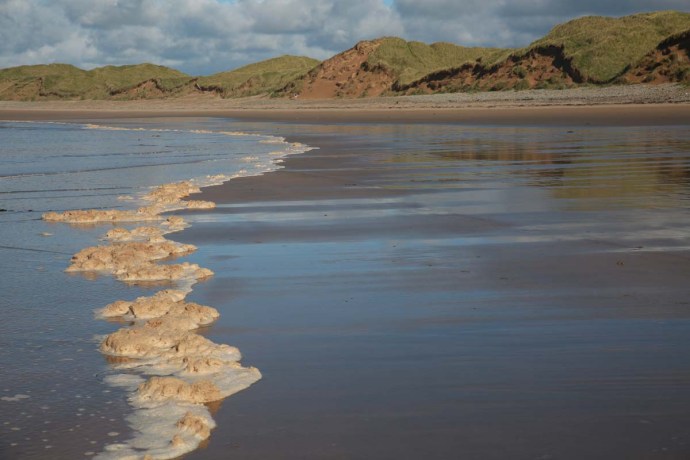
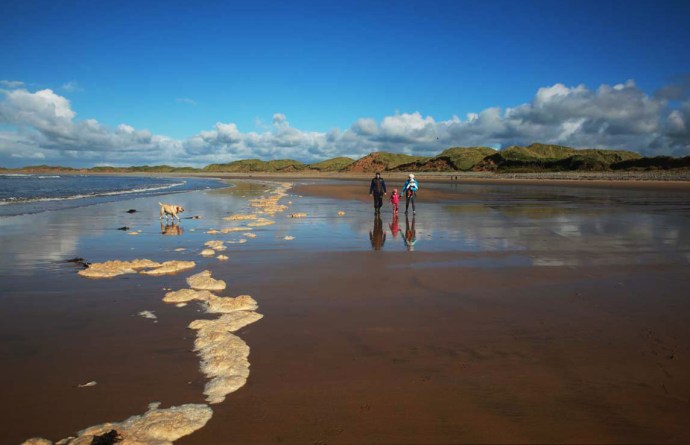
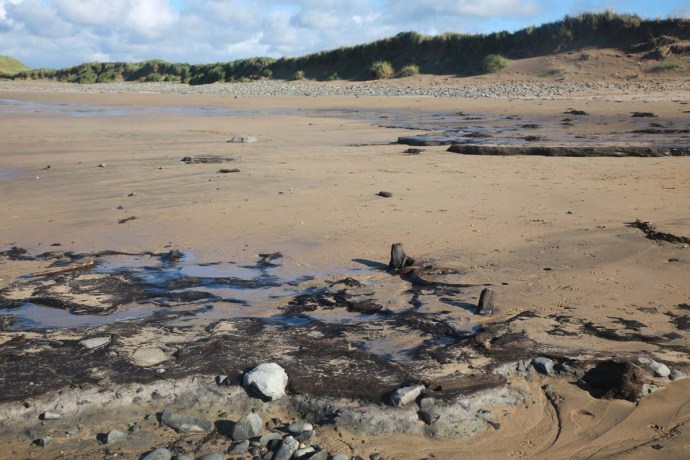
I noticed a small patch of peat exposed on the beach. This part of the beach is littered with old timber and tree stumps and roots. Part of an ancient drowned forest such as was revealed near Spiddal after the February 2014 storms. I’ve seen this before also at Caherush, though that one is now covered over again. Here there is very little of the peat exposed and it is is very narrow (less than a foot thick) and is clearly eroding fast.  It sits on a bed of quite soft mudstone which was the original forest soil layer. The stumps with roots attached many in situ and upright with the roots extending into the substrata. Chances are this represents an old forest from around 4-5,000 years ago, most likely inhabited. Most of the stumps appear to have met with a natural end, but I did notice one which had a definite saw cut – evidence of timber harvesting? This is amazing; they had saws back then? I can think of no other explanation.  This is a remarkable and unheralded window into the past.  Unfortunately it won’t be around long I’m guessing.  Not Trump’s fault this one, just the forces of nature.

ig3c0502

Doughmore Beach.  Part of submerged forest and remains of peat layer.  Grey rock underneath the peat is original soil layer of the forest.


ig3c0532a

Large stump, showing roots.


ig3c0504

Doughmore Beach.  Ancient tree stump and roots.  Peat all washed away.


I have to go back to that accursed wall. This is not his first attempt. Trump began to dump boulders along the beach soon after purchasing it, without any permits, before Clare County Council intervened and forced him to stop the work. Then he came up with a relatively benign solution which had the support of environmental groups. No this was too namby-pamby. He changed his mind, sacked the very experienced consultant and hired another who would support his now much more drastic proposal. It is currently before Council. Trump firstly applied to bypass the council and declare it a project of national importance (the nerve!). This failed and Clare Council to its credit has initially rejected the application and is seeking more information on 51 questions. This will take many months. Trump’s bullying tactics have so far not helped. We will watch with interest.

I urge everyone who reads this to go visit Doughmore and see for themselves. If you live overseas and intend to visit Ireland, it is a short drive from the Cliffs of Moher and is on the way to the Kilkee cliffs and Loop Head anyway (which should be on your list of must-see places). Hopefully it will all still be there when you come.

ig3c0060

Intricate flow patterns of sea grass on an exposed rock platform


Categories: My Journey, Real Ireland, Wild Ireland | Tags: , , , , , , , , , , , , , , , , , , , , | 3 Comments

The Sheela na Gigs of County Clare: An embarassment or a treasure?

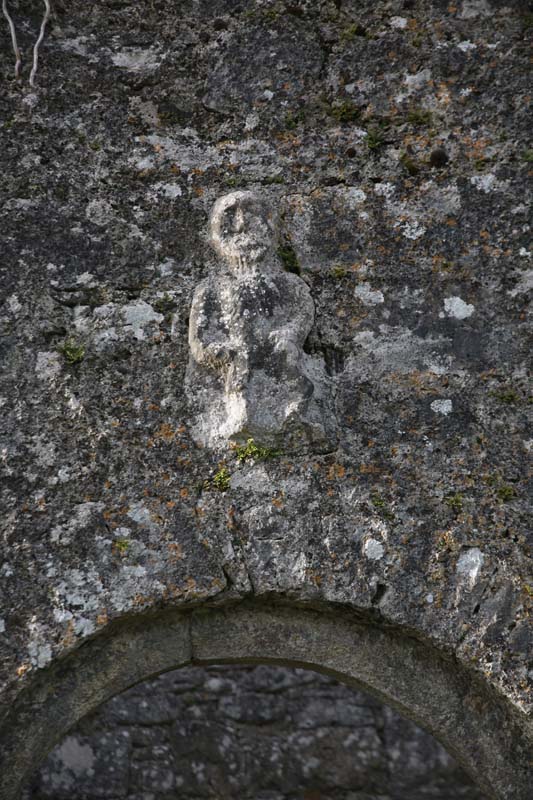
I was shown my first Sheela-na-Gig way back when I first arrived in Ireland. I probably wouldn’t have noticed it if it wasn’t pointed out to me.  High above the entrance door on the ruins of the Kilnaboy Church in North Clare. It was difficult to make out and my guide was perhaps too embarrassed to explain it in detail. However this first exposure aroused  my interest (ha, no pun intended).

Indeed my introduction to the Sheela was perhaps symbolic of the historical ambivalence and difficulty their existence has caused in Irish culture. Embarrassment at talking about them and trying to explain them and tolerance and acceptance of them in very public locations and seemingly incongruous places such as churches and castles.

So what are they?  As in most of these things much is conjecture with theories of their origin falling into two camps.  Firstly it is thought they came from Europe in the 11th or 12th Centuries and were introduced into areas of Ireland conquered by the Normans.  In this case their location on churches and the grotesque features of the figures, even by medieval standards, suggests that they represented female lust as hideous and sinfully corrupting.

An alternative theory is that they may be of pagan origin and represent  Goddess-like figures that are in some way symbolic of fertility and fecundity. They seem to appear in 11th-12th century churches but are reused in structures built much later.  They may even date back further at least to the time of the Irish conversion to Christianity.

The name seems to be Irish (‘Sila’ means girl but can mean Hag or witch) and one translation is ‘Woman of the Breasts’. The name however is modern, probably dating from 1840.  No one is sure what they may have been called contemporaneously.    There is an interesting Australian connection here.  The slang term ‘Sheila’ is a generic term for a woman or girl.  “She was a bonzer Shiela!”.  It is thought to have come over with Irish convicts.

The Sheelas are usually very explicit female exhibitionist figures with legs wide apart and the vulva displayed, sometimes spread by the fingers.  There are similar goddess-like figures in other cultures but here they are unique and identifiably of Celtic/Irish origin.

Why they are placed above doors in churches or castles is not definitively known and it is possible that in medieval times their original significance was lost and they were used simply as a warning against evil and sin.

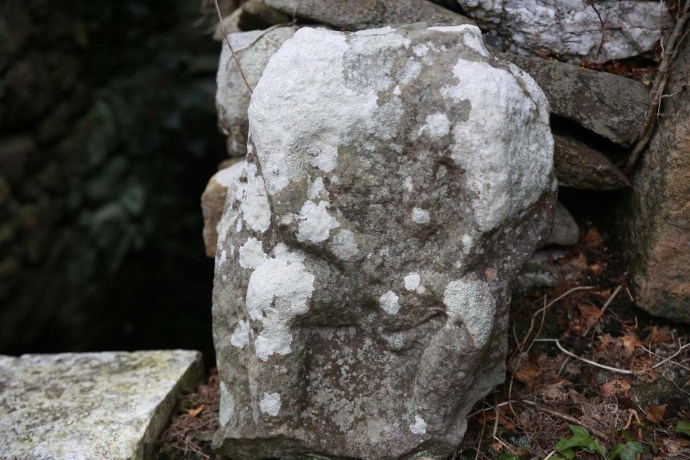
It is a miracle that some actually remain in situ. Most have been removed to a less public place, or hidden in a back garden, or disposed of or made their way to private collections or a museum. Many are missing.

Clare has nine known Sheelas.  Three are in situ as near as one can tell. One is in the Museum at Ennis, one was relocated into a bridge in 1796, one has been moved to another location in a castle, one has been moved to the back garden of a bank and two are missing.

So that is seven.  I decided to visit all seven.  This little adventure on its own told me a lot about Ireland and the Irish.  So here is the result of my endeavours.

I have already mentioned Kilnaboy.  Kilnaboy is one of the better known and most accessible in situ Sheelas in Ireland.  The parish lies in the heart of the Burren and is close to many well known megalithic monuments including Ireland’s best known portal tomb at Poulnabrone.  The church is highly significant and is said to date back to the 11th-century but was repaired in 1715. It has a number of interesting features including a large Cross of Lorraine in raised stonework on one gable and the ruins of a round tower in the grounds.  The Sheela is located over the arched entrance to the Church.  It is a little worn but complete and in remarkably good condition considering it may have been exposed to the elements for 900 years!  There is no fanfare, no sign and if you  didn’t know about it you could easily miss it.


ig3c5638

Kilnaboy Church. Sheela na gig located over arched entrance

ig3c5639

Kilnaboy. Sheela na gig. Detail.

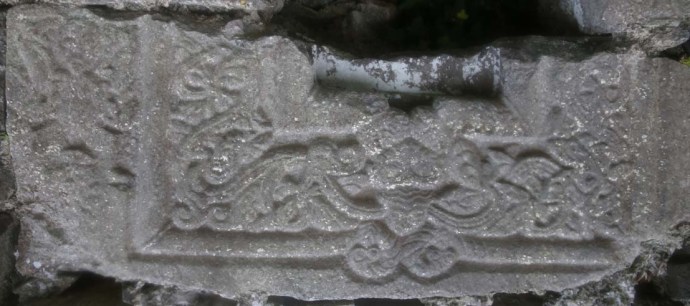
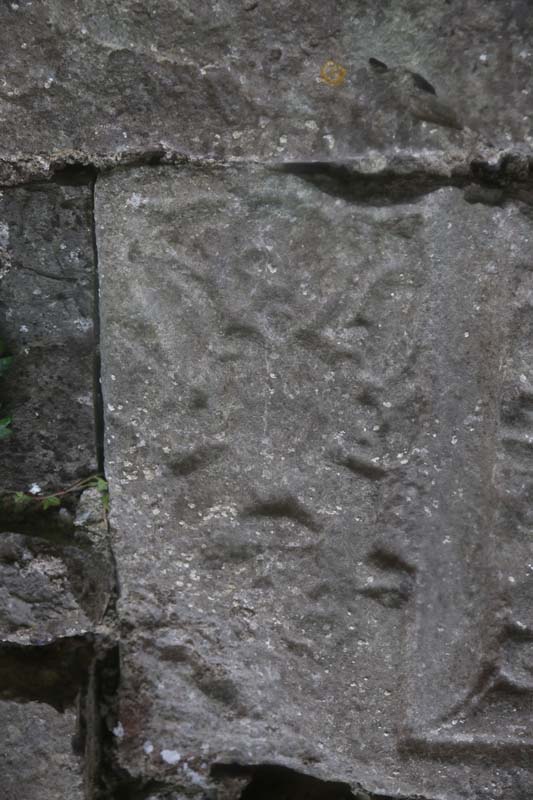
Rath lies between  Ennis and Corofin and is near Dysert O’Dea castle.  Here lie the ruins of a monastic site that dates back to the 6th Century. The current church buildings date from the 15th century but incorporate stonework from the 9th or 10th century. The Sheela na gig is located in a large fragment, originally used as a window sill, and possibly dating from the 12th century. The stone is inserted upside down in a wall of the church and shows a female figure outside the main intricately carved dsign. It is considerably worn but recognisable.

ig3c7287a

Church ruins at Rath

ig3c7299

Carved stonework block in wall of church at Rath.  Block is upside down.  Sheela na gig is on the right side.

ig3c7322a

Detail of carved stonework.  Rotated back to upright.  Sheela na gig is on left

ig3c7281a

Drawing of carved stonework

ig3c7319

Sheela na gig at Rath.  Detail.

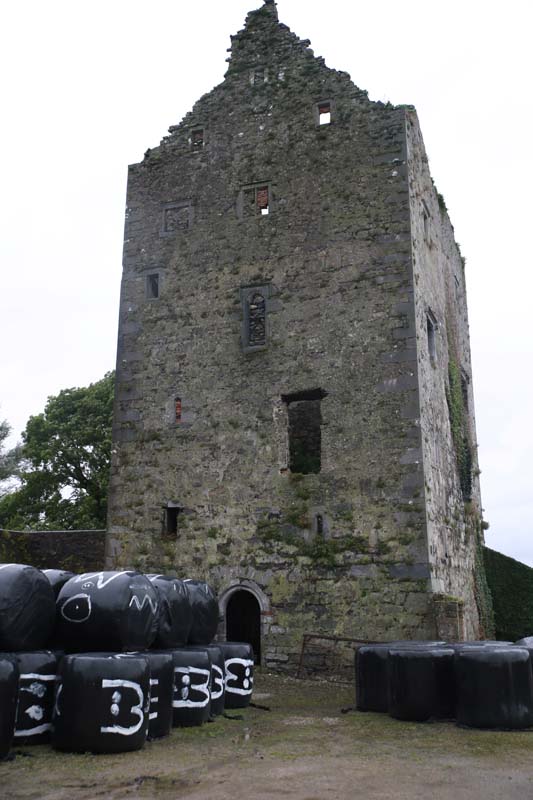
At Clenagh, close to the bank of the River Fergus near Newmarket-on-Fergus is the ruins of the Clenagh Castle. This is a large reasonably well preserved Tower House which was the home of the McMahon family. Date of construction is not clear but it was last occupied 200 years ago. The tower is now surrounded by farm buildings and locked gates and the yard is incongruously used for storage of bales of silage and farm machinery. Luckily on this wet and windy day the gate was unlocked and I could sneak in.

The Sheela wasn’t located where I thought it would be – near the well preserved entrance. It took quite a bit of searching.  I found it close to the ground carved into a quoin at the corner of the structure. There is no way of knowing the date but the style appears unique with spindly legs.  It is reasonably well preserved with a very clear outline but details are worn. There is evidence of rubbing. To me it looks like this is carved in situ into the stone which would make it much younger than the others. But hey I’m no expert.. Again no signage, and definitely no invitation to view.


ig3c7240

The castle at Clenagh.  The grounds are used to store silage and farm machinery and it is not open to the public.

ig3c7260

Clenagh Castle.  Sheela na Gig is located on corner of building near a more recent brick wall.

ig3c7262

Clenagh Castle.  Sheela na Gig.  Detail.


Ballyportry is a Tower House from the 15th Century. It is near Corofin. Formerly the seat of the O’Briens. I visited it but as it is privately owned could not gain access. Of course I could have stayed there for 2-3,000 Euros for three nights. But no point really as the Sheela na gig from here is on public display in the Clare Museum. It was found in the castle grounds and removed in 1942. I checked it out. It is very well preserved and has many unusual features. An over large head, teeth being bared, big rounded ears and holding open what appears to be her anus.

img_3540

Ballyportry Castle.  Privately owned.

ig3c7200a

Sheela na Gig from Ballyportry Castle.  Now on display in Clare Museum.

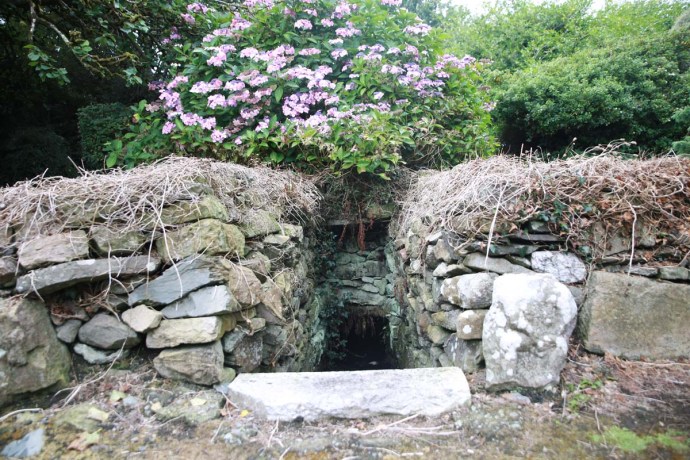
Killaloe sits right on the eastern edge of Clare and is separated from Ballina in Tipperary by the Shannon River.  It is the ancestral birthplace of Brian Boru.  And there is also St Flannan’s Cathedral. Across the road from the Cathedral is the AIB Bank. So what you ask. Well in the back garden of the bank is a Holy Well and next to this, leaning against a stone wall, is part of a Sheela which purportedly came from the Church.

To get access I spoke to Rebecca at the Customer Information desk and after much rooting around she found the key and I was given admittance. No special treatment, just another service offered by the bank. Seriously, I was amused that an historic treasure would be located in the grounds of a bank and that, amazingly, tourists find their way there and are given access. Ireland!

This figure is headless and considerably worn. but large and, depending how you catch the light, quite detailed.


ig3c7059

The AIB bank in Killaloe viewed from the grounds of the church.

ig3c6982

Holy well in the back garden of the AIB Bank, Killaloe.  Sheela na Gig fragment is on the right of the entrance.

ig3c6986

Killaloe Sheela na Gig. Detail.  Head is missing.


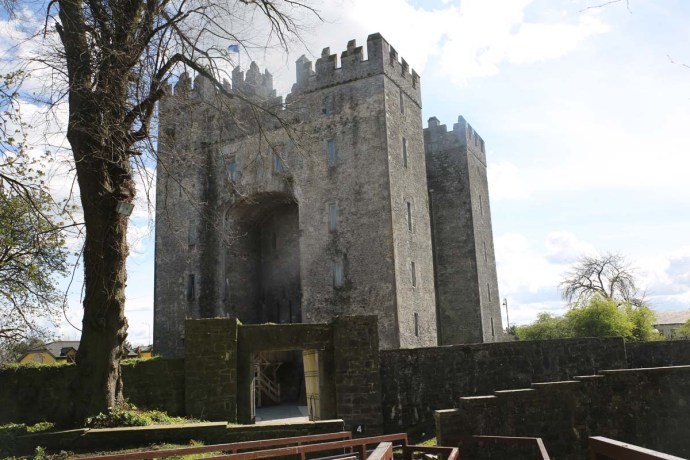
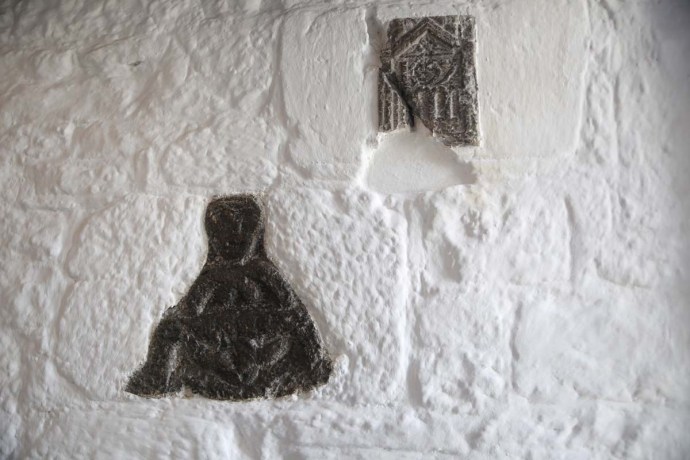
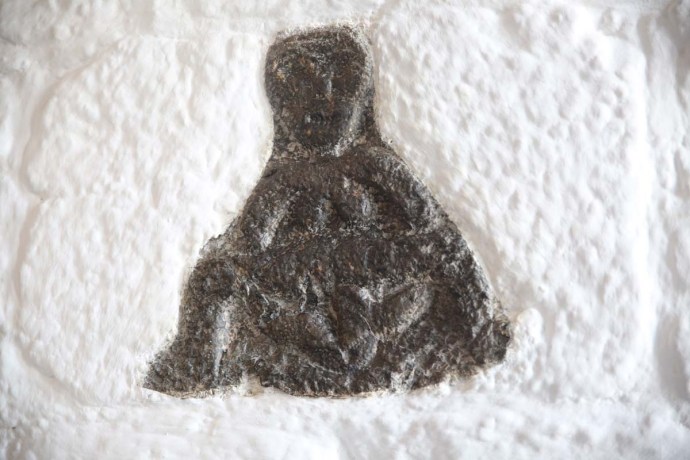
Bunratty is a very well known Castle and Folk Park and a major tourist attraction in Clare not far from Limerick. High up in a wall in the Great Hall of the Castle is a Sheela. It is in good condition but its location is such that it is hard to view. I am guessing it was moved from somewhere, perhaps an earlier castle structure and relocated during the construction of the current Castle to a place where it was not so conspicuous.

Interestingly the current castle is the fourth on this site and was built in 1425 by the MacNamara’s (again!)  but then greatly expanded by the O’Neills (again!) around 1500. The earliest castle is believed to date to 1251, though the site had been settled since 977. Exactly where the Sheela na Gig fits in is unknown. It is somewhat insensitively painted black and stands out starkly from the lime washed wall so the tourists can see it.  It seems to be in good condition.  This was the most unsatisfying Sheela I saw.  I hated that you had to put a telephoto lens on to see it.  And for feck’s sake – painted black!


ig3c9679

Bunratty Castle


ig3c9644

Bunratty Castle.  Sheela na Gig

ig3c9646

Bunratty Castle.  Sheela na Gig.  Detail.

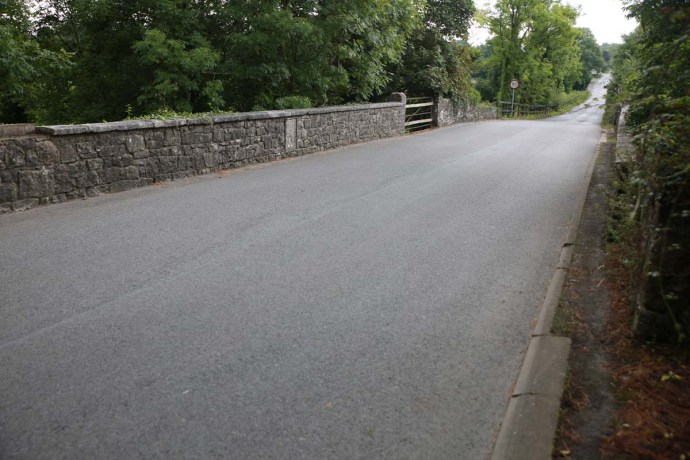
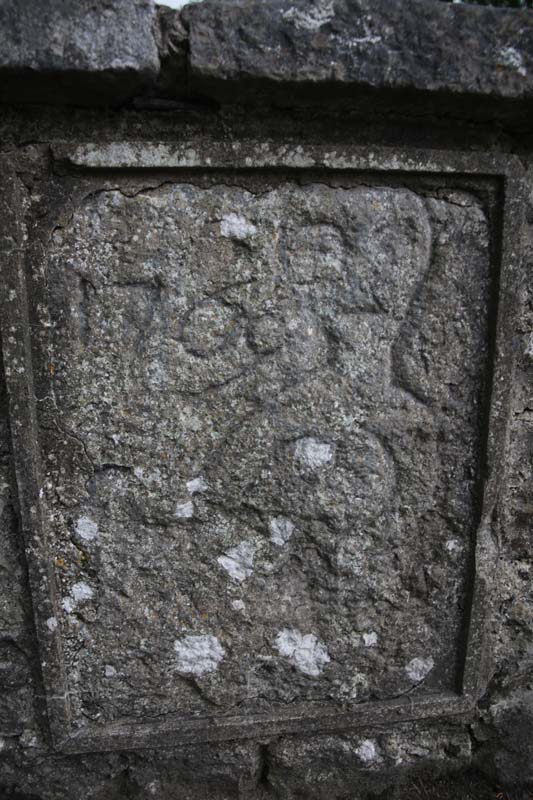
Lastly, there is a doubtful Sheela inserted as a panel into a bridge at Clonlara.  The panel is inscribed ‘1769’ which relates to the date of construction of the bridge.  The Sheela comes from an unknown site and is quite defaced.  Only the head and arms are distinct.

ig3c7196

Bridge at Clonlara

ig3c7188

Clonlara.  Sheela na Gig on stone panel inserted into wall of bridge.


ig3c7061

Clonlara.  Sheela na Gig.  Detail.

A final thought.  I find it fascinating that the Church has placed these extremely confronting figures at their portals for centuries and yet preach a moral purity. It seems a trifle dissembling. But I suppose we should be grateful that this unusual window into medieval and pre-medieval thinking and practice in Ireland has been preserved at least in a fragmentary way.


Anyway Ireland is full of mysteries and Sheela-na-Gigs are another one. I suggest if you come to Ireland you make a point of chasing down your nearest Hag in the Wall.  There’s sure to be one near you.  There are 140 of them.  The search will be as much of an adventure as the discovery.

Categories: My Journey, Real Ireland | Tags: , , , , , , , , , , , , , | 6 Comments

Protected: Tale of two sessions

This content is password-protected. To view it, please enter the password below.

Categories: Real Ireland, Sessions, Trad Irish Music

Achill Island – a story of butterfly collections, Jehova’s Witnesses and old postcards.

During late July I spent a week on Achill Island in the west of Co Mayo. My reason for being there of course was music, a Summer School called Scoil Achla. This was my third time and I have spoken at length about it in my previous blogs. Indeed raved about it, so I won’t repeat that here. Just type Achill into the search box!  This time though I didn’t attend classes and to say I needed a break after the summer touring would be putting it too mildly. This was the perfect place to spend time away from the music but to have it on tap at the same time. At least that was my intention.

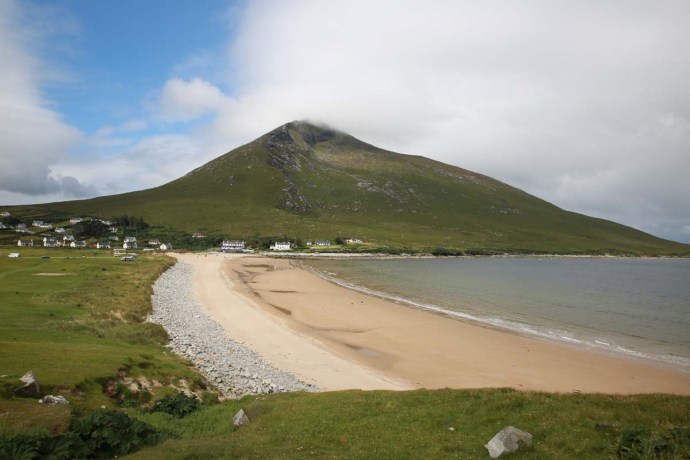
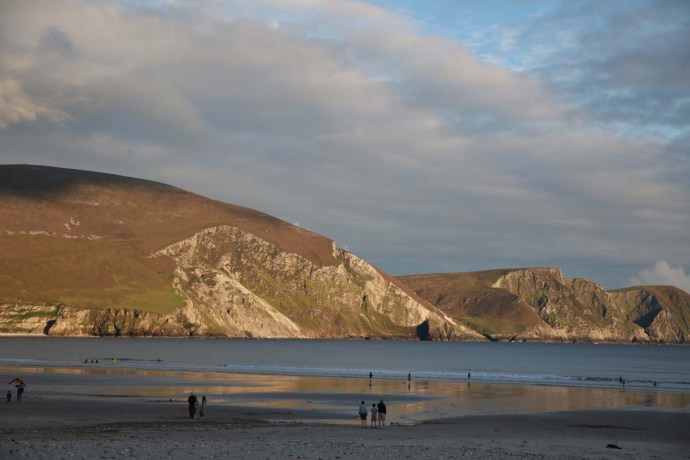
After my previous visits I thought I knew Achill. But what I discovered here was another Achill, not the one I had written about before. Oh that was all here too, the wonderful music and the undeniable beauty of this place as a Summer holiday destination.  So let’s get that over with.  Here are some shots that showcase Achill Island.  Hopefully you will hop onto the internet, book your accommodation and plan your trip as soon as possible.  But before you do read on……

IG3C5841IG3C5882IG3C6351IG3C6045IG3C4654

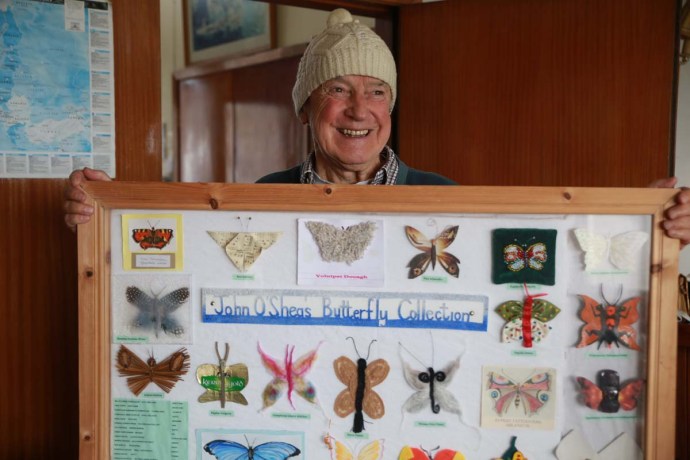
This time I got to know the people.  I met some genuine Achill characters, people that shape the place now and reflect where it has come from.  In particular there was John O’Shea, quintessentially Ireland and quintessentially Achill. A more delightful person you will struggle to meet. He lives in the appropriately named “Beach House” and he welcomes you to his house with his whole being. Never short of a quip, or a quick riposte, or a yarn he would entertain and educate for hours given the chance. I was introduced by a friend and we connected straight away. He has a passionate interest in the history of Achill and collects photos, postcards, books and ephemera relating to this. This parallels my own interest in the early history of the Goldfields of Western Australia as well as our similar collecting interests.

IG3C4821IG3C4804IG3C4788

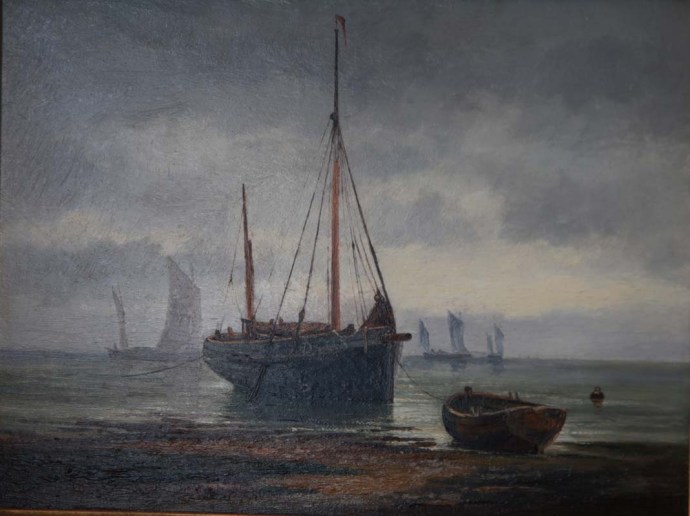
So I spent quite a bit of time in his home as he generously allowed me to view his collections and we swapped stories.  He talked of the original settlement and the sale of the Island to the Rev Nangle and the establishment of the first village. Paintings by Alexander Williams and postcards dating  from 1903 to the First World War speak eloquently of an Achill which though much has disappeared is readily identifiable today. IG3C4770IG3C4778

One story that stuck with me was of a cruel landlord. Many of his tenants were killed in a tragic accident that took 25 lives. Because these families had lost their breadwinners and could not pay the rent they were evicted. This was 1847! in the height of the famine. He showed me a wooden bowl and a spoon made of horn, from this time, used to eat soup. This puts stories like this into harsh reality.IG3C6257

John is a truly charming man with a great line of patter and is quite one with the ladies. He is legendary for inviting visitors to the island to view his ‘butterfly collection’.  So for his 77th birthday his many friends on the island got together and created a butterfly collection for him. Each butterfly is cleverly designed to tell a story and is an individual work of art and he now proudly displays his ‘real’ butterfly collection.IG3C4755IG3C4744

He is also a man of spirit, a spirit I suspect comes from a harsh life in a remote place. He single handedly appealed a decision of his home insurers following their refusal to pay for storm damage and has taken it all the way to the High Court where he has tasted victory against the whole legal system railed against him. What we would call an Aussie Battler.

A lasting memory for me was of how he handled a pair of Jehovah’s Witnesses at his front door. They arrived moments after me so I was standing in the foyer listening. There was a father and his daughter. Two other daughters in the car if they needed the heavy artilery. They said they were from Germany but initially didn’t say what they wanted. The man’s first question to John was whether he had a God. A man of faith, John answered he did. “Does your God have a name?” John was well aware where they were headed and he dodged around the answer, quoting passages from the Bible, which completely threw the evangelist’s well rehearsed patter. The man was searching for passages to respond with on his tablet (that’s the android version not one of stone!) but was not able to recover. At the same time he charmed the daughter with handshakes and blessings and she could do nothing but smile. He had them on the ropes now as he asked whether they were Jehovah’s Witnesses knowing full well they were. When they affirmed, “Yes”, he said, “I have read the Watchtower and I think you have a different view of God to me”.  As the man tried to fight back then came the knock-out punch. “I’m so sorry I don’t have time to talk with you, my Australian cousin is here”.  I bet they don’t meet many like that.

IG3C5605

There were so many highlights of my time on Achill. Here are a few that randomly jumped into my brain

  • Having a sean nós dancing lesson in one of the local pubs, from Pauline, a local artist and then being joined by some random punters for an impromptu performance.

    IG3C5456

  • Fired up by this I then did two proper sean nós dance workshops offered by the School. Thanks Pauline for dragging me along.

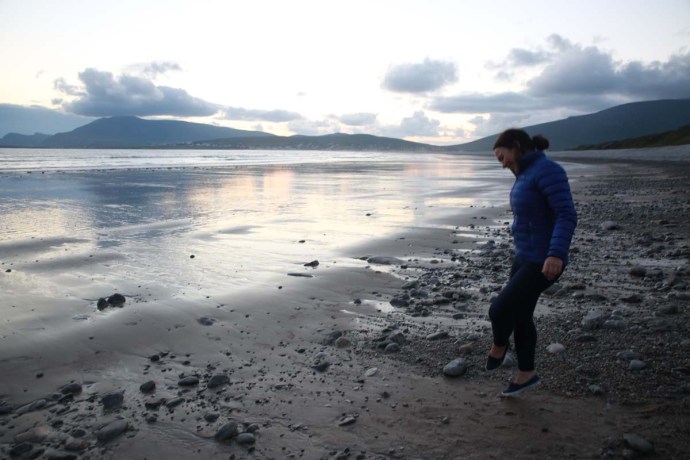
  • And then a bit of a dance on Keel Beach.IG3C6400
  • The Red Fox Gallery and Press and Frances and Antic-Ham who run it. Two people in such obvious harmony and in harmony with their special place over looking Doogart. Francis collects polaroid cameras and they produce the most stunning Polaroid photography and art in book form.IG3C5493

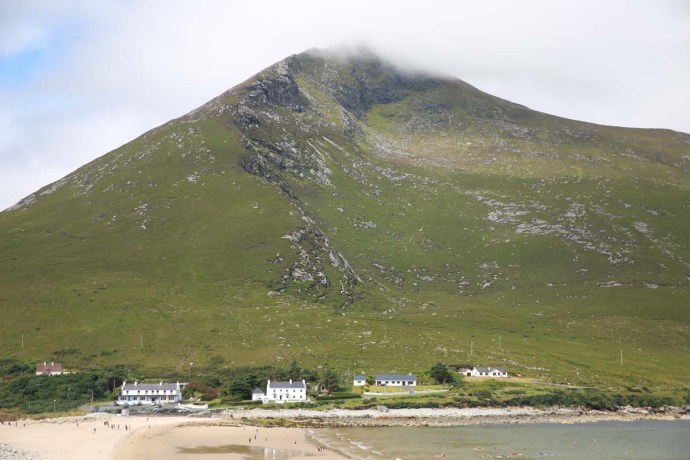
  • A walk on Keem Beach, one of the most beautiful in IrelandIG3C4870IG3C4910aIG3C5206

  • The constant mist that hangs over the hills; lifts like a dancer lifting her skirt and just as quickly letting it fall.  And occasionally she puts on a spectacular show in the evening light.  IG3C4617IG3C5555IG3C5469IG3C6091IG3C5549IG3C6301IG3C5313

  • Impromptu sessions in quiet pubs.

  • Noisy sessions in packed pubsIG3C5411IG3C5410IG3C5414IG3C5349

  • A lovely vegetarian meal with my new friends at Pauline’s house with views over Keel and then songs and tunesIG3C6282IG3C629413918672_10153802382657634_1999679985_o

  • Hot soup in the Beehive CaféIG3C6106

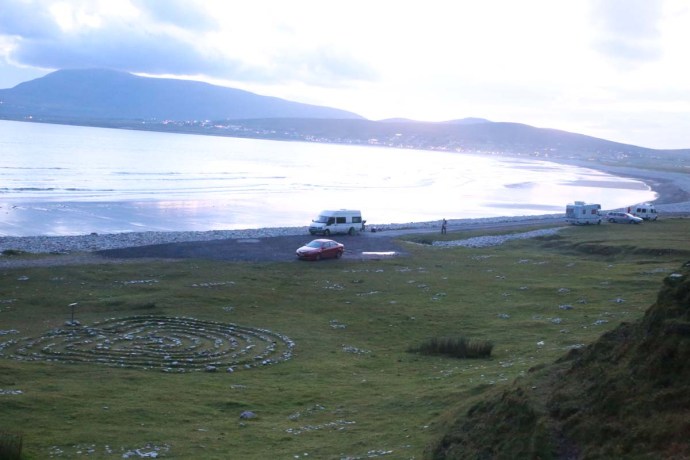
  • the labyrinth at the end of Keel beach. Mirroring the twists and turns of life and our endeavours to reach the centre.  IG3C6442IG3C6430

  • The evening light turning the cliffs yellow and red and reflecting on the shallow strand.IG3C6321IG3C5908IG3C5920IG3C5930IG3C5947

  • Fish and chips for my birthday at Geilty’s Pub. The best I have tasted in Ireland.  And at the same meal, my introduction to banoffee!

  • Nutella and banana pancakes sold from a caravan at the camping ground at Keel. No pictures sorry.  Too busy scoffing them down.
  • The sound of Paul Dooley’s Brian Boru harp,  Absolutely entrancing to all ages….IG3C5685a

  • Brendan Begley singingIG3C5579

  • Sessions in the Wave Crest Hotel, which only opens for the Scoil Acla week.IG3C5595

  • The Richview Hostel and the many international visitors who inhabited it

  • A swim in Keel Beach with Bridge and Siofra. Everyone else was wearing wetsuits! Still can’t believe I did that.13879371_1016935231760452_1295093538081463806_n

  • And I was still talking to Bridge afterwards so it was pizza with them at Pure Magic CafeIG3C5545

  • A visit to the workshop of Johnny Butler who took the time to show me how Uilleann pipes were made. A true craftsman.

  • A couple of hours at the Inishbiggle Festival including tunes in the tent and skipping rope.

Actually there’s a whole lot more but that gives you the gist.  I have said enough.  If you have lasted this long then you deserve a medal.  Achill is a special place and a special time.

 IG3C6048IG3C6055

Categories: Festivals, Real Ireland, Stories, Trad Irish Music | Tags: , , , , , , , , , | 4 Comments

The Last Day of Summer?

Today is 31st August.  The last day of Summer. Well is it? The Irish Met says Summer is June, July and August, but the Irish Calendar says it is May, June and July. Anyway putting that aside, I decided to attempt to cure the PFB’s (post-Fleadh blues) with some natation at Spanish Point. After all three days ago the beach was crowded and it was 20 degrees and this summer I had already swum on Achill Island and at Lahinch.

20160828_152441

Spanish Point August 28th 2016

It couldn’t be that bad, could it?  So rain hail or shine I decided to do it.

Well I woke up this morning and it was neither rain hail nor shine. But it was cool and windy. Just normal West Clare wind. I headed down about 11 am. Pretty different.  Today the beach was nearly empty and the lifesaving flags were having a hard time standing up.

20160831_111215

Spanish Point Beach August 31st 2016

20160831_112506


20160831_112637

But I could feel the love.  Well, subliminal messages written in worm excrement and weed.

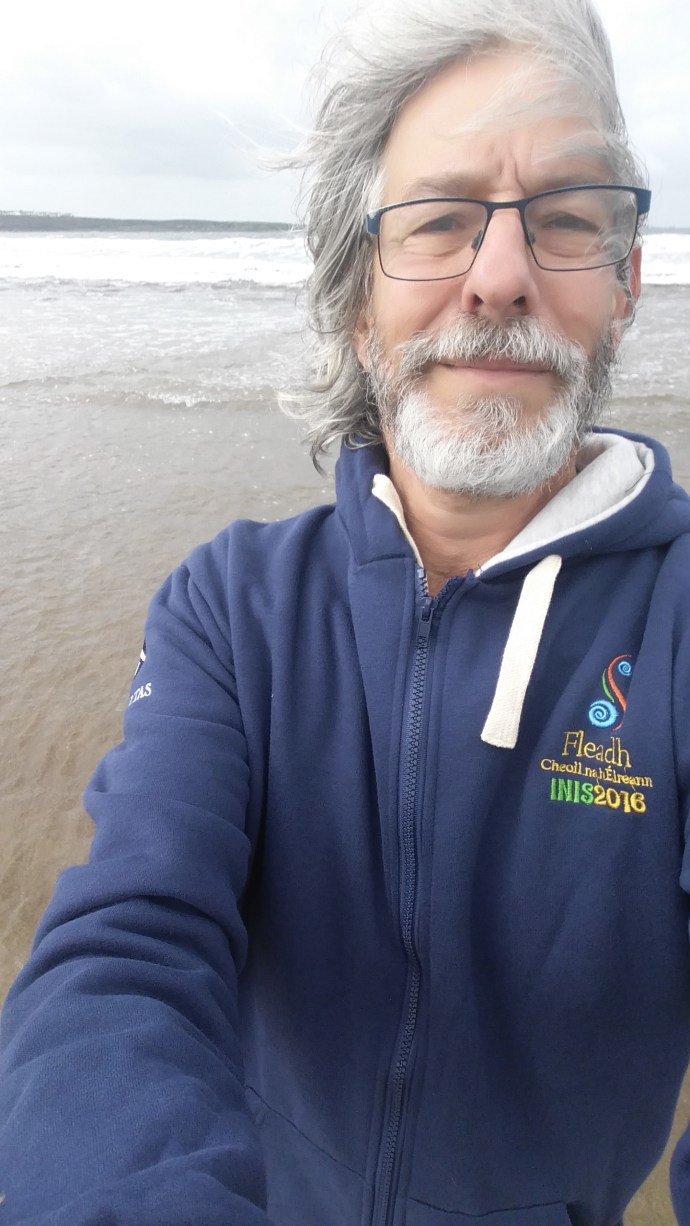
I tested the water but was still wearing my newly acquired Fleadh zippie, so you can guess that my heart wasn’t really in it.  After a wade, a shiver and a nice walk I headed back. Defeated.  Selfie time.

20160831_111738

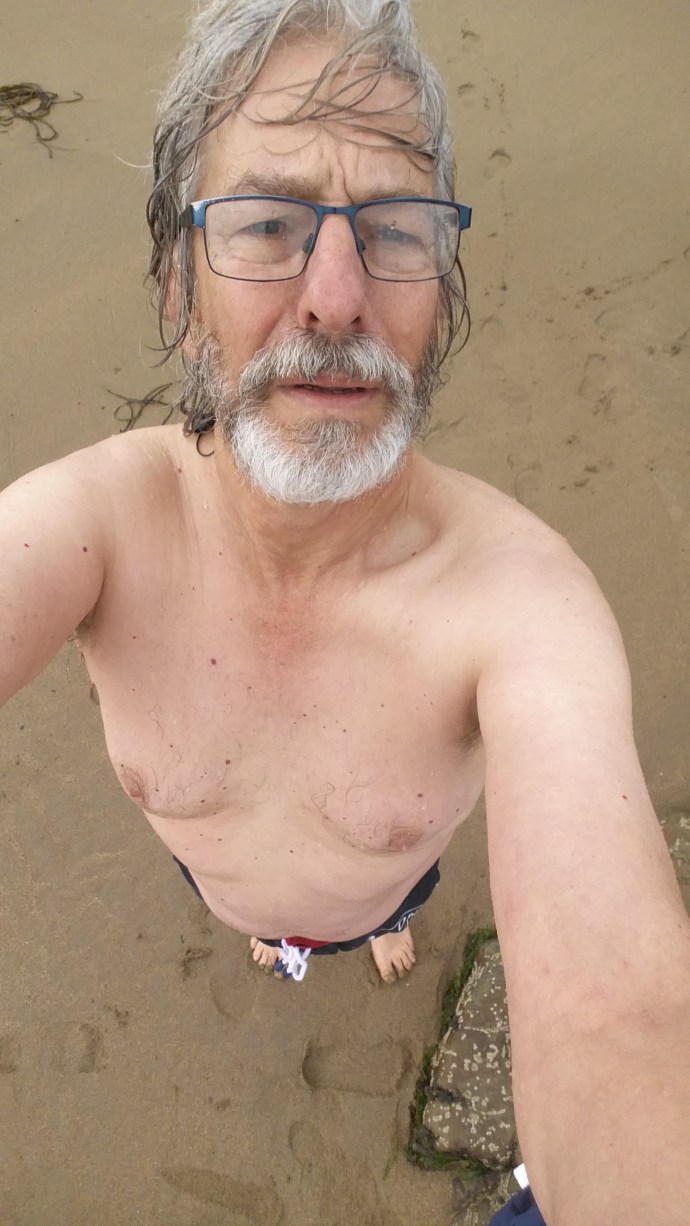
But feck it. I’ve made the effort. Why don’t I just do it. After all the water temperature is probably warmer than the air (well it actually wasn’t!).  So this was my little Everest and for the last time this year I braved the Wild Atlantic. No selfie of me actually in the water. So you’ll have to believe me. But with that one act the SADS disappeared and I was invigorated. Mind you I didn’t stay in that long. There is a limit to bravery or stupidity.

20160831_11381520160831_113849

I can’t believe this is my third summer in Ireland and my first in the water. After all I grew up on the northern beaches of Sydney.  I have an Aussie friend in Galway and she swims every day of the year. I don’t think I’ll go that far but hey, you never know.

Can’t wait for next summer.

Categories: My Journey, Real Ireland | Tags: , , , , , , | 1 Comment

Glencolmcille, Donegal. Fiddles in the Glen. And Much Much More.

First I should apologise to my blog followers. I have been travelling and attending many festivals over the last two months so I have neglected you.  It has been an amazing Summer with visits to Festivals in Dungarvan, Doolin, Spiddal, Miltown Malbay, Tubbercurry, Drumshanbo, Achill Island, Glencolmcille and Feakle.  I have many stories and photos and I will try and bring my readers up to date over the next little while.

IG3C6934

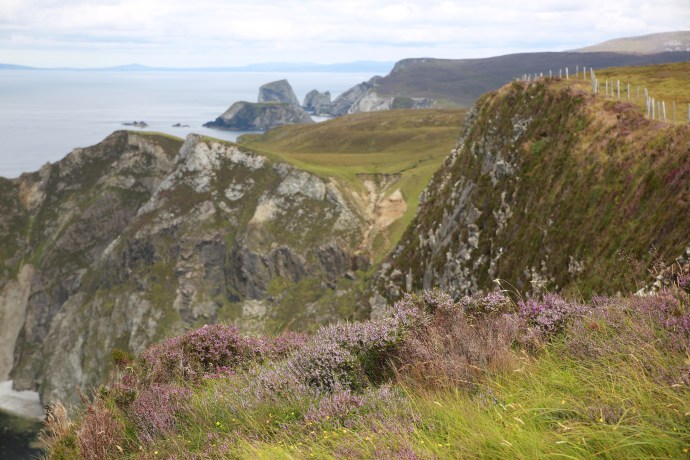
In the first week of August I went to Glencolmcille in the south west of Donegal. There is a Fiddle Festival there which I had yet to attend, but not only that it is a place of remarkable beauty.

I had been there before but it was the depths of winter and it was so cold with biting wind and lashing rain and I had a cold and the memory is generally not a pleasant one. I should add also that it was the first place in Ireland that I missed playing music. January 2nd 2015. After almost eight months.

I had driven up from Achill and the most glorious weather welcomed us on the Monday. I had a carload from Italy, France and Spain that were also visiting the Festival. The first thing that struck me about this place was the awesome grandeur and beauty. It was just too beautiful. I didn’t know where to start exploring it. It’s rather like turning up to a session with a dozen great fiddlers and you leave your fiddle in the case, because you don’t know where to start. It’s just too intimidating and daunting.

I was originally booked into a Bed and Breakfast but a friend convinced me to give the Dooey Hostel a go. I have shied away from hostels because I never sleep, with snorers and tossers-and-turners and people coming in late and getting up early, but I went along with it. It is truly a unique place. It is built into the hill with the natural rock being one wall and the other side giving magnificent views over the strand and the bay one way and the glacially scoured valley the other way. There is a crazy paved floor as you would have out on the patio and ivy and all sorts of plants growing up the walls. The walls are damp with the natural seepage and there is piping to take away the water when it rains, which gives the sound of an ever present waterfall. It is on many levels with four dormitories each with their own shower toilet and kitchen, another generous kitchen, some private rooms and a gorgeous common room that overlooks the bay. There is plenty of eccentric and eclectic memorabilia and trinkets everywhere. 


IG3C6948

Dooey Hostel, Glencolmcille

IG3C6943


IG3C6962

The view from the Common Room of Dooey Hostel


Miraculously I didn’t have a snorer in my dorm so I slept brilliantly.

The hostess is Mary, quite an institution in this part of the world. And mad as a March hare. You can’t really describe her but she is as wild as the Atlantic and had us in stitches much of the time. “I just compost people who fall out of their bunks”, she says. The residents were an interesting lot too. Many there for the fiddles but many just travellers. By a country mile, the majority were from France. Some spoke exclusively French which was a bit annoying for me but it was a diverse bunch with many interesting stories. I met of course loads of new friends and I could not help but become part of the craic.
IG3C9052IG3C7478IG3C9088IG3C9097

I decided not to do the classes and Monday was so beautiful I had to get out and about. I was told of a lovely beach called Port, so that’s where I headed. Google Maps misled me though (I have to blame someone) and I ended up high on a remote bog.   As I was sinking deeper and deeper into the unsealed road I decided to retreat. A 21- point turn executed with fear of my wheels leaving the road and of getting stuck in the ditch. But there’s always a reason for things happening in Ireland and I spent a lovely hour exploring photographic possibilities in this remote part of Donegal.

IG3C7001IG3C7078IG3C7085

IG3C6995IG3C7022

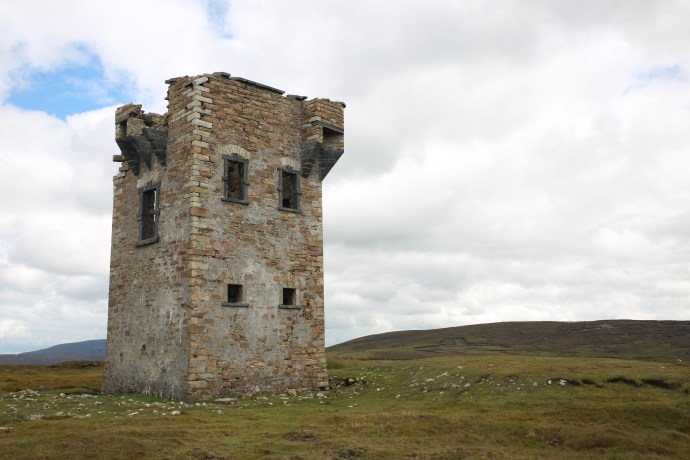
On returning to Glen I found myself following some road signs to the Holy Well of St Columbcille. This was not what I expected as after quite a walk I discovered the well site protected by a massive Donald Trump style wall. Continuing the walk I ended up at the Tower, which was built to keep a lookout for Napoleon and the invading French. One would have to say it was unsuccessful as the French continue to invade! The views from the top are impressive though.

IG3C7235

St Columbcille’s Well

IG3C7216


IG3C7154IG3C7163IG3C7121IG3C7130IG3C7256IG3C7289IG3C7321IG3C7333

IG3C7356

View towards Port Beach

IG3C7402IG3C7414


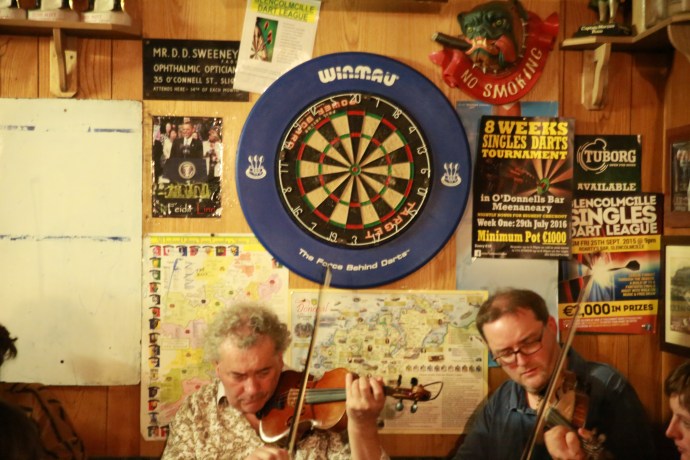
As far as the music goes this festival or school is completely different. First it is fiddle only. Second it is Donegal style and tunes only. It is classes morning and afternoon so if you don’t do the classes the place is pretty deserted except for the tourists. It is pot luck after that. There are only two pubs so it is hard to miss a session. After about 9 pm it kicks off. Roarty’s was the spot and on the Monday night there was a session there with 45 fiddles. For a brief time there was a single guitar. It was a unique sound. Not to everyone’s taste, I know but how often do you get to hear that in Ireland. I recognised about 10% of the tunes, but played along where I could. A who’s-who of Donegal fiddling was there. Mairéad Ní Mhaonaigh, Martin McGinley, Ciarán Ó Maonaigh,  Conor Caldwell, Danny Meehan.  But it was hard to get a seat so I did a lot of listening.  The tunes are infectious and probably easy to learn but the fiddling is not my style with its sawing bowing.  But it was great to be there.  Some of the best sessions though were in the Common Room of the hostel or outside overlooking the bay.

IG3C7558IG3C7527IG3C7522IG3C7518

IG3C7463

Fiddlers in the Glen

IG3C7455IG3C7446


IG3C7606IG3C7625

The bad weather closed in (well it is Ireland and it is summer) and Wednesday started out very unpromisingly. But it looked to be brightening up so I decided to go to Maghera Caves of which I had heard a bit about. When I announced my intention at the Hostel I immediately had half a dozen takers to come with me. In the end  I was accompanied by Blandine from France, Alex from Italy (the Great Bastoni! but that’s another story), Tall Paul from Holland and People Katherina from Germany, a 20 year old on her first solo overseas trip who, the day before, had walked 27km with her 20kg pack in the driving rain.

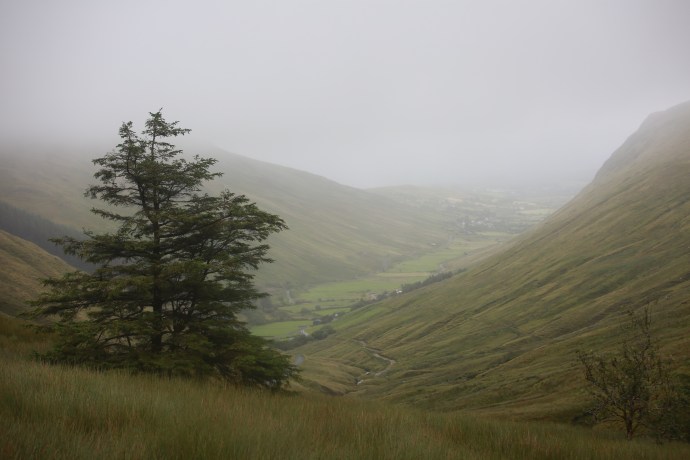
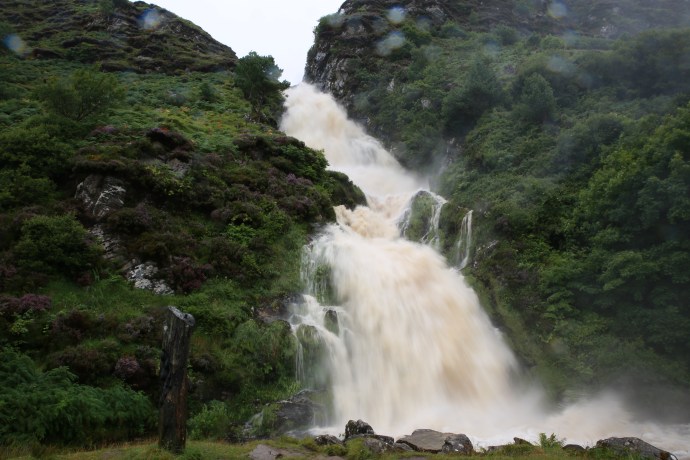
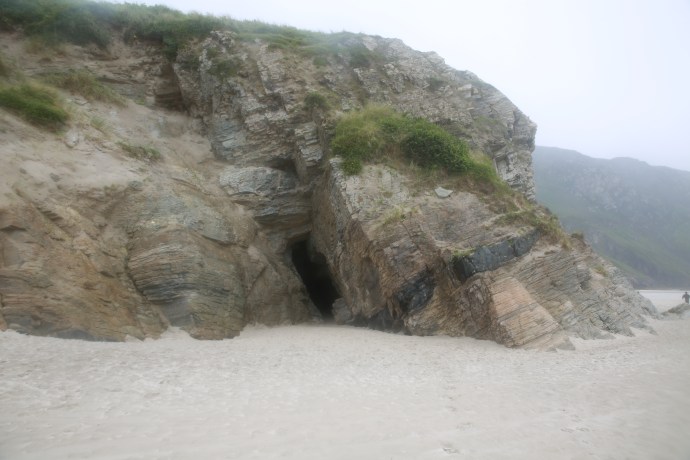
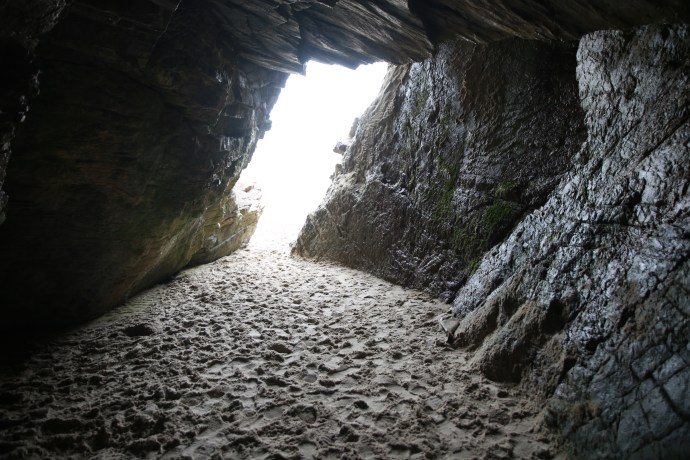
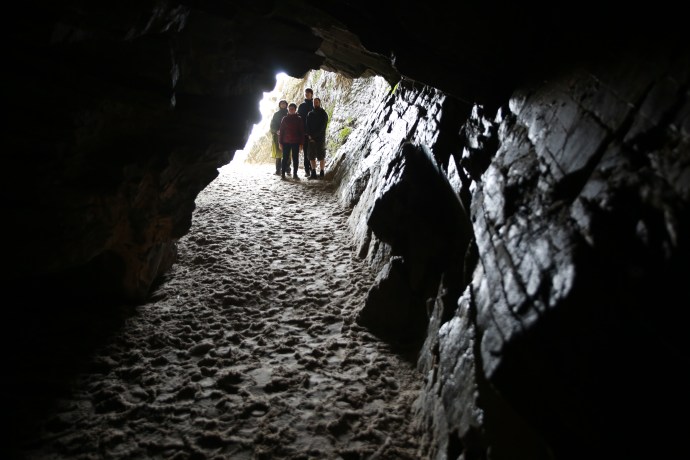
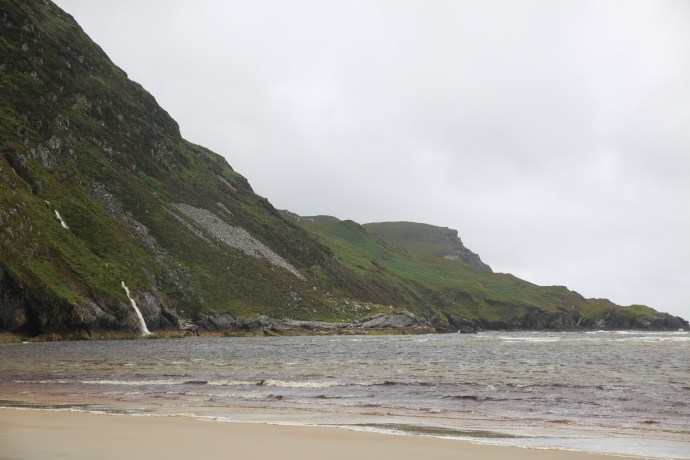
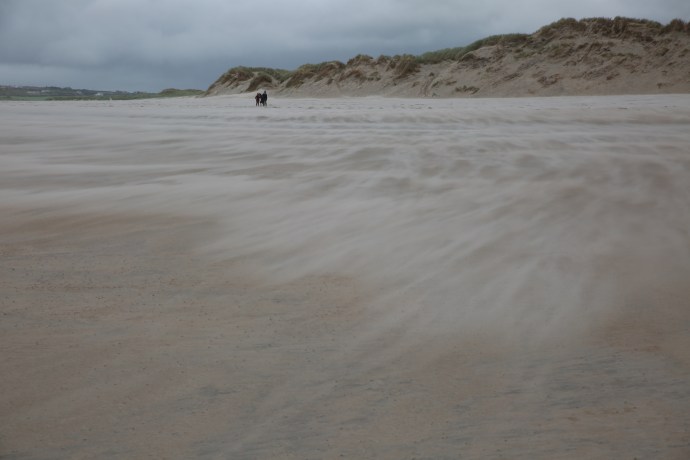
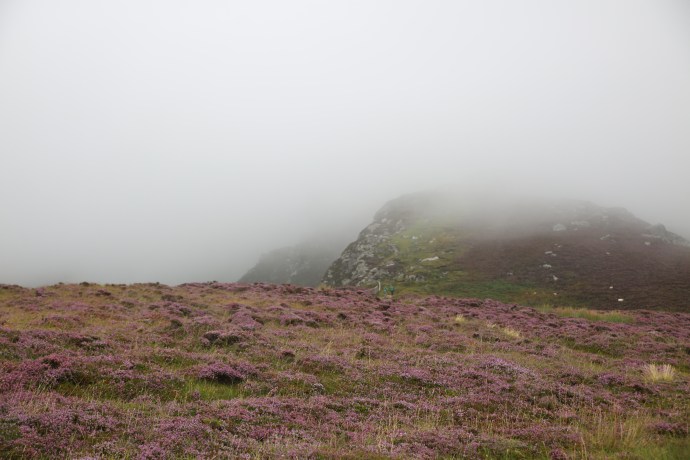
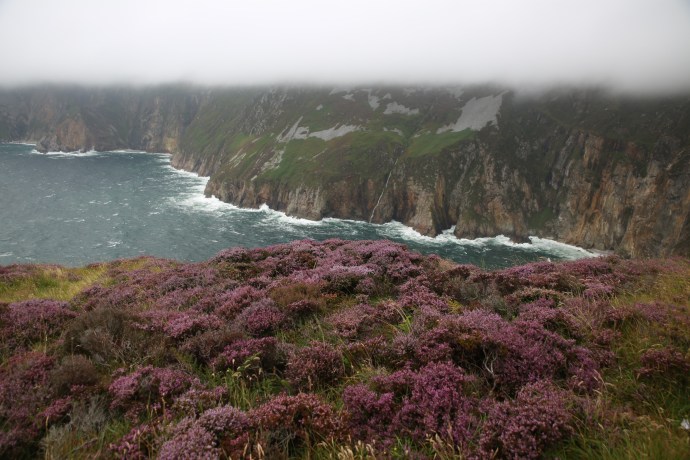
The weather did not ease up. The rain came and went with and without wind and we had in total 15 seconds of sunshine. The caves were not what I expected. They are only accessible at low tide which luckily it was, They seem to be caused by erosion along faults associated with dolerite dykes and sills in very siliceous sediment. They are right on a really wide beach. Stunning. The wind at times whipped the sand along creating and eerie landscape.  And there was a labyrinth, similar to the one on Keel Beach on Achill.  Someone put a lot of work into it but I can only guess how long it will be there before the sea subsumes it.  On the way there was Assaranca Falls: a ferocious waterfall fed by the heavy rain at the time. Unfortunately photographing it was tough in the weather. We went cross country then to the majestic Slieve League cliffs. Conditions were attrocious with the mist descending, sometimes to a complete whiteout. I loved it though; when the clouds parted to reveal the rugged landscape for a few moments and then closed in. Thee was no pattern to it but it provided everchanging vistas and light. Then a visit to the gorgeous beach at Malin Beg which I have to say would rival Keem Strand on Achill for a place nearthe top of the list of best Irish beaches I’ve seen.

IG3C7781IG3C7840IG3C7848

IG3C7868

Assaranca Falls

IG3C7909IG3C7942


IG3C7964

Near Ardara

IG3C7972

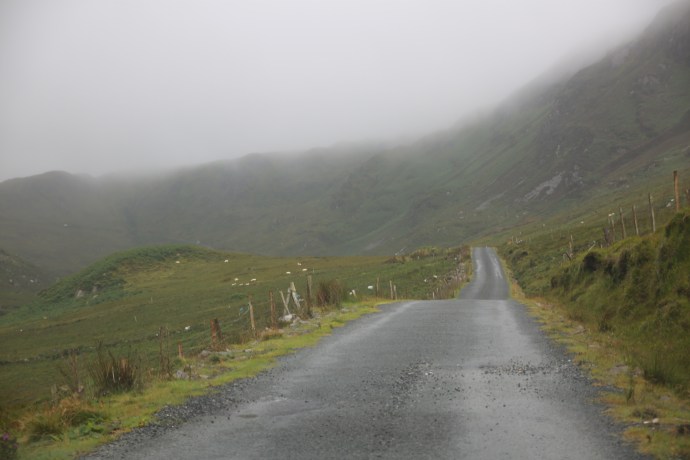
The road to Maghera

IG3C8014


IG3C8060IG3C8105

IG3C8130

Cave at Maghera Beach.  One of 27

IG3C8151

Dolerite sill and later crosscutting dyke.

IG3C8189

Sheared dolerite dyke and cave.

IG3C8296

IG3C8326

even the water is green!

IG3C8363

IG3C8398

Maghera Strand.  A wicked wind!

IG3C8413

Maghera Strand.  Another view

IG3C8485

Labyrinth at Maghera Strand 

IG3C8591

Have you seen green like this?


IG3C8654

Heather on the Moor.  Slieve League

IG3C8682

Slieve League

IG3C8731

A few minutes later.  The clouds descend

IG3C8735

Try standing up!

IG3C8784

A soft day at Slieve League


IG3C8804

Malin Beg

IG3C8944

Malin Beg

IG3C8931

IG3C8902

Malin Beg

IG3C8874

Weathering bands in schist.  With sandhopper


I enjoyed this place so much that only playing a few tunes in the evening didn’t seem to matter. We sat up chatting in the Hostel till about 4am and the sweet Katherina, full of self doubt about travelling Ireland on her own yet so confident to walk such huge distances could not contain herself. Every few minutes saying “I am so happy”. In fact she held on from going to the toilet for an hour because she was worried we would go to bed and the night would end.

IG3C8623

Monarch of the Glen

IG3C8643


The Festival overlaps with Feakle Festival which is one of my favourites so on Thursday I headed off back to Clare.

I will definitely return to Donegal. Maybe next time I’ll get to Port Beach without getting lost……..

Categories: Real Ireland, The Fiddle, Trad Irish Music, Uncategorized, Wild Ireland | Tags: , , , , , , , , , , , , , , | 4 Comments

Blog at WordPress.com.