Author Archives: singersong

Unknown's avatar

About singersong

A lapsed geologist. After 35 years hitting rocks I am setting out on a musical journey through the west of Ireland.

The Colorado Rockies 3. Independence Pass.

Independence Pass

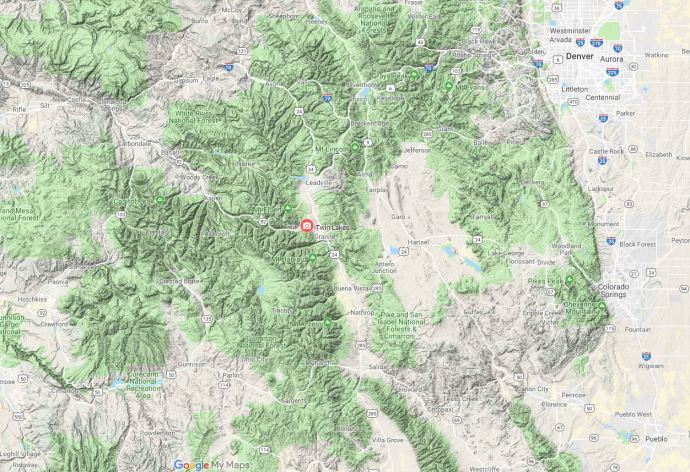
This is the third in a series of blogs on the Colorado Rockies following my visit during September 2018.  In an earlier blog I looked at Twin Lakes.  If you continue driving west from here along Highway 82 towards Aspen you cross the Independence Pass.  That’s where we will go today.

Independence Pass is the highest paved crossing of the Continental Divide in the USA.  The Divide runs like a spine through North and South America from the Beering Straits to the Straits of Magellan and marks the hydrological divide between rivers that drain into the Atlantic to the east and the Pacific to the west.  Independence Pass reaches an elevation of 12,095 feet (3,687m) in the Sawatch Range.  It is closed for much of the year, from October, due to extreme snowfalls.  But this September day, clear blue skies greeted me and not a trace of snow.

IG3C1128

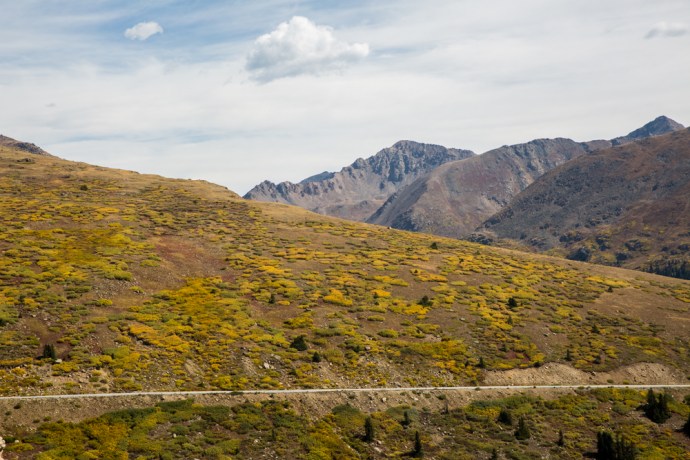
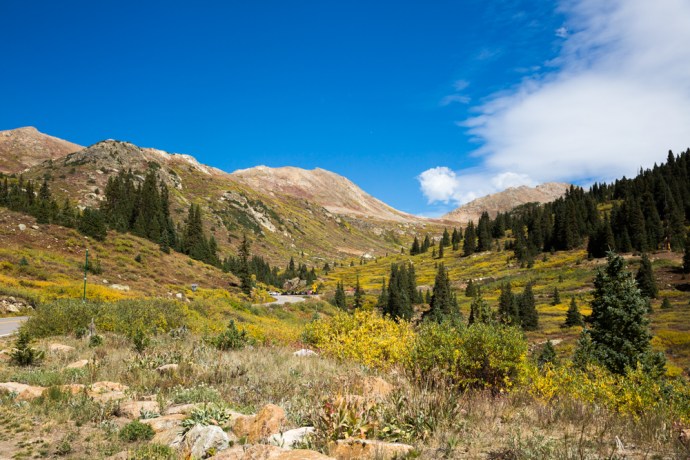
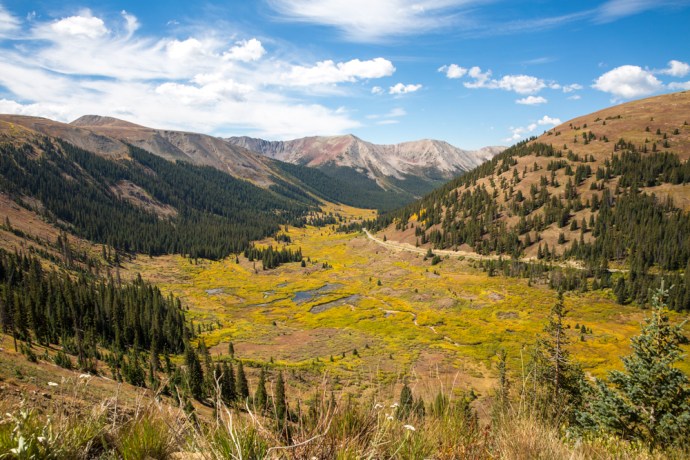
An incredible drive up, switchbacks snake through forests of pine, spruce, fir and aspen and past lakes surrounded by soaring peaks many reaching as high as 14,000 feet (14ers as they call them in Colorado), luckily with a few pull-offs to admire and photograph the views.

IG3C1081

A typical Colorado mountain scene on the way up Independence Pass

IG3C1066

A huge switchback takes you from the valley floor to the top.

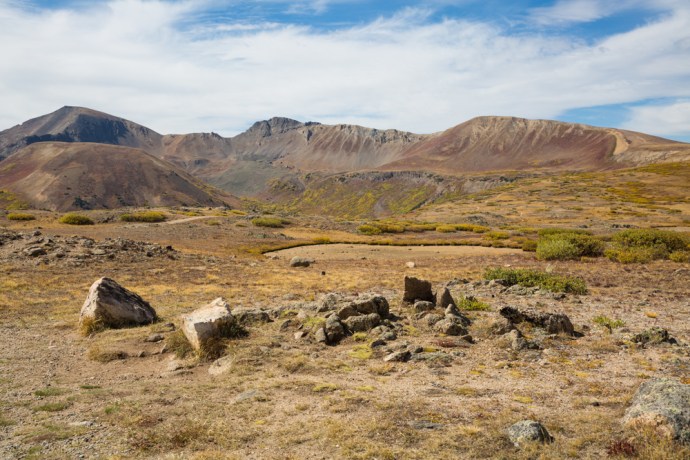
Near the top though there is a dramatic change as you enter the treeless alpine tundra environment of open grassland, low shrubbery, bare exposed rock and ephemeral pools.

IG3C1147

Wild landscape at the top of Independence Pass

IG3C1150

This ephemeral lake has dried up during the summer

IG3C1194

The car park under an ‘exploding hill’ at the top of Independence Pass

IG3C1190

arctic tundra

Everywhere you look you see the results of glacial action, the land being smoothed out during the last ice age about 12,000 years ago.  The rocks of course are much older and comprise gneiss dating back 1,700 million years and younger intrusive granites.

The Pass has an interesting history.  Spotted by Zebulon Pike in 1806, during his mapping of the southern boundary of the Louisiana Purchase, it wasn’t fully surveyed until 1873.  It was the limit of European settlement at the time.  West, the land was reserved for the Ute people and travel was prohibited but prospectors defied this and on July 4th 1879 discovered gold 4 miles from the pass on the Roaring Fork River, at a place which naturally became known as Independence.  Eventually the mountain, lake and pass itself were given that name.  Independence started a massive gold and silver rush and is now a fascinating ghost town.  I will have more to say in an upcoming blog.

The original path over the pass was suitable only for horses but as Independence became a more permanent settlement, in 1881 the pass was improved so that stagecoaches could cross. A toll was charged and this paid for a team of men who shoveled snow through the winter to keep the road open.  They were successful at doing this for five years but on occasions sleighs had to be used. A typical voyage over the pass required 10–25 hours and five changes of horses. A new road was built in 1927 and the current paved road in 1967.  I took a little time to ponder the different obstacles and tribulations that the prospectors of Colorado had to deal with, compared with those in the Australian gold rushes.  all incredibly hardy folk.

From the viewpoint at the top which looks east you can see a number of peaks including from left to right 1 Casco Peak (13,908 ft, which hides the highest mountain in Colorado, Mt Elbert at 14,433 ft),  2 Lackawanna Peak (13,661 ft). 3 Rinker Peak  (13,783 ft), 4 La Plata (14,343 ft), 5 Star Mountain (12,941 ft) and 6 Ouray Peak (12,947 ft).

IG3C1170-Pano2

View looking east from Independence Pass showing major peaks.

An awesome feeling standing at the top of the world.  Imagine the scene before me draped in snow.  I didn’t want to leave, but when I did the view from the western side on the way down towards Aspen was just as good.

IG3C1212

Over the pass and down the western side.  A classic glacial valley.

IG3C1209

Heading back beneath the tree line towards Aspen


Categories: America | Tags: , , , , , , , , , , , , , , , , , , , , , , , , , , , | Leave a comment

The Colorado Rockies 2. Hanging Lake and the Spouting Rock.

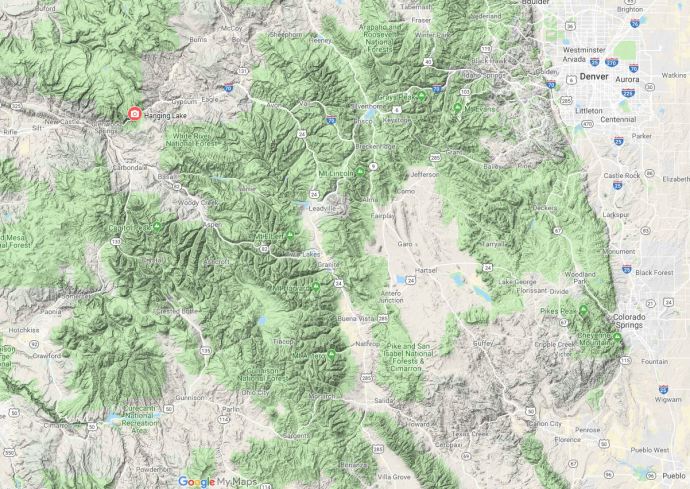
Hanging Lake

This is the second of a series of blogs on the Rocky Mountains of Colorado.  I visited for a week in mid September 2018.  This spectacular part of the world comprises rugged mountain ranges that tower over the Mile High City of Denver.  Today I will talk about a difficult-to-get-to gem  in the hills above the Colorado River.

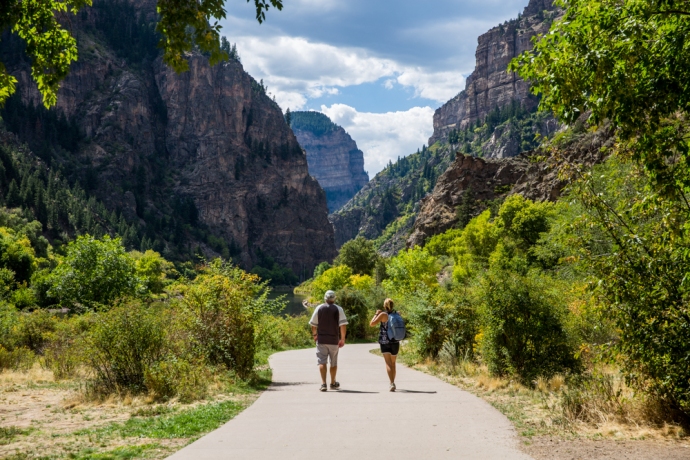
If you drive east from Glenwood Springs along Interstate I-70 towards Denver you pass into the incredible Glenwood Canyon. Twelve miles of precipitous sandstone walls loom beyond 1,000 feet above the Colorado River.  Nestled in these cliffs is Hanging Lake.  A short spur off the Highway takes you to the river where you need to arrive early if you want a park. There is a level concrete bike path that runs along the Colorado River and accesses the trail head, which follows the charmingly named tributary, Dead Horse Creek.

IG3C2535

Concrete path leads to the start of the Hanging Lake trail.

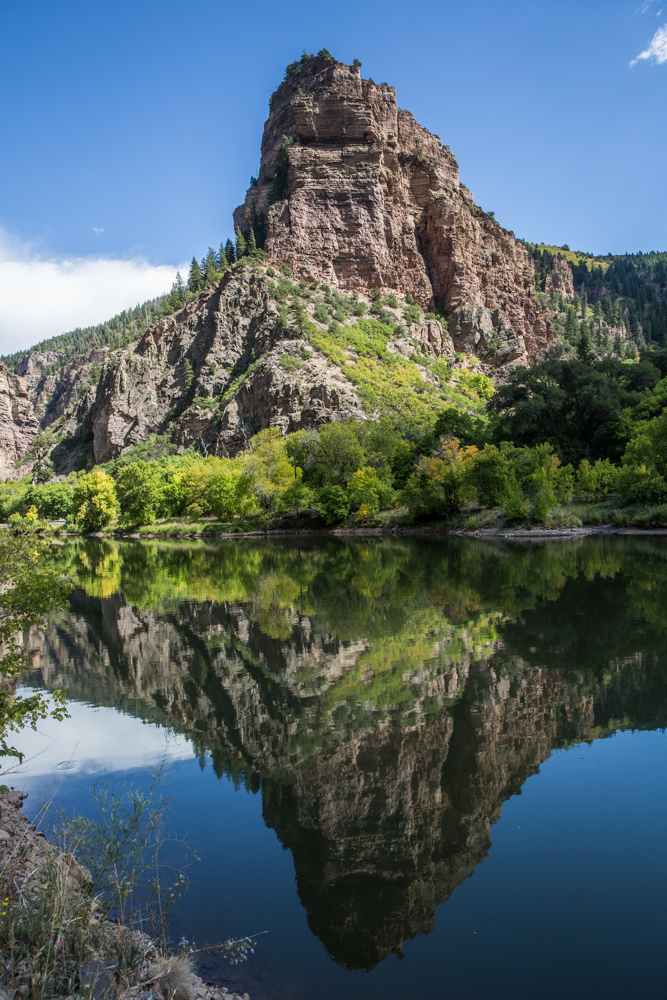
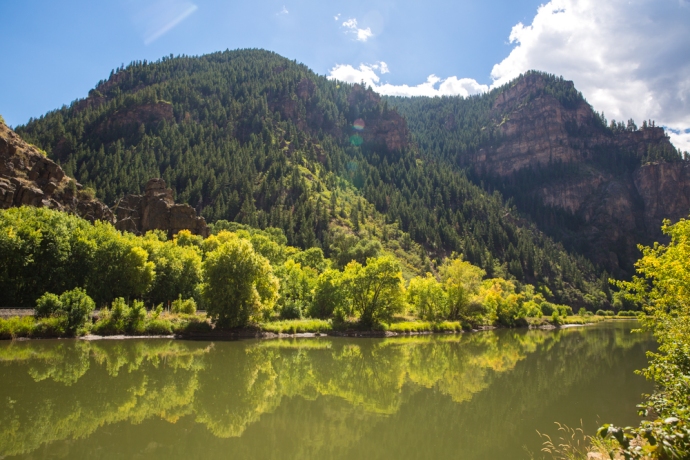
You get a temporary respite with the incredible beauty of the steep hills reflected in the calm river waters but make no mistake, this is the toughest hike I have done in a long long time.

IG3C2614

Calm reflection I

IG3C2578

Calm reflection II

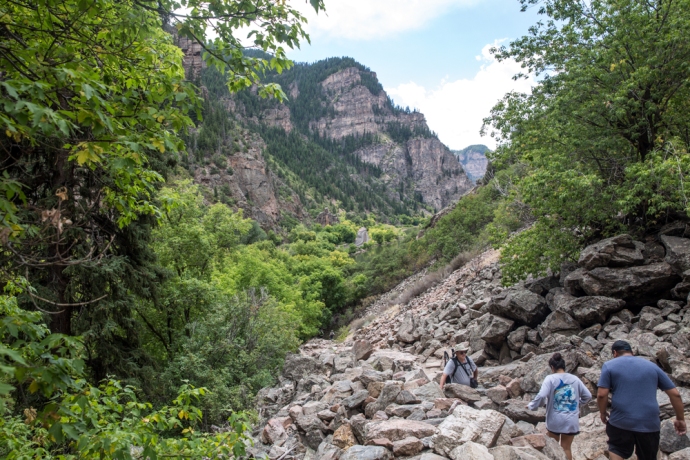
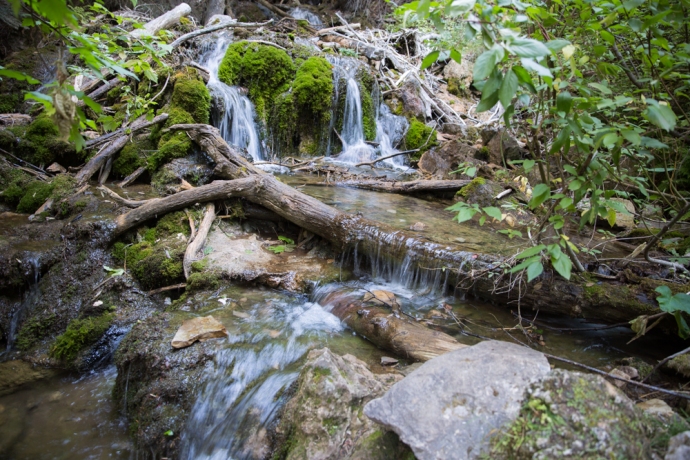
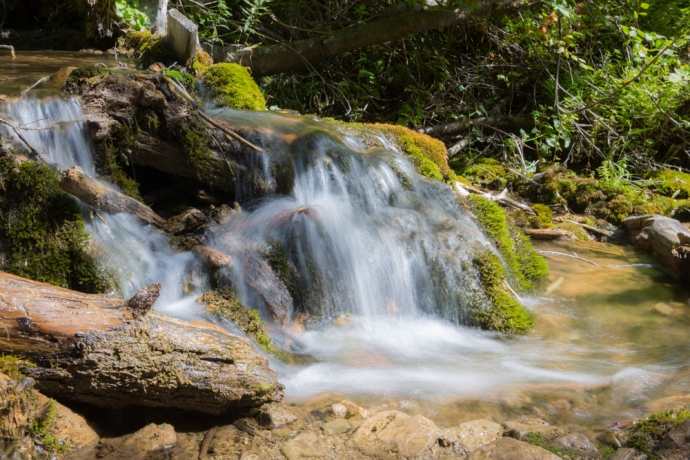
The trail climbs relentlessly for more than 300m over the relatively short distance of 2 km. You traverse rough steps or traipse over boulder covered slopes and scree or over exposed tree roots; you have to carefully place every step to be sure of your foothold. I do not recall any downward sections. Every step is up.  The trail crosses the creek a few times on wooden bridges and you get delightful views of the mountain stream cascading over moss covered rocks and logs.

IG3C2496

Near the head of the Hanging Lake Trail. Picking your way over boulder slopes.

IG3C2006

A mountain stream I

IG3C2450

A mountain stream II

When you think you can’t go on, it gets steeper. The worst is right at the end where giant steps are cut into the rock and you are grateful for the sturdy railing that provides some sort of barrier to the steep drop on your right. But then you are there. The trail guide says to allow one hour. It took me two.

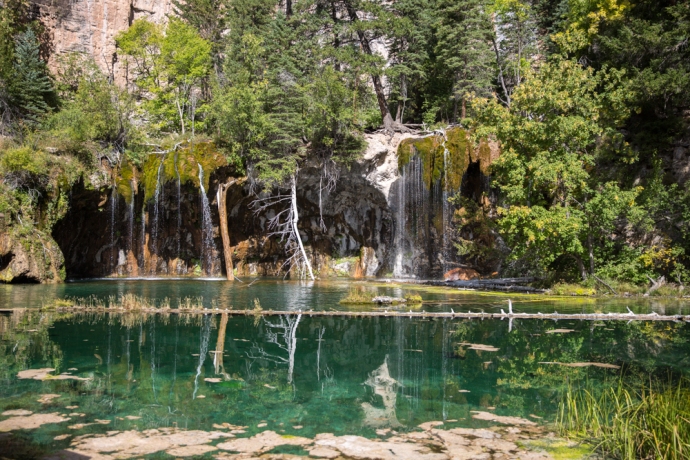
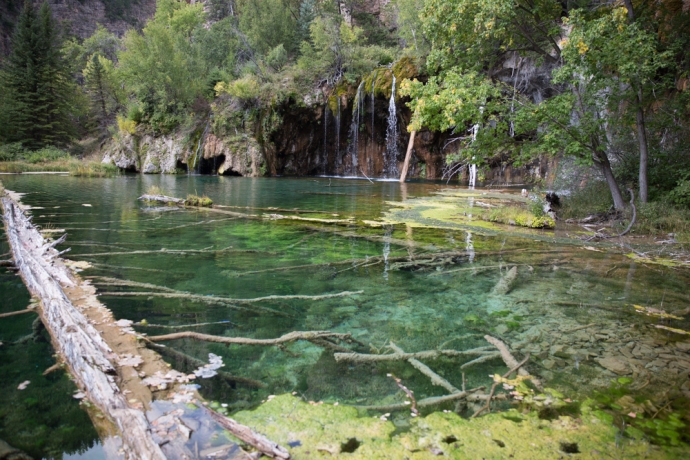
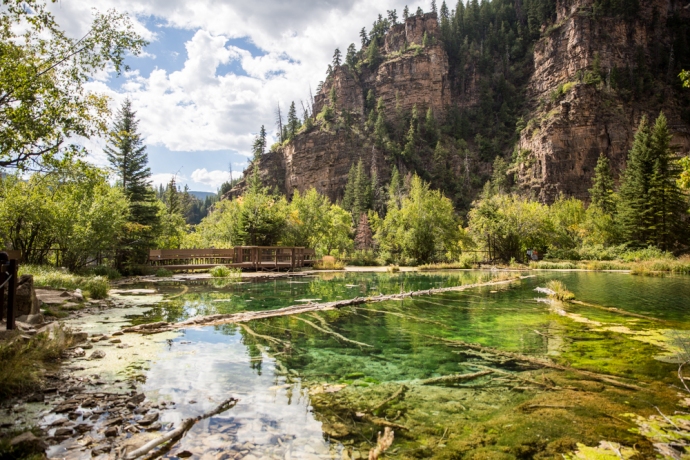
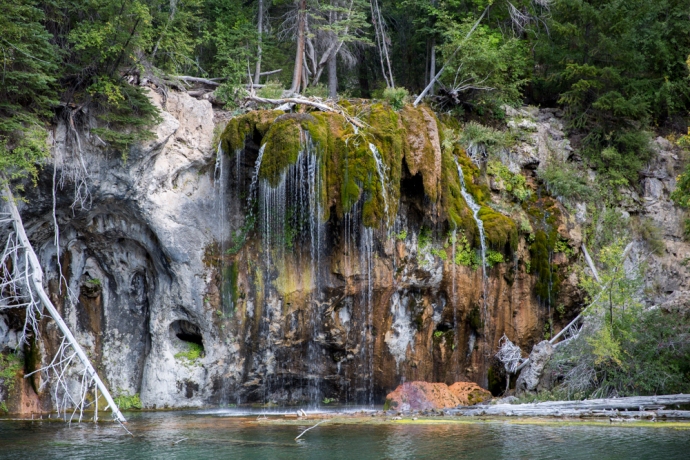
At an elevation of 7,200 feet (2,200m – that’s roughly the height of Mt Kosciusko, Australia’s highest mountain!) you reach Hanging Lake and all that strenuous effort is soon forgotten. Fed by a bridal veil falls, it was created by a fault with its waters dammed by travertine deposits created from the underlying limestone. Only 1.5 acres in area, the crystal clear turquoise, blue and aquamarine coloured waters reflect the verdant growth that drapes the cliffs and over which the water trickles.  Autumn colours and fallen logs enhance and add texture to this exquisite scene.

IG3C2152

Hanging Lake I

IG3C2228

Hanging Lake II

IG3C2249

Hanging Lake.  Bathed in autumn colours.

IG3C2083

Bridal veil falls over brown and white travertine

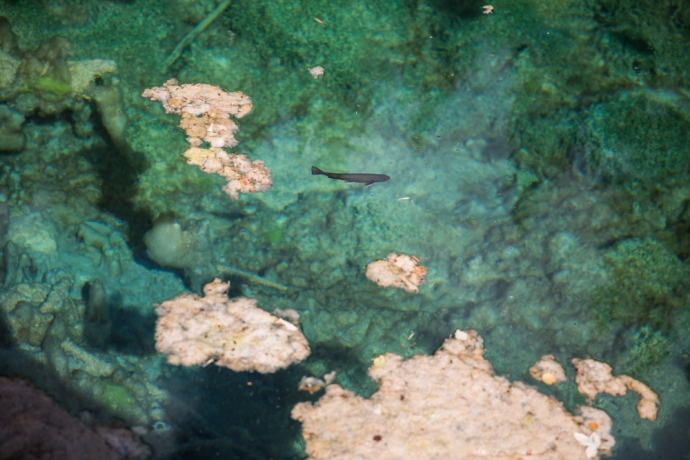
Travertine is formed from the re-precipitation of dissolved limestone which contributes the carbonates that give the water its unique colours. You can see small trout darting about in this mountain pool. The thin air, the high cliffs and the still waters (and a little exhaustion) create a calm contemplative quietude which infects all that make it here. But nature has one more little surprise.

IG3C2141

Mountain trout and travertine through clear waters

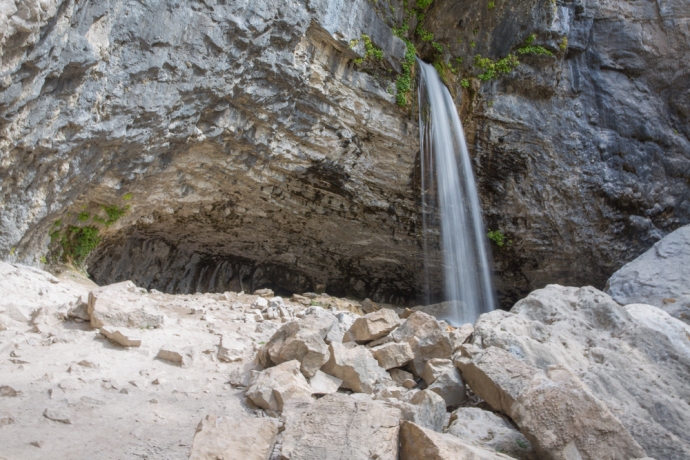
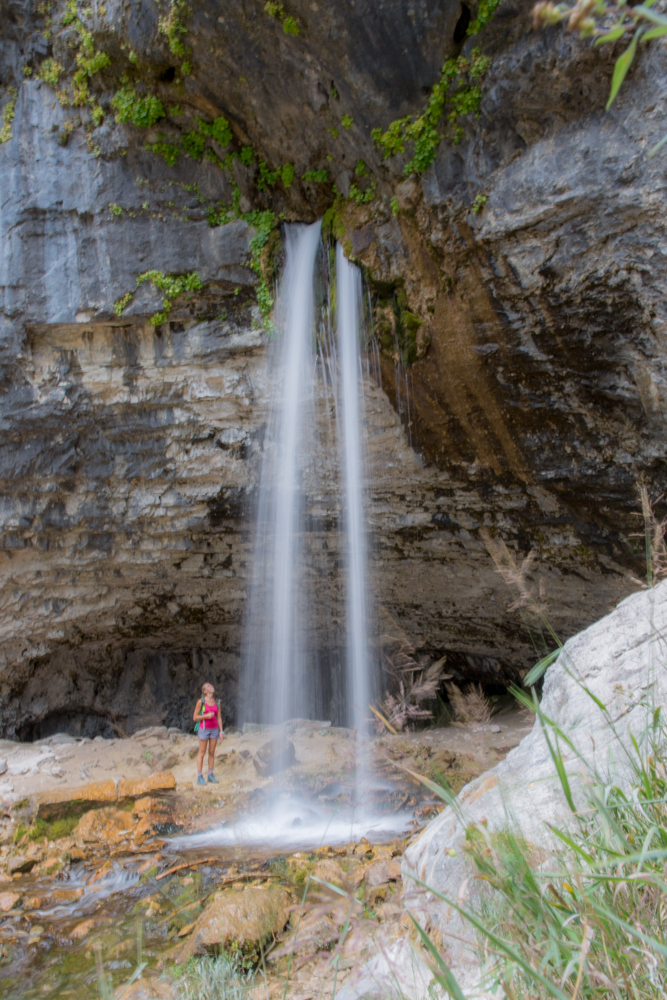
A further short climb takes you to the Spouting Rock. An impressive waterfall feeds the creek above the lake and dramatically spouts from a crack in the face of the cliff. You can easily walk behind the falls into a cave eroded into the limestone. Many miss this little gem and walk right on past the turn off.

IG3C2346

Spouting Rock I

Spouting Rock I

IG3C2389

Spouting Rock II

Time to return down the same path. Any thought that the homeward journey would be easier soon dissipates. The descent is treacherous. A wooden pole, thoughtfully left by a previous hiker was an essential aid in negotiating the rocky stretches. I took my time. Another two hours before I was at the bottom. Plenty of time to chat with and provide sage advice and support to the many climbers who pass you on their way up.

Well that’s Hanging Lake. For me it was Hang-in-there Lake. So glad I did.

Categories: America | Tags: , , , , , , , , , , , , , , , , , , , , , | Leave a comment

The Colorado Rockies 1. Twin Lakes. A Classic Photo Opportunity.

Twin Lakes

This is the first of a series of blogs on the Rocky Mountains of Colorado.  I visited for a week in mid September 2018.  This spectacular part of the world comprises rugged mountain ranges that tower over the Mile High City of Denver.  There is much to see.  It is a photographer’s paradise.  My early plans had me on an extensive road trip that would take me to the four corners but I soon realised how impractical that was, so my travels on this occasion concentrated on the area west of Denver to Glenwood Springs, south to Cañon City and north to Estes Park.  First up is my visit to the iconic Twin Lakes.

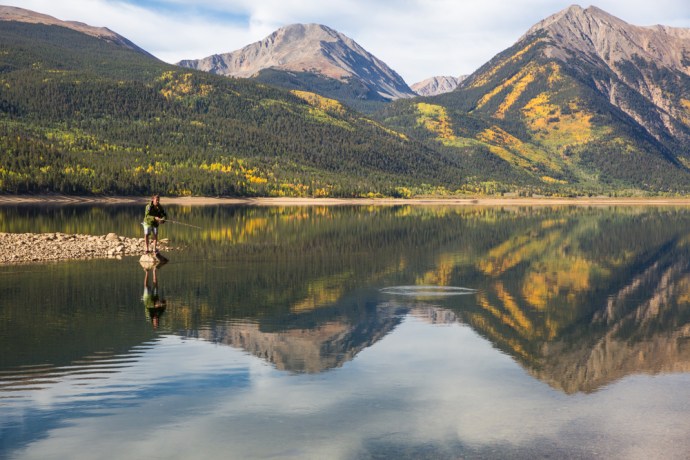
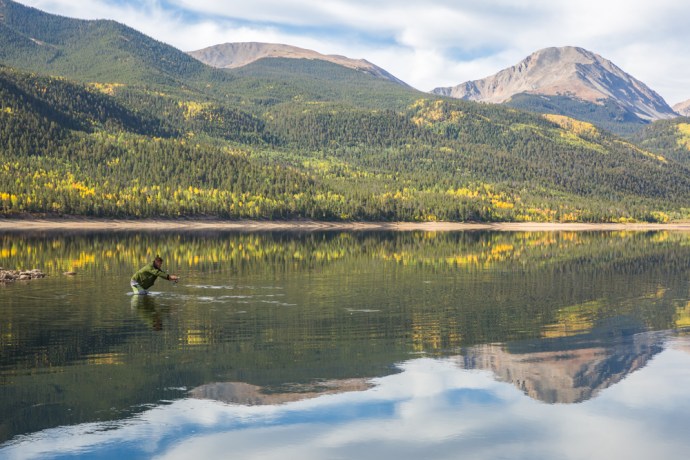
I had read about this location and its reputation for getting those classic Colorado photos if conditions are favourable. It is a half hour drive from Leadville in the Central Rockies  and on the way up the Independence Pass, which I’ll talk about in an upcoming blog. It is a well known fishing, camping and hiking spot and there are, as the name suggests, two lakes are connected by a channel. If there is no wind and the sun is shining, the location provides countless photographic opportunities for symmetrical reflection of the distant mountains in the still waters of the lake. Luckily, such were the conditions on the day I visited. And to top it off I had blue skies and autumn colours and a cooperative fisherman in the mix.  Here are a few of my favourites,

Quintessential Colorado.

IG3C0913IG3C0946IG3C0964IG3C0966IG3C0978

IG3C0895

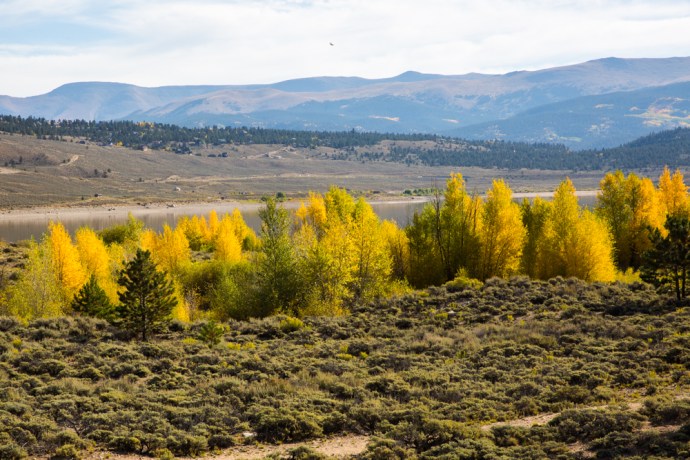
Fall colors.  Twin Lakes

IG3C1052

A mountain stream that flows into Twin Lakes

Categories: America | Tags: , , , , , , , , , , , , , , | 1 Comment

CD Review: Not Before Time. Paráic Mac Donnchadha.

I normally don’t do CD reviews of Irish music. Firstly I am friends with many of the musicians involved so it is an area that is fraught and secondly the vast majority are brilliant expressions of the variety and many nuances and interpretations of Irish music today so reviewing them is pretty pointless.

I do make exceptions though. The recent release by Páraic Mac Donnchadha Not Before Time, is one of these. First I have to declare some conflicts of interest.  Páraic is a friend and has been very supportive and welcoming to me on my own musical journey and I am grateful to him for that, and secondly he has used one of my photographs on the CD. But having said that I love this album. I was lucky enough to be at the first launch concert at the Feakle Festival and got my copy there. More on that concert later.

Páraic’s playing of the banjo is a revelation the first time you hear it, and a wonderful advertisement for the much maligned instrument. The first thing that strikes you is his gentle tonality and the unadorned clarity of his music along with his steady pace where the musicality takes precedence.  There is always a wonderful rhythm and pulse that is hypnotically engaging.    Primarily a session player he surrounds himself with players with a similar musicality. A lover of small sessions where each musical layer can be clearly heard and contributes to the whole and where he explores unusual keys and instrumental pairings. I have had many memorable experiences listening to Páraic.  Who could forget a session with Cormac Begley in A-flat at Ballyferriter, Co Kerry, in 2015 I think, that lasted 11¾ hours? Or in Friels in Miltown Malbay, during Willie Week. There is a generosity in his playing that comes out when he is sharing with like-minded players.

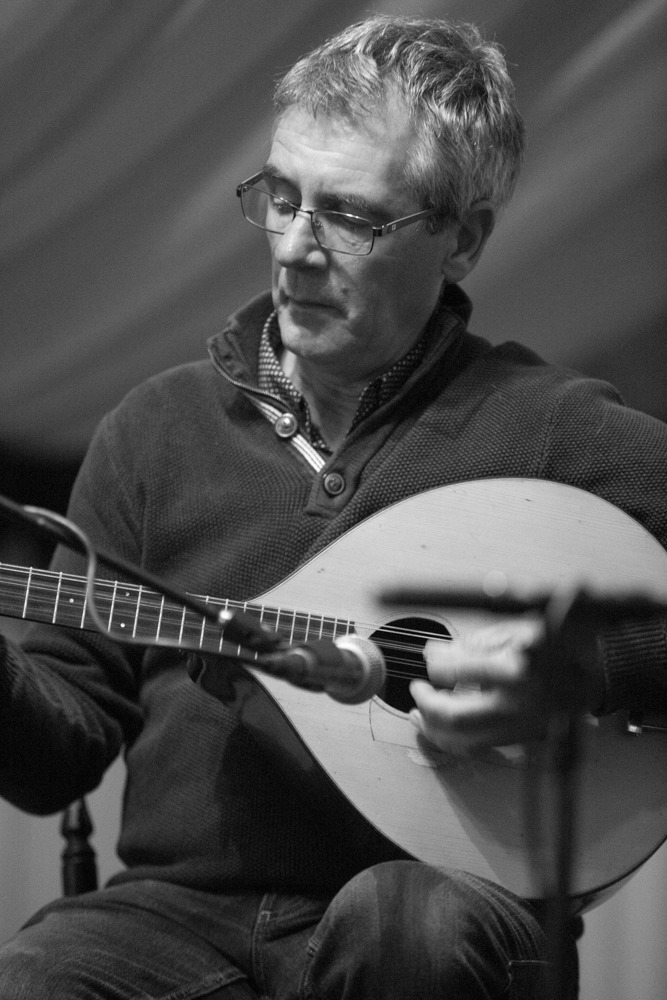
If that feeling was what Páraic was trying to capture in this album then he has been wildly successful. Much of it is recorded in Pepper’s Bar at Feakle and I was lucky enough to be there for one of those recording sessions. For this album Páraic has involved many of his most recent sparring partners. And that’s when his playing shines. Whether it is the sublime fluidity of Claire Egan’s fiddle or viola or the insistent rhythmic pulse of Cormac’s bass concertina or the wonderful ensemble playing of Graham Gueren, Colm Murphy, Noel O’Grady and Libby McCroghan, Páraic’s banjo is there at the heart of it. Crisp, clean and simple. No distractions. It’s all about the tune. He also plays to great effect with his brother Mac Dara and sister Sinéad and in a tribute to his roots, honours his father Séan by revisiting one of his songs. But there are a few tracks where he is on his own, and this is where his mastery comes to the fore.  He plays with just the subtle and supportive bouzouki of talented young Waterford player and instrument maker, Macdara Ó Faoláin or the gentle guitar of Terence O’Reilly.

The tune selection is fantastic. Really, really good.  Many are familiar, some not, but they always come up fresh with Páraic’s playing approach or with his local versions or the unusual key selections.  Sometimes it ensnares you and you just don’t want the track to end.

The CD itself is brilliantly presented with a comprehensive and informative book integrated into the cover. Paraic’s musings on his musical journey and influences reveal a man who writes as well as he plays. And I found the thoughtful and well researched tune notes by Graham Guerin added considerably to my listening enjoyment.

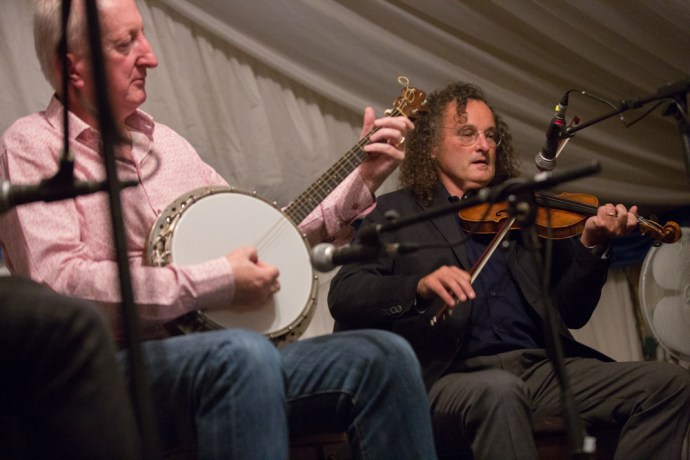
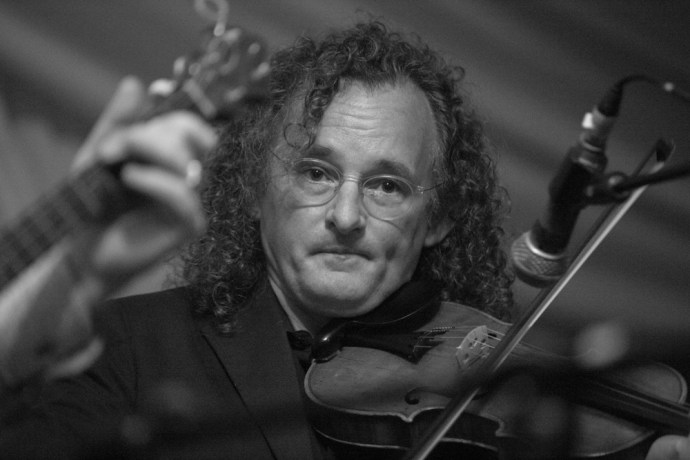
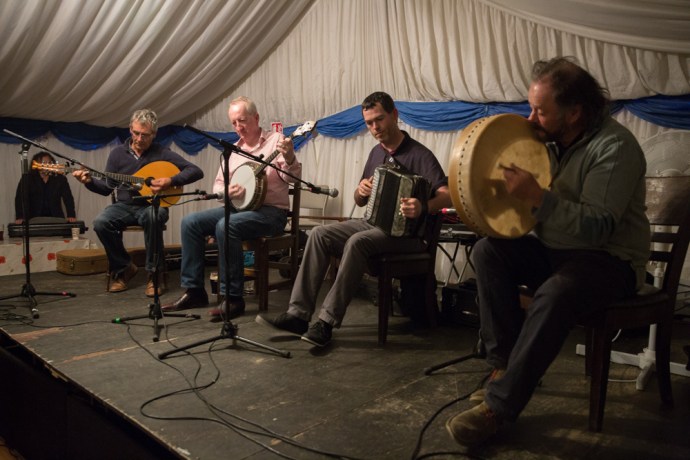
The concert to launch the album was held in the marquee at the back of Pepper’s Pub during the Feakle Festival. Gracing the stage were (almost) all the musicians who played on the album.  With the wonderful bonus of a guest spot from Martin Hayes who spoke eloquently of Paraic’s music and its East Galway roots and the connection with East Clare.  Having all this amazing music served up to us in a venue packed with appreciative fellow musicians, had me salivating!

So on the drive from the concert to my home at Quilty, a drive of well over an hour, I listened to the album.  Such a generous slab of music reflects the man.  Eighteen tracks took me to my front door!. And I listened again the next morning . This time on a good sound system. Just beautiful.  And it hasn’t come off the player since.

How could I fail to love this music.  It has truly captured the spirit that Páraic engenders when he shares his music making with his fellow musicians.  Now he has shared it with us.  We can all sit in.

Not before Time. 

IG3C0423

Macdara Ó Faoláin, Paráic, Claire Egan and Terence O’Reilly

IG3C0290

Paráic Mac Donnchadha

IG3C0341

Macdara Ó Faoláin and Paráic,

IG3C0281

Macdara Ó Faoláin

IG3C0266

Terence O’Reilly

IG3C0401

Macdara Ó Faoláin, Paráic, Mac Dara Mac Donncha and Terence O’Reilly

IG3C0390

Paráic Mac Donnchadha, Mac Dara Mac Donncha

IG3C0498

Paráic and Claire Egan

IG3C0556

Claire Egan

IG3C0559

Claire Egan

IG3C0611

Martin Hayes launches the CD

IG3C0711

Paráic and Martin Hayes

IG3C0619

Martin Hayes

IG3C0731

Martin Hayes

IG3C0723

Martin Hayes

IG3C0770

Noel O’Grady, Paráic, Graham Guerin and Colm Murphy

IG3C0779

Colm Murphy

IG3C0798

Noel O’Grady

IG3C0805

Graham Guerin

IG3C0848

Martin Hayes and Cormac Begley

IG3C0876

Paráic and Cormac Begley

IG3C0856

Cormac Begley

IG3C0940

Cormac Begley

IG3C0958

Libby McCroghan

IG3C0832

Sinéad Nic Dhonncha

IG3C0379

An appreciative audience.

Categories: Festivals, Stories, Trad Irish Music | Tags: , , , , , , , , , , , , , , , , , | Leave a comment

Sampson Island at Loop Head, Co Clare; You’ve probably never heard of it.

Loop Head is only an hour away from my house near Quilty.  It is one of my favourite places to take visitors no matter what the weather.  So serene and dramatic when it is calm; wild and scary in the wind and rain.  If you have been following this blog you will have seen my earlier posts and photographs. Spectacular cliffs displaying contorted folded sediments, rock arches and caves, a lighthouse, dolphins and in the distance the mountains of Kerry.

IG3C2765

Contorted rocks in the cliffs north of Loop Head

There is a rocky island at the end of the headland which looks like it was sliced off with a giant knife.  It is mad with breeding sea birds through the summer.  The picture below was taken in May and shows just a few early arrivals, taking up prime spots.   A deep and treacherous chasm separates it  from mainland Clare.  As you would imagine, much mystery and legend surrounds this place.

IG3C2820

The island is popularly known by some as Diarmuid and Grainne’s Rock, one of many places in island that reference the famous Irish legend of the love triangle between Fionn Mac Cumhail, his warrior friend Diarmuid and a girl named Gráinne.

The gap to the island is also known as Cú Chulainn’s Leap. And that’s another interesting story in its own right. Here is the short version.

Cú Chulainn was an ancient Gaelic hero warrior gifted with superhuman strength, speed and skill.  He was leader of The Red Branch Knights, who in ancient times would be fighting battles, protecting the folk of Ulster from invaders.  He would, however,  often go travelling.   On one of those trips, he met a ‘cailleach’, translated variously as a wise woman or a ‘hag’. Her name was Mal.  She fancied him and as she had magic powers with which she could ensnare anyone she touched, he took flight.

She chased him all over Ireland eventually following him to this remote promontory in west Clare. He leaped across the channel to the island but she was fairly athletic as well and was able to follow.  Still desperate to avoid her he hopped back to the mainland.  She continued to give chase but she didn’t quite make it slipping on the edge and and ending up in the ocean below. Three days later her head washed up at what became known as Hag’s Head and nine days later her remains came ashore at Quilty. The bay here took the name Mal Bay (hence Miltown Malbay) and the site of the jump became Leap Head or later Loop Head.

All fascinating but I digress.

At the end of April with Spring desperately trying to make an appearance I paid yet another visit. Isn’t it amazing that you can walk past a spot a dozen times and just not realise the significance of what you are seeing?  Well this day I noticed on the cliff edge two metal spikes fixed into the rock and a neat wall and some stone construction above them, including a large stone lined hole.  It all was heavily disguised by the soft spongy grass and the newly budding sea thrift.

IG3C2826

Two Iron spikes fixed into the cliff and a stone wall and hole above.

IG3C2833

Looking from the north to the south

I was intrigued. My first guess was that it was evidence of a former bridge. Perhaps a rope bridge like Carrick-a-Rede, I thought. But why? And in any case, hard as I looked I could see no works on the other side of the island which I would have expected. It remained a mystery but unsatisfied I resorted to Google later that evening.

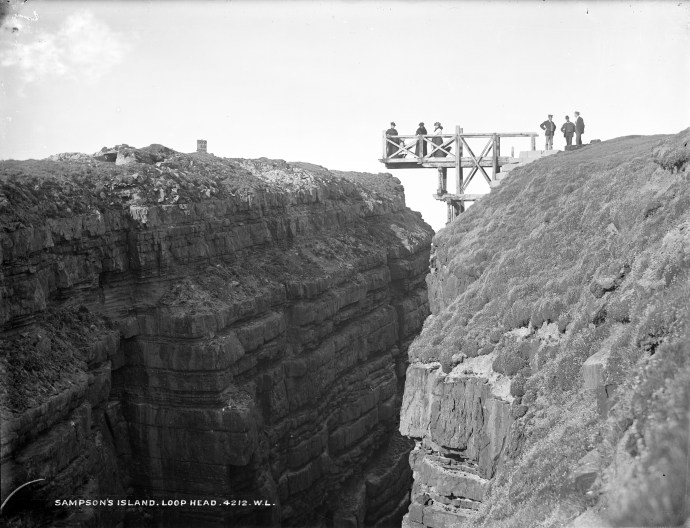
It didn’t take long to find this truly amazing photo in the archives of the National Library of Ireland.

9148091321_5a53eb9010_o

Viewing Platform Sampson Island.  c1905

What I was seeing was in fact the remains of the foundation of this viewing platform. The  photo is dated at c1905. and reveals a lot. You can see a sign on the Island that says ‘Sampson Island’ and proffers a date in the 1830s suggesting a landing then.

9148091321_5a53eb9010_o-2

Detail of above photo showing sign and shelter.

Did Sampson stake a claim to the island? There is also evidence of a small shelter. Further the people on the lookout are identified by researchers as members of the Sampson family.  But really it is all speculation. Why build this elaborate and hair-raising construction and how did they actually get across to put up the sign?  Why even bother naming it?

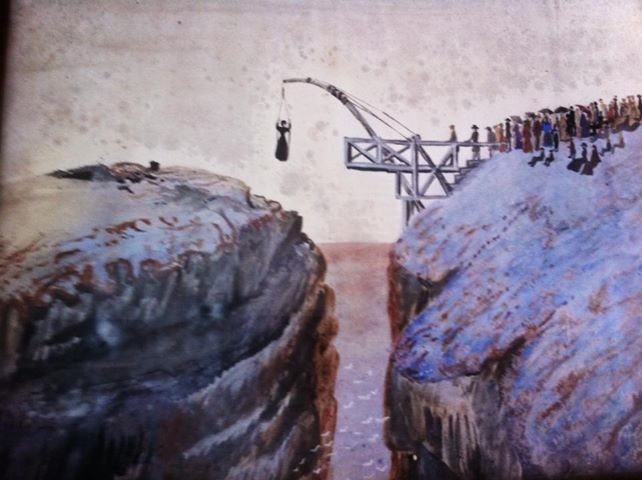
Then I saw another image.  God knows how the photographer got this angle

9149347173_f6609352eb_o

Crossing to Sampson Island?

That is one very brave woman in that sling. I am not exactly sure what is going on but it is possible that this was how they got across. There’s quite a crowd waiting to try. Perhaps Mal would have been better off to wait for the Sampsons to build this before attempting the crossing.

With Ireland’s long and convoluted history it is common to come across these hidden stories for which only scant evidence remains. Sometimes though you have to look very hard.  Next time you visit Loop Head have a look for it.  It’s close to the edge though so take care lest you end up like poor old Mal.

IG3C2900

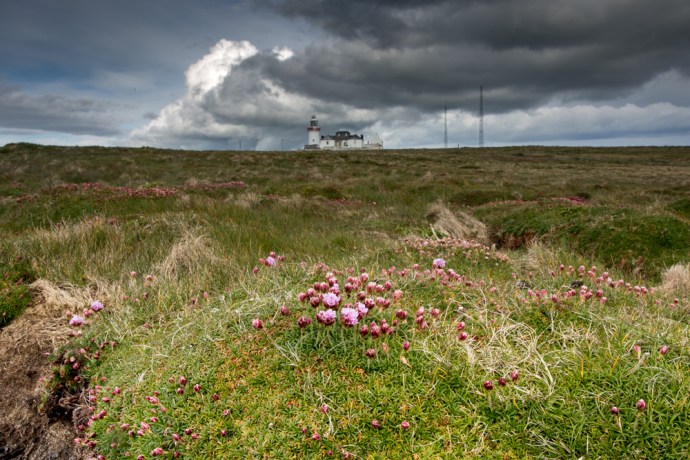
Loop Head lighthouse with the sea pink just starting to bloom

Categories: My Journey, Wild Ireland | Tags: , , , , , , , , , , , , , , , , , , , | 2 Comments

Dursey. An island at the end of Ireland.

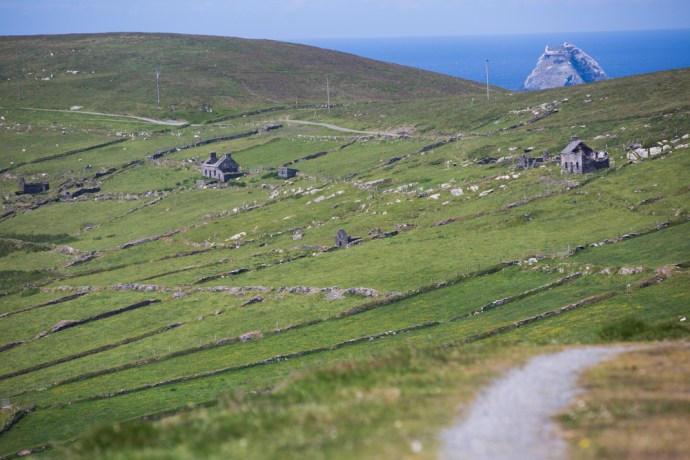
Dursey Island lies at the end of the Beara Peninsula in West Cork. It has been inhabited since antiquity and though it lies only 200 m from the mainland it has always been one of the most remote and inhospitable places to live in in the whole country.

IG3C3006

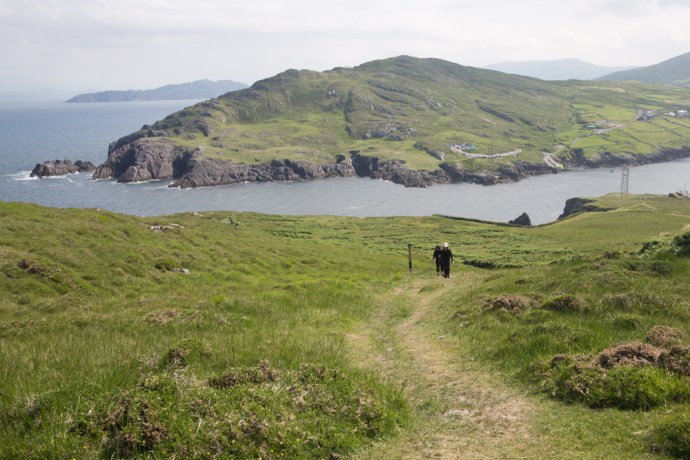
Dursey Island looking towards the mainland.

It had a tortured early existence and was the site of one of the most horrific events in Irish history.  Following the Battle of Kinsale and the defeat of Donal Cam O’Sullivan at Dunboy in early 1602, the English moved to clean up the last of the rebels.  Many of the O’Sullivan Clan’s non-combatants had been sent to  Dursey to keep them out of harm’s way.  An English force attacked the small garrison guarding the island. They butchered the entire population of the island, women, children and the garrison. Three hundred people executed on the cliffs and their bodies (some were still alive) cast into the sea.  O’Sullivan survivors from the whole of the Beara Peninsula, about 1,000 of them, then marched 550 km north to seek shelter from the O’Rourkes of Leitrim, but that’s another story.

As with the rest of the west coast of Ireland, Dursey suffered during the famine with a 30% reduction in its population in the 1840s.  Its subsequent and continuing depopulation reflects that of many other Irish islands but its survival displays the resilience and strength of its people. In 1860 the three villages of Ballynacallagh, Kilmichael and Tilickafinna,  a population of around 240 eked out a lonely life on the treeless but well pastured island.  By 1969 this number was down to 53. A feature of the island now is the large number of abandoned houses from these times.  This eloquently tell the story of a disappearing population, but they also give the island its remarkable character.

IG3C2842

Abandoned village

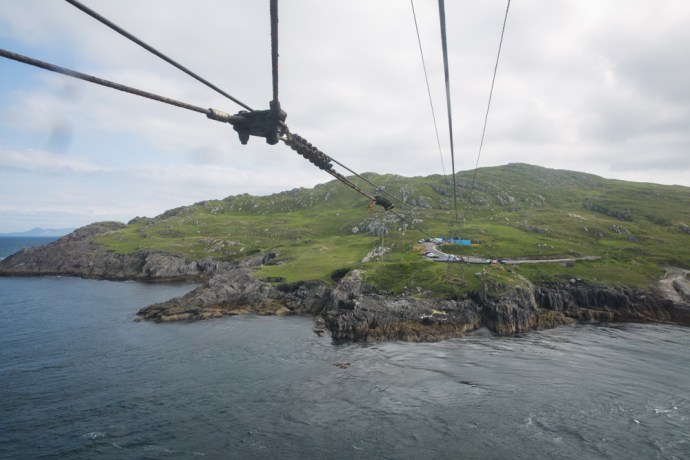
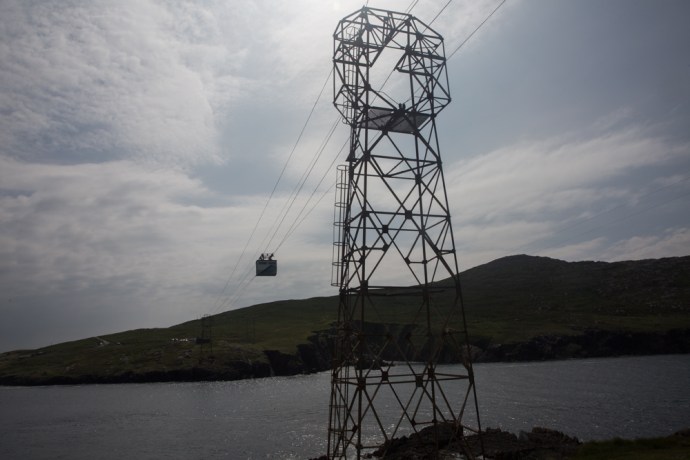
Up until 1970 the only way to get on and off the island was by boat across the channel.  A channel that could become so treacherous with storms and a tidal surge  that for a month and a half each year the island was completely cut off.  Considering that there was no electricity, TV, doctor, priest, food supplies and no hall or pub, life must have been very bleak indeed.   After much agitation from islanders the Government agreed to build a cable car to provide a lifeline and, while that did save it from the same fate as the Blaskets, which were abandoned in 1953, it did not stop the population drain until, by 2011, there were only three permanent residents.

IG3C2411

Treacherous tides and surges made this channel very dangerous to cross.  Not these days.

IG3C2448

Approaching the island

IG3C2435

Anticipation. A picture window.

But the cable car opened the island to the tourist.  6.5 km in length, there is much of interest.

To walk the island takes at least 4 hours but I spent over 6 hours ambling and rambling, getting lost and finding myself again.  Just absorbing the ambiance and grateful for the glorious sunshine and the warm breeze that accompanied me. It is glorious to walk either along the sometimes paved road (which despite the alarming speed sign is almost devoid of vehicles;  I saw only one) or across the hills but best to stay on the marked paths unlike me.

IG3C2470

There is a marked walking trail across the hills.  Looking across to the mainland.

IG3C2486

If you leave the path walking through thick vegetation and across stone walls can be a challenge.

IG3C2790

I can never understand Irish speed limits.  100 kph!?

IG3C2880

Looking from the western tip of the island back towards the mainland.  A signal tower stands on the highest point.

On your walk you will come across the remains  of St Mary’s Abbey, a Napoleonic signal tower, historic ruins, spectacular views, rocky cliffs, birds galore, native orchids and your best chance  in Ireland to see dolphins and whales.

IG3C3170

St Mary’s Abbey

IG3C2623

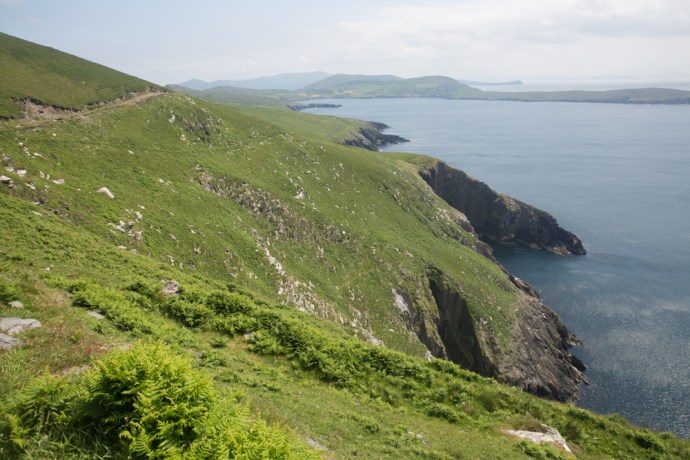
Cliffs on the southern side of the island

IG3C2647

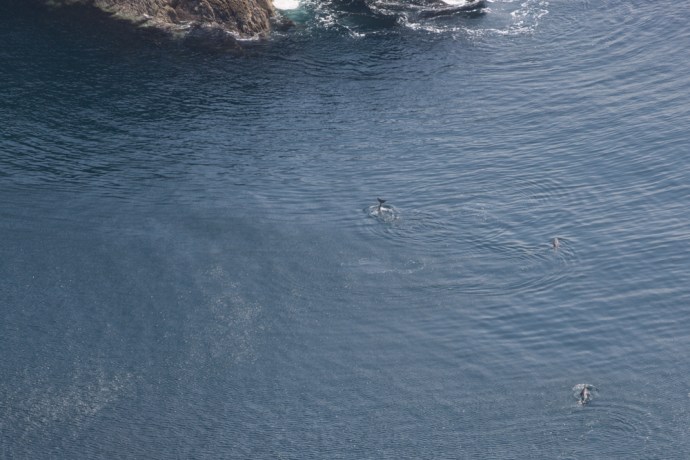
Dolphins

IG3C2727

I tracked this pod of dolphins for over half an hour down the coast

IG3C2928

Native orchids are common

At the western end of the island are three small islands.  Well, rocks really.  They are known as Calf Rock, Cow Rock and yes, you guessed it, Bull Rock.

IG3C2799

Looking west across Dursey to the imposing Bull Rock, two miles off shore

IG3C2889

Cow Rock and Bull Rock

A lighthouse was established on  Calf Rock in 1866.

Less than three years later a storm damaged the lighthouse.  This led to another tragic event in the saga of Dursey.  The Keeper, on Dursey, thought he saw distress flags and six boatmen were dispatched.  Those on the island were safe however, on the the return trip, the boat capsized and all six were lost

On 27 November 1881 in another  violent storm the the tower and lantern just snapped off above the steel base and fell into the sea. No one was hurt but it took two weeks to extract the four men stranded on the island. You can still see the base of the tower to this day.

IG3C2897

Calf Rock with the remains of the steel base of the light tower. Wrecked in 1881

To replace this lighthouse one was built on nearby Bull Rock, work commencing in  1882.  The light didn’t open until 1888.  It is worth pondering the challenge of constructing this on an island of precipitous cliffs measuring 230 m by 160 m and rising to 90 m above sea level.

The station consisted of an octagonal lighthouse tower, dwellings for the Keepers, and an oil-gas works.   This was a massive undertaking and the optic was the biggest in Ireland.

IG3C2915

Bull Rock with its lighthouse.  You can also see a gull colony and the entrance to a natural tunnel that goes right through the island.

The light still stands proudly today though it was automated in 1991. The island is swarming with gulls.  Also noteworthy is a natural tunnel that goes right through the island.  You can see the eastern entrance in the picture above.

That’s Dursey.   Take everything you think you’ll need because there are no supplies on the island and not even a toilet. And it won’t always be mild and sunny as it was for me; go prepared for bleak and wild.

But don’t miss it.

IG3C3225


Categories: My Journey, Real Ireland, Wild Ireland | Tags: , , , , , , , , , , , , , , , , , , , , , , , | Leave a comment

Mutton Island. A Clare Treasure.

This is my longest blog to date.  It is also one I have had the most pleasure writing.  It is about a special place.  Never visited by tourists and only by a handful of locals.  A place where little vignettes of a vanished Ireland can be glimpsed, where nature has done its wonderful work and where you can find peace in solitude.  I hope you find the time to read it and that I can give you a little of this feeling in these words and pictures.  


I live on the edge. Of Ireland, that is.

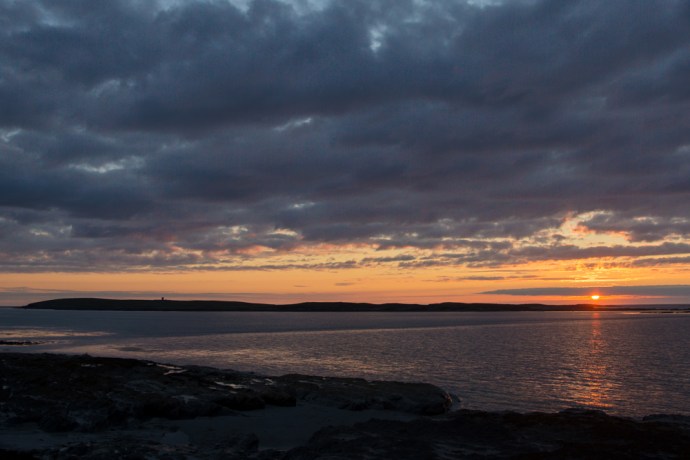
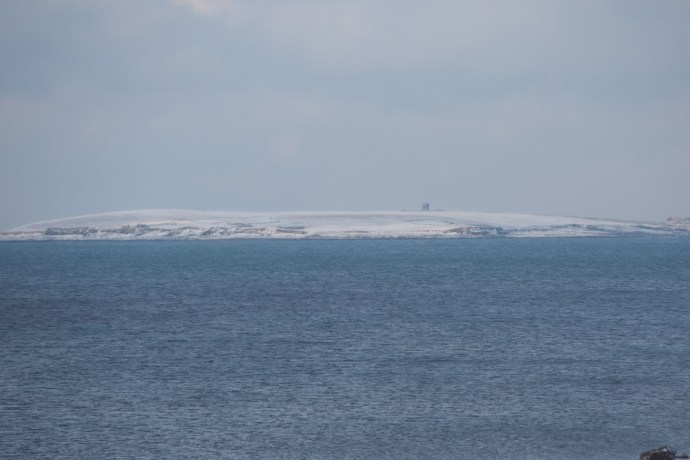
Every morning I pull the curtains and look out my window across Caherush bay. The first thing I see is Mutton Island. It’s the image that begins every day. Sometimes the cloud or mist or the spray from wild waves hides it and sometimes it is like a green jewel floating on a blue calm. I’ve seen it covered in snow and I’ve seen it bathed in the glow of a West Clare sunset.  But in four years I’d never been there.
IG3C8074-HDR

Sunset over Mutton Island viewed from Seafield Beach at Quilty.
IG3C3546

Mutton Island during the ‘Beast from the East’ in March 2018. Covered in thick snow.

The island of 185 acres is shrouded in myth and mystery. It’s inaccessibility gives these stories weight.

There is no obvious way to get there for those of us who don’t own a boat or a kayak, but I decided one July Tuesday in the midst of an extraordinary spell of hot, fine weather to try and get there.

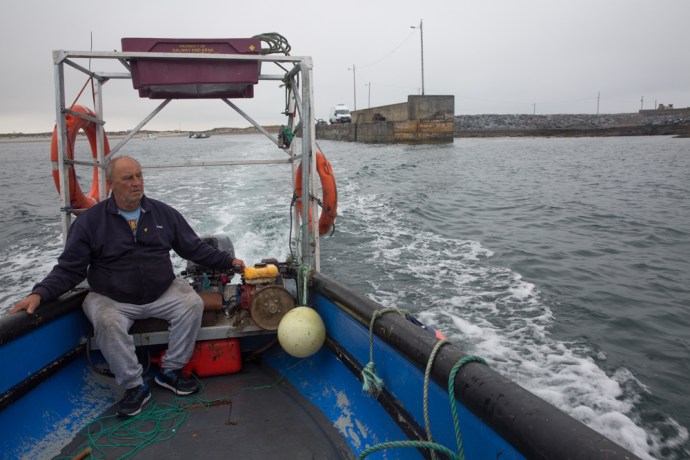
My inquiries led me to Anthony Murrihy, a Quilty fisherman, and so 10am Wednesday saw me waiting at the Seafield Pier to be ferried across. Well, after two weeks of blue skies, this morning arrived with low cloud covering Quilty and the island. Mmmm. That’s Ireland. Still there was no rain and it was just a bit cooler than it had been which in the end I was grateful for.

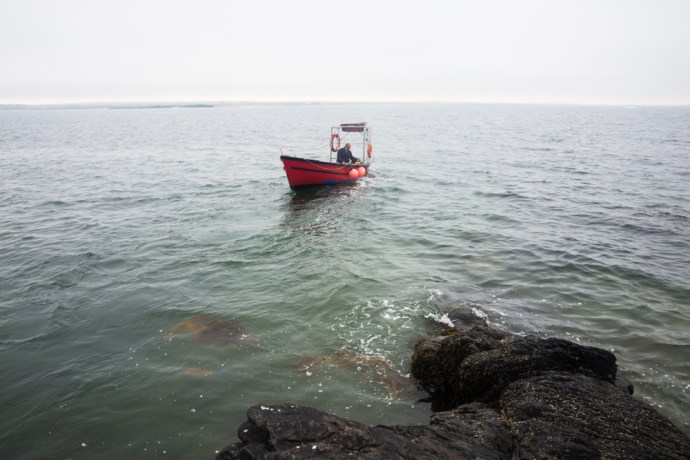
As the little red boat pulled away from the Quilty shore, it somehow seemed appropriate that the island should be shrouded in mist. Why would it give up its secrets so easily?
IG3C4150

Anthony Murrihy, Quilty fisherman.  Leaving Seafield Pier.

In my travels around Ireland, I’ve visited many islands: Tory, Inis Oir, Inis Mor, Cape Clear, Sherkin, Valentia, Achill, Aranmore, Dursey, Scattery, Skellig Michael, Garinish. Most are ‘tourist’ experiences. Ferry terminals, interpretive centres, maps and paths, signs with arrows and glossy brochures.  All were wonderful experiences of course, but nothing is like Mutton Island.

So it was just me, Anthony and a little red dinghy heading across the flat Atlantic.  There is no actual landing point on the island and as Anthony tried to hold the boat against a rock with a gaff (made from a paint roller, a broom handle and some duck tape), I gingerly stepped ashore clinging to my camera bag and my egg mayo sandwich.
IG3C4190

The landing spot.  I had to step ashore off the boat onto that rock……

Then it was just me. Anthony and the little red dinghy disappeared back to the inhabited part of Ireland.

It was the strangest feeling watching the tiny speck disappear into the distance. I just stood there for some time, quite dumbstruck.  I really can’t describe it.  A sense of excitement, of respectful awe, and at the same time a creeping solitude. It is so rare to actually be alone and isolated in this ‘civilised’ world. But here I was the only human being on this little slice of the planet. At least for the next few hours.

The island is elongate east-west fattening to the west. The boat dropped me near the eastern end so it seemed logical to start there and circumnavigate the island. This was my kind of exploration. It reminded me of my early days of geology fieldwork. No preconceptions, only a vague idea what I would find and no guide book to follow.  I think now that’s what attracted me originally to exploration geology. Here was an empty, abandoned world. Everything you see is a surprise, no paved path to follow, no interpretive centres or explanatory signs. Just raw nature, landscape, geology, wildlife and archaeology and only your eyes and feet to unravel it.

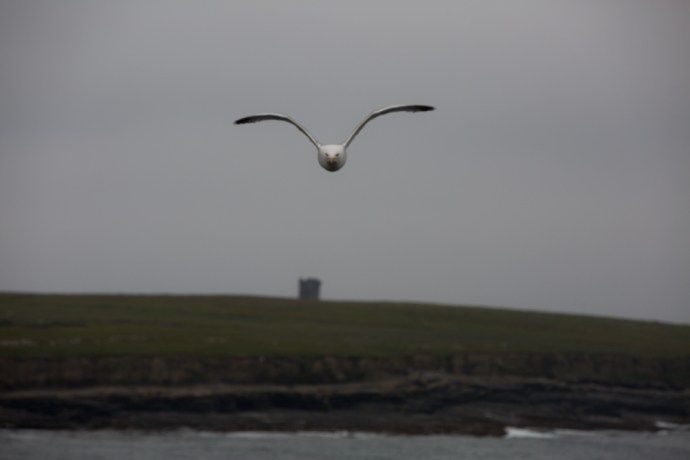
My first surprise was that it wasn’t the quiet idyll I expected. Because I wasn’t truly alone. The screeching and squawking of gulls and the persistent piping of oyster catchers was overpowering at times. They were telling me in no uncertain way that I was an intruder. Why would they welcome me? This was their world. One gull took a particular exception to me. I was repeatedly dive bombed. Heading straight for my head and only pulling on the joy stick at the last minute to clear me by inches. This was only a taster though. A more Hitchcock-like experience awaited me on the other side of the island.
IG3C4391

Being dive bombed by a gull.

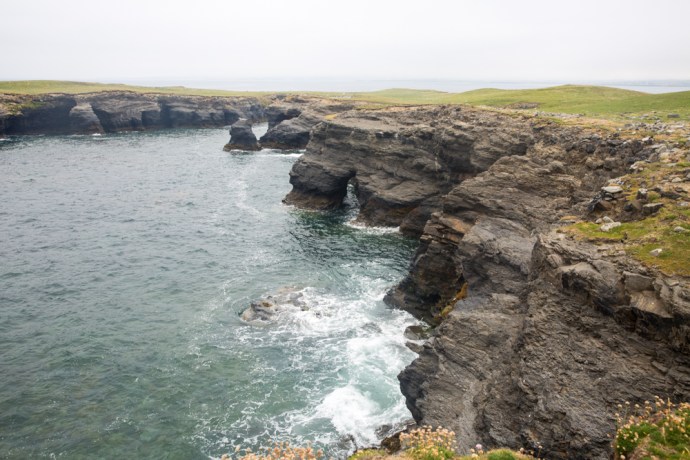
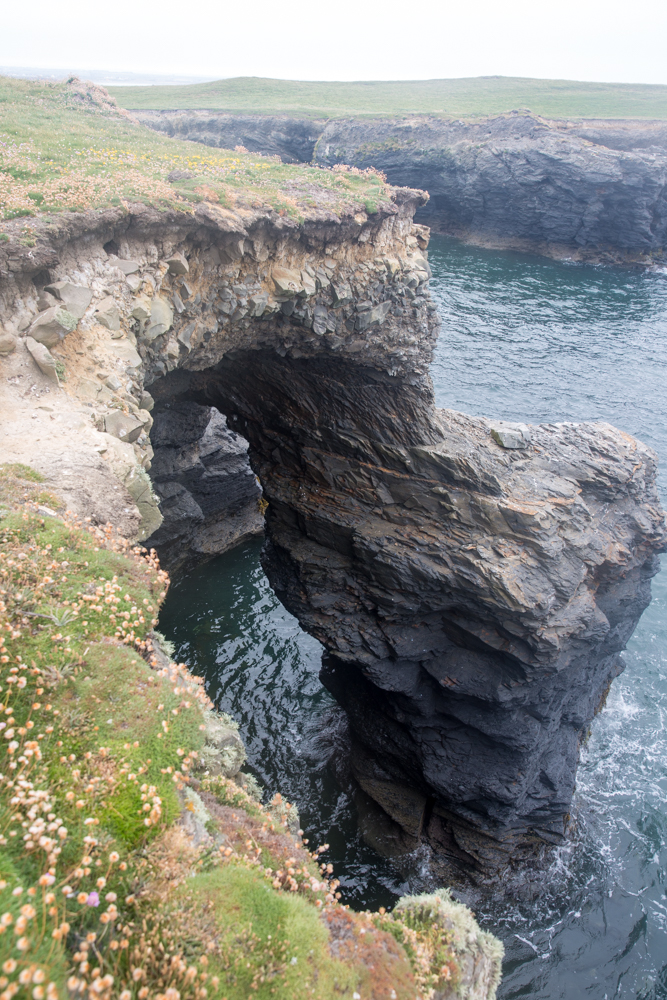
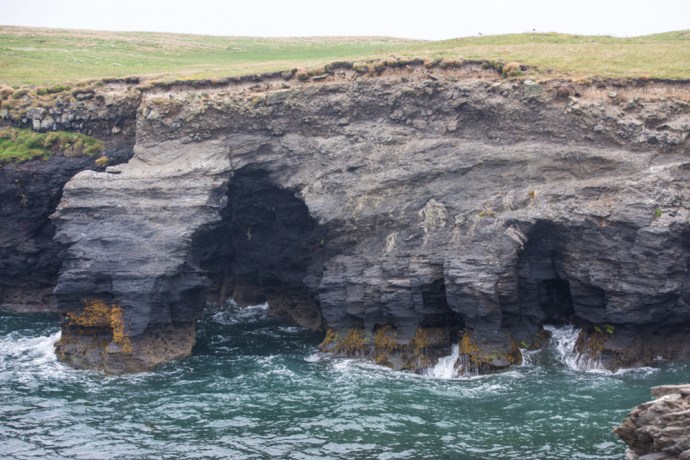
It only took a few strides from the rocky beach though until I realised this was a much more varied landscape than I had imagined. The rolling green slopes that you see from the mainland were there, yes, but hidden from view there were rugged cliffs. Sheer drops and a deeply incised coastline, caves, sea arches, channels and stacks revealing a wildness that was breathtaking.
IG3C4444

The beautiful incised coast at the north eastern end of the island.
IG3C4338

A natural arch on the northern coast

IG3C5467

The sculpted coast exposed at low tide.
IG3C4382

Caves and Arches I.  High tide

IG3C5481

Caves and Arches II.  Low tide.

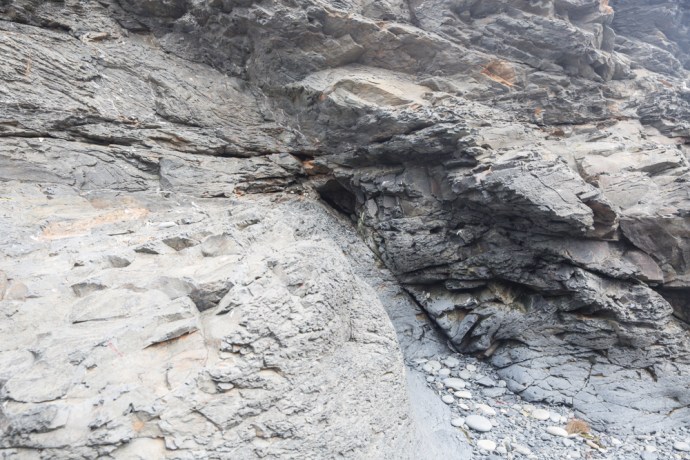
The rocks are all sandstones and shales, as on the mainland, faulted and folded by a disruptive tectonic event nearly 300 million years ago. This alternation of soft and hard layering and extensive faulting has provided many opportunities for selective erosion creating these awesome geological features.

IG3C5436

This cave is formed at a fault boundary where soft shale is in contact with hard sandstone
IG3C5456

A cave in the early stage of development.  Erosion is taking place along a fault and under a sandstone cap.  Come back in a few hundred years and this will be a cave.

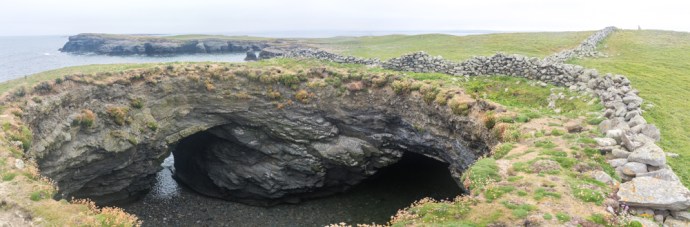
Sometimes the roof collapses forming what are known as stacks. There is particularly impressive roof collapse which has formed a cave (known as Poul Tabach, a reference to the contraband dealings that went on there),  It has created a giant sink hole with two entrances one open to the sea.
IG3C4454-Pano

A collapsed cave and arch.  Poul Tabach.  Walled off by the early settlers to stop livestock disappearing down the hole.  Said to have been used by smugglers.

On the western side of the island there are many similar caves and arches.  I found a number of natural bridges across steep narrow chasms right at the north western tip – in one case a double bridge, something I had never seen before.

IG3C4731

Arches and bridges over a steep natural chasm.  The bridge in the middle distance is actually a double arch.

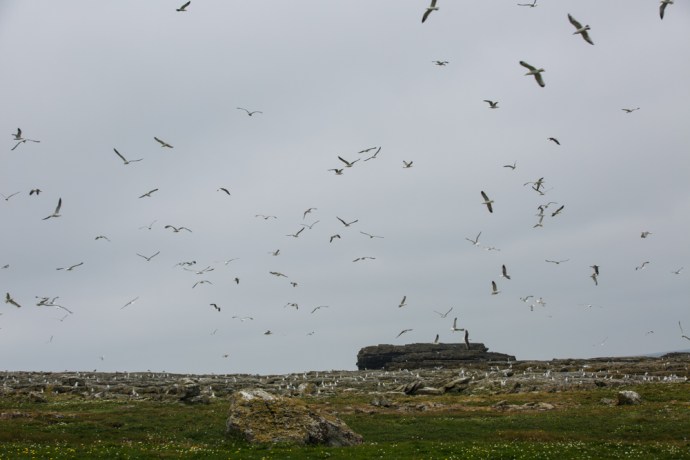
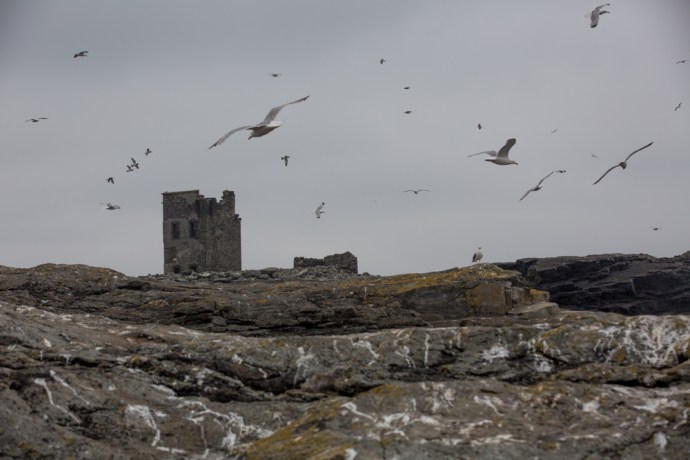
As I walked west the sky became thick with those gulls again. I was approaching their breeding grounds. I felt a bit like a cross between David Attenborough and an extra in The Birds, as I skirted around the edge trying as much as possible not to disturb them but at the same time wanting to observe close up this rare experience.
IG3C4642

Gull colony with the cliffs of the north west tip of the island in the distance.
IG3C4806

Gulls take to the air over the Napoleonic Tower

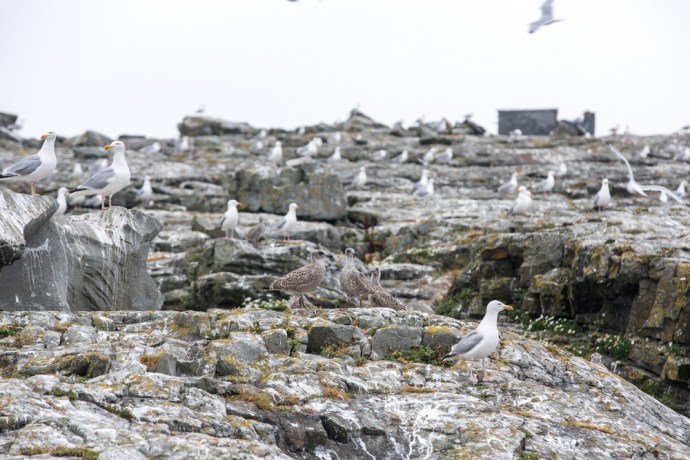
To my untrained eye there seemed to be two species of gull sharing the same nesting sites. I later identified them as Herring Gulls and Lesser Black-backed Gulls.
IG3C4697

Herring Gulls and their chicks

IG3C4911

A Lesser Black-backed Gull in flight

There were two distinct colonies with thousands in each. One was on exposed rocks with nests on little remnant vegetated patches or just on the bare rock and the other, some distance away with extensive burrows in a field. The dowdy chicks still unable to fly and with their distinctive grey, brown and cream down, scampered across the rocks or hid in their burrows abandoned momentarily by their parents to try and distract me. The more confident ones standing on the cliff edge dreaming of the day they would fly.
IG3C5236

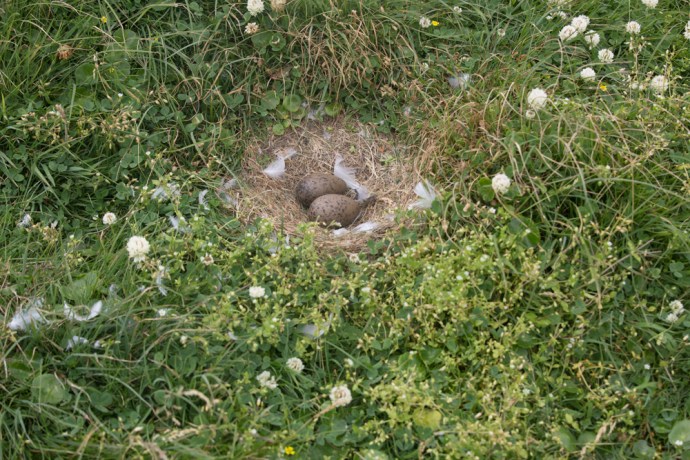
Gull eggs.  Here they are in a nest but often they are laid on the bare rock.
IG3C4813

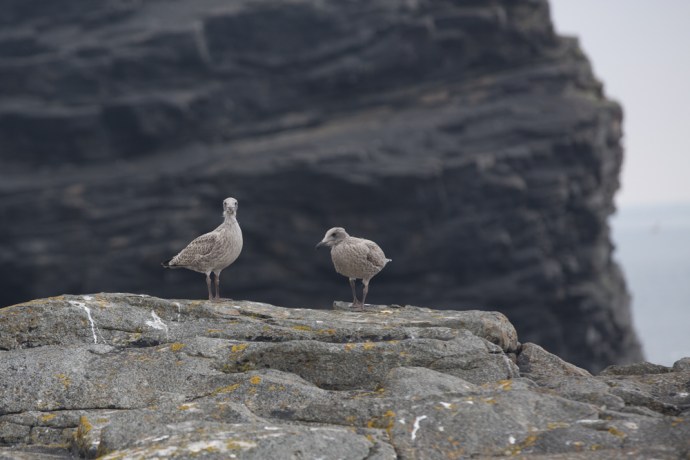
Two Herring Gull chicks.  Ready for their first flight?

IG3C4280

Herring gull chick taking refuge in a burrow

I was endlessly fascinated watching this seething mass but there was more to see. Not far away was the tell tale silhouette of a Napoleonic signal tower, so I headed there.

Bearing a superficial resemblance to a Tower House, many call these structures ‘castles’. They are not. They are a part of a network of towers built between 1804 and 1806 as a response to the threat of invasion by the French. There were around 80 towers built along the west and south coast from Malin Head all the way to Dublin. Each cost £3,000 to build.

The idea was that they were within sight of each other (theoretically! Irish weather not withstanding) and in this way a message could be transmitted using flags and black balls on a tall wooden mast.  Following Napoleon’s defeat at Waterloo in 1815, the towers fell into disuse. Though solidly constructed many are now crumbling ruins. This one though has many typical architectural features preserved and seems to have been one of the better built ones.
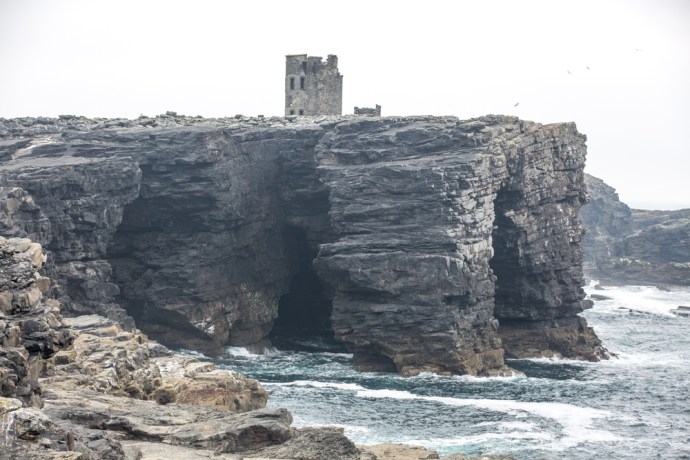
IG3C4762

Sea cliffs with caves and bridges and the Napoleonic Tower
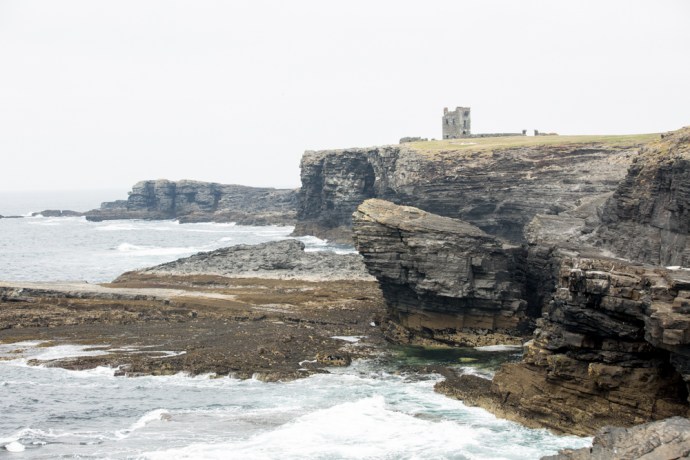
IG3C5125

The western coast of the Island

It is a handsome building with solid mortared stone walls built of local shale and sandstone but with window surrounds of cut and dressed limestone. Other highlights such as the fire places, the elegant window surrounds and the observation platform buttresses were also of this limestone. Some features were also constructed of red brick. The walls were rendered in a cement with a lot of shell grit  The walls were covered inside and out with a mortar of the same material, though only a little remains.   The external walls were covered with overlapping slate tiles of which only those on the north-east wall have partially survived. The limestone, bricks and mortar would have been imported to the island. Internally you can see remnants of  timber lintels and floor joists.  Again presumably imported onto the island. There are many names and dates scratched into the mortar with elegant script and though largely illegible now, most seem to date from the 1800s.

IG3C4940

Napoleonic Watch Tower

The whole is surrounded by a very solid wall in similar style to the tower and a stone out building. It is perched on the top of a cliff on the highest point on the island and in sight of the Hag’s Head tower to the north and Loop Head (tower now gone) to the south.

IG3C5027

Entrance gate and wall surrounding the tower.

These towers are a reminder of the fear that would have engulfed Britain and its colonies at the time and the incredible effort that nations would go to to protect their borders. It is truly remarkable to think that 80 of these towers were built in a two year period in some of the remotest places you could imagine.

My day was rapidly coming to an end. To get back to the pick up point I had to cross a wide expanse of meadow and in places, bog. But first I headed out to the headland at the southern end of the island.  Something drew me there. I think it was the cormorants at the point but on the way I pondered a rubbly ridge of stone on the landward side of the headland.  Later I discovered this is believed to be the site of an ancient Promontory Fort possibly Bronze Age.  You can clearly see this rocky ridge on the google image.

IG3C5179

Rocky rubble possibly representing the wall of a promontory fort at the southern tip of the island
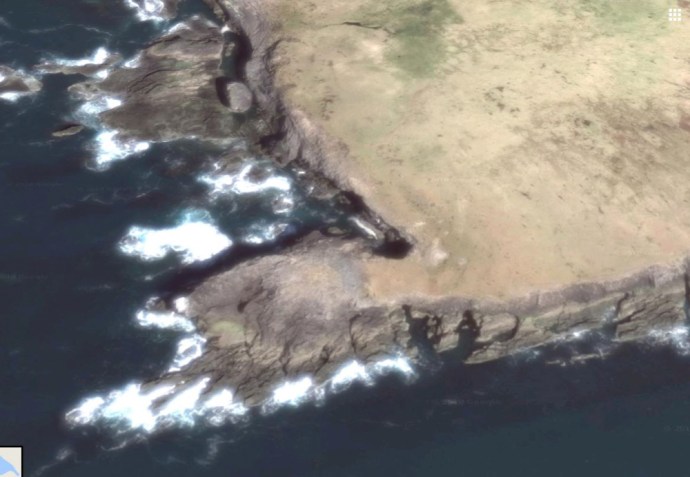
Mutton island prom fort

Google image of the promontory fort  You can see the break where the rubble in the photo above is.

No one really knows what these were used for.  But they may have been some sort of lookout. This would suggested habitation before the time of Christianity.  St Senan was said to have built a monastery here before going to Scattery.  So we are confident it was lived on in the 7th century.  Records suggest four monks had an oratory here.  It is common for oratories to have a circular wall and there is such a wall at the eastern side of the island.  Was this the site of the oratory, long since gone?
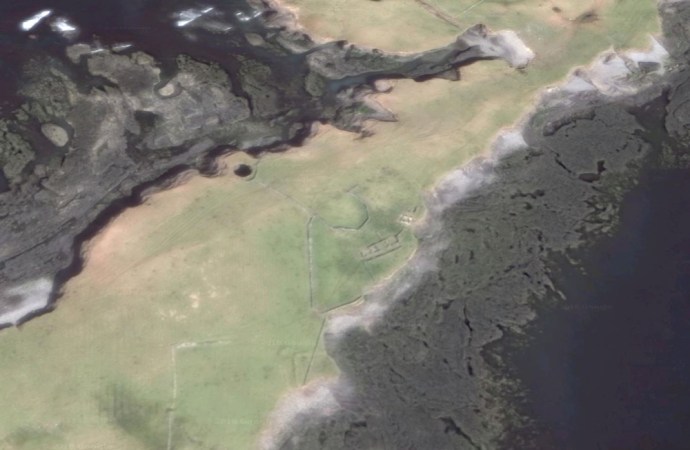
mutton island circle wall

Google image showing part of  a circular wall which may have been the site of St Senan’s oratory.  The hole to the north of this is Poul Tabach.

IG3C4459

The circular wall and much later ruined cottages.

It would seem the island is getting smaller as Samuel Lewis in his 1837 book on Clare gives it an area of 210 acres, down now to 185 acres. Historically however it may have been much, much bigger. The island is referred to in The Annals of the Four Masters, (a compilation of Irish history up to 1616) as Fitha Island which included the now separate islands of Mutton Island, Inismattle and Roanshee. This source states that Fitha was connected to the mainland until in 804AD “the sea swelled so high that it burst its boundaries, overflowing a large tract of country and drowning over 1,000 persons.” This is now presumed to have been a tidal wave and it is speculated that it may have been responsible for separating the islands from the mainland. Geologically, this would be pretty unlikely if the connection was of sandstones and shales, however it is plausible, given the extensive glacial deposits still on the island, that if these unconsolidated sediments were the connection with the mainland, then such an event may well have removed some of these deposits.  As storm events today still do.

In fact the water between Mutton island and Quilty is very shallow. Anthony, my ferryman, told me that they used to walk cattle across on very low Spring tides. As we returned on the boat he showed me the ‘road’ that lies at the ocean bottom visible in the clear water just couple of metres below.  In these very low tides water will reach your knees suitable for cattle.  A couple of days later I visited the Seafield shore to see whether I could find it. Sure enough there is a ramp of sorts visible at low tide and in the photo below you can see the trace of the submerged roadway, highlighted in the evening light.  It turns out it is in fact clearly visible also on the google satellite image.
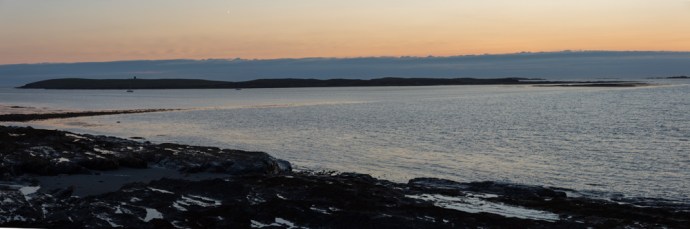
IG3C7629-Pano

View from Quilty to Mutton Island.  The ramp to the left is the start of the ‘roadway’ and you can see its trace continuing to the eastern end of the island. You can also see it in the first photo of this blog.

Mutton island road

A google image showing the shadow of the roadway at the eastern end.

The island would have had many stories to tell. A ship, the Sao Marcos, from the Spanish Armada, is said to have run aground in 1588 with sailors buried on the island, and it was used extensively by smugglers in later years who took advantage of its many caves. During the days of the Sinn Fein courts, which operated outside the British justice system, it was used as a detention camp.

Further evidence of habitation is in the ruins of some cottages on the south eastern side of the island. It is believed that up to a dozen families lived here in the 19th century, the population peaking in the 1920s.  They fished, harvested seaweed, grew potatoes and vegetables, and as the island’s name suggests kept livestock.  ‘Mutton Island’ is said to derive from the quality of the meat, flavored by the lush grasses and herbs that the sheep dined on.

IG3C5355

Ruins of the village on the island.  A home now for the starlings

People lived on the island seasonally until late in the 20th century.  One resident led a hermit-like existence there until the mid 50s, living summer and winter for four years.  Quite remarkable when you think about it.

As I walked around I saw signs of more recent human activity however. Some fencing. Lobster pots, the remains of a motor vehicle? I had heard a report that one of the residents of the island had built a raft and freighted a Ford Anglia to the island.  Was this it?

IG3C5424

Is this the the wreck of the Ford Anglia?

Mutton island is an island of mystery.  I have talked about the archaeological heritage but what about this?  I found yhis unique figure in the thick grass around the Napoleonic Tower.  Made from the red bricks used in the tower construction.  Is it the oldest example of an iconographic emoticon?  Predating the digital age by two centuries?

IG3C5052

Archaeological heritage?  An early emoji.

And then there’s this.  A crop circle?
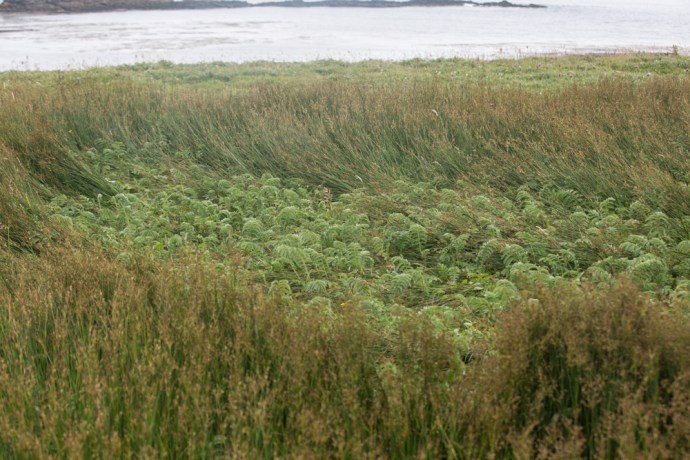
IG3C5319

A crop circle?

There is a wide variety of vegetation.  No trees.  That’s a given, but grasslands, bogland and in places thick growth of thistles and cow parsley that comes up to your chest. Not easy to walk through especially given the hidden rabbit holes!

IG3C4490

Fields thick with cow parsley.

IG3C5284

Bog cotton

For now the island is populated by rabbits, rats, seals and reportedly goats (though I didn’t see any, so that population may have died out). Doesn’t sound appealing but all the land mammals were introduced from the mainland and are happy in this people-less place.  Even less appealing perhaps were the colonies of midges.  But, you know, they weren’t interested in me in the least.  They were quite happy to dine out on the sweet nectar of the cow parlsey flower.
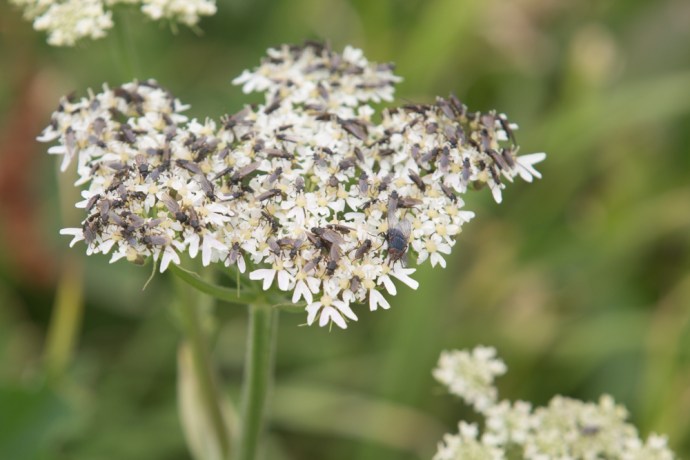
IG3C5369

Midges on a cow parlsey flower head.  That’s a normal fly for scale.

The island is privately owned and changed hands many times of late.  At one time it was owned by the DuPont corporation who thought that it would make a perfect terminal for shipping the oil that was discovered west of Aran Islands.  Luckily that plan fell through!  An American bought it then and he had grand plans but couldn’t get permission for a pier.

It is a bird sanctuary now and this gives it protection, to some degree, from such avaricious planning decisions, so hopefully it will be there to be enjoyed by those willing to take the trouble and time to get there and who respect its cultural value to Ireland.

This is as it should be.

Around 5 pm Anthony returned in that little red boat, this time finding a shallow beach to pick me up.  Reluctantly I re boarded, but the memory of that special place will be permanently etched.  Images that will return every time I pull the curtains of my bedroom window to let in the morning light and stare across at that proud rock.
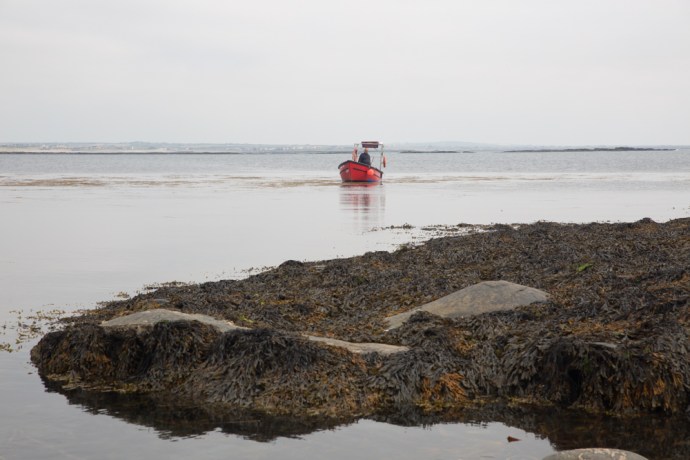
IG3C5516

The ferryman returns to collect me

IG3C7972

An excellent four part radio series about Mutton Island was made by Raidió Corca Baisicinn in 2016   It’s worth listening to.  You can find it at http://rcb.ie/mutton-island/
 

Categories: My Journey, Real Ireland, Wild Ireland | Tags: , , , , , , , , , , , , , , , , , , , , , , , , | 1 Comment

Spancil Hill is……

I’ve been going to Spancil Hill Fair in Co Clare for five years now.

The Fair has been going for 300 years.  I’ve blogged on two previous occasions (2014.   2015)     So I thought I would do something a little different this time.


Spancil Hill is a spectacle. A melange.
Folk from Ireland and beyond
Travellers and settled; families and bachelors
Horses and donkeys, ironmongery and saddles
Buggies and carts, burgers and fries

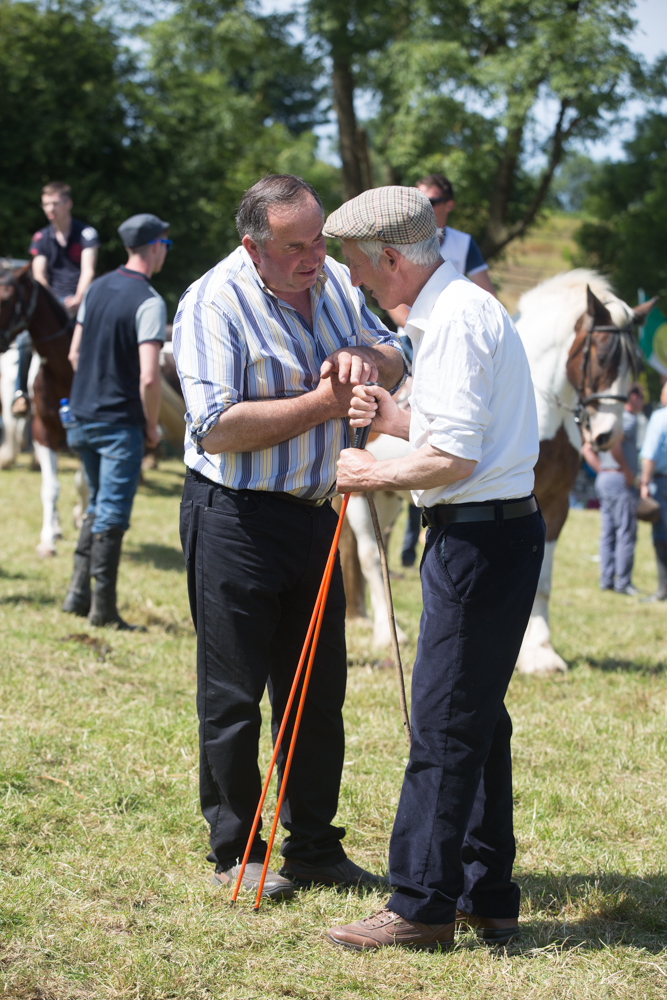
Spancil Hill is sticks.
Of blackthorn, hazel, fibreglass or ash
Sticks in earnest conversation
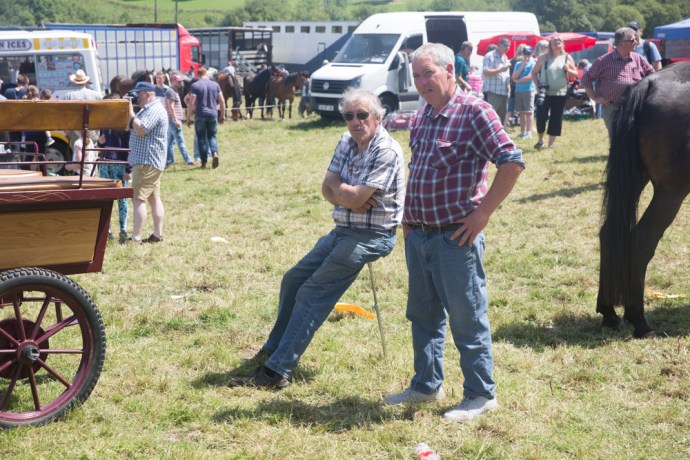
or just to lean on
or to sit on.

There’s a man selling sticks. I bought one.

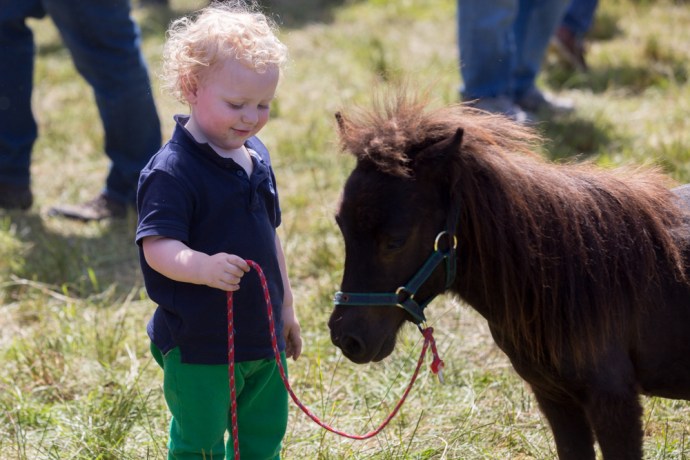
Spancil Hill is a toddler eye to eye with a pony

Spancil Hill is a runaway pony,
Scared.
Horses rearing.
Until it is cornered and held safely and lovingly in a boys arms.

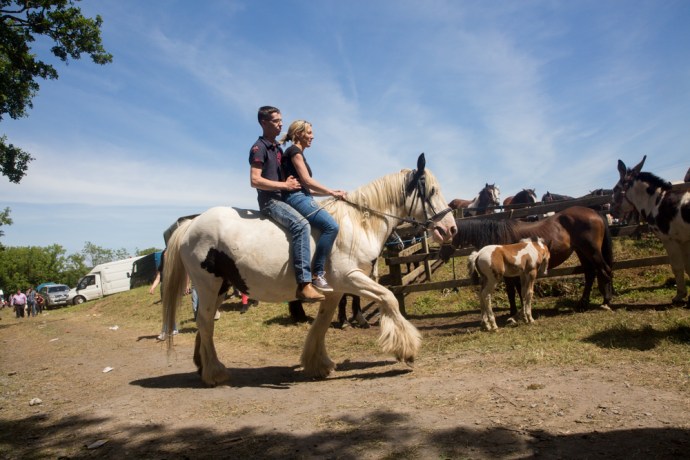
Spancil Hill is the Irish Cob
How do they see?
Full-maned and feathered, by buyers prodded and stroked.
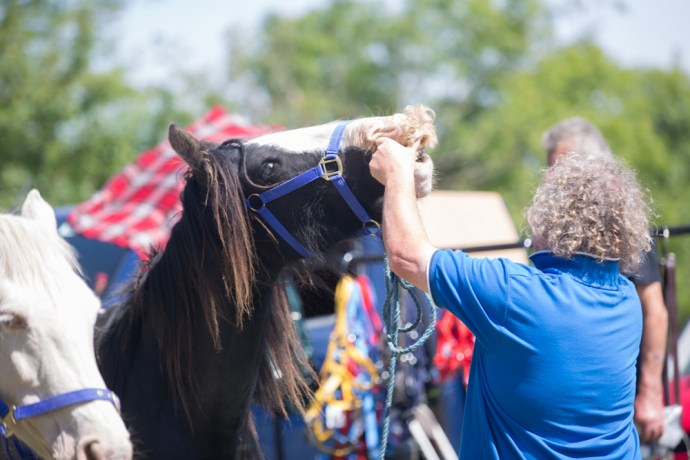
Mouth pulled open and poked (I’m sure there’s a reason).
Or another pulling a buggy,
or cantering imperiously.

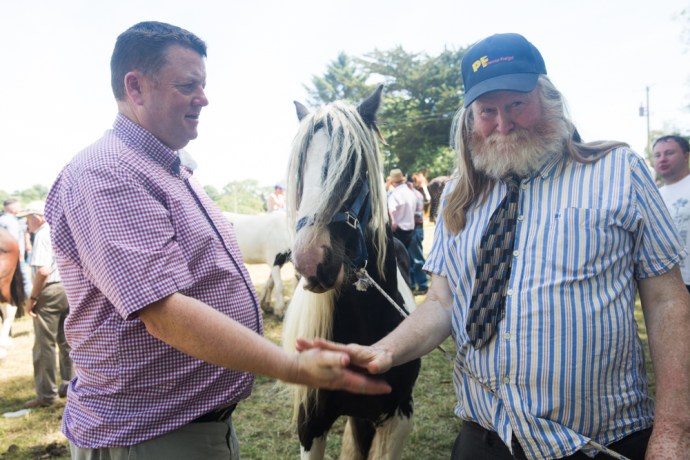
Spancil Hill is John Sheridan sealing the deal on a pied cob.
Slapping hands with the seller.
His family posing proudly for the camera.

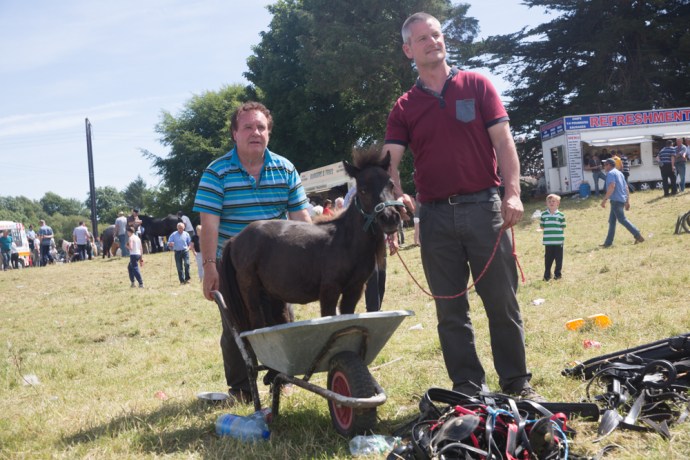
Spancil Hill is Sean O’Leary standing with his pony.
Waiting all day for a buyer.
Is it the smallest in Ireland?
For this tiny equine there are many who are keen.
But will they meet his price?

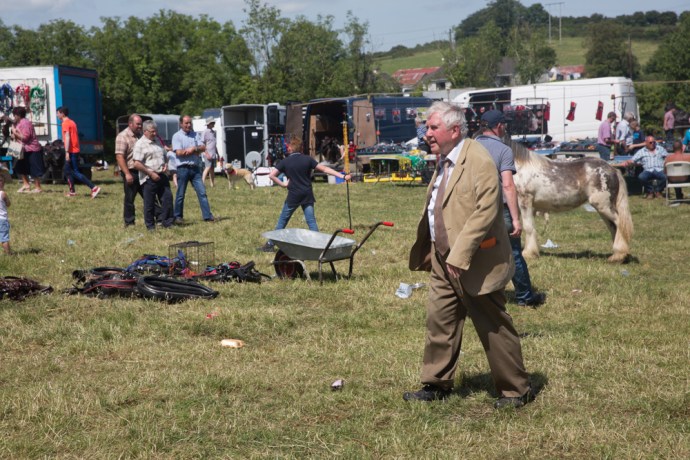
Spancil Hill is a man in a beige suit,
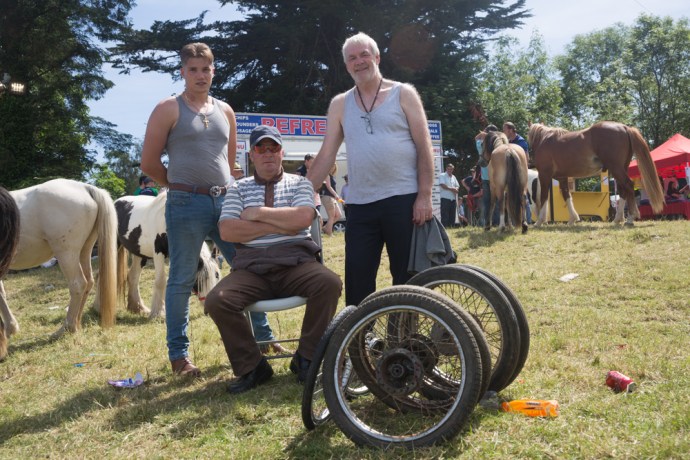
Another without a shirt.

Spancil Hill is lorries loaded with horses.
Headed for Europe.

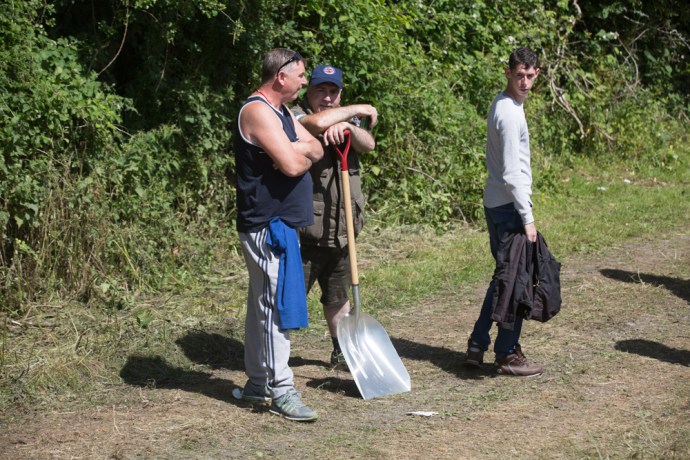
Spancil Hill is a giant spade.

Spancil Hill is ice creams.

Spancil Hill is John Dooley, a Feakle man sitting in his chair
Since 1946 he’s been there.
It’s his 72nd Fair
The stories he could tell.

Spancil Hill is Aisling and Paddy leading home the newest member of their family

Spancil Hill is Albert and his family selling buggy wheels.

Spancil Hill is Ireland then and Ireland now.

An apposite anachronism.

I love it. 

IG3C1037

Spancil Hill is Sticks.  In earnest conversation

IG3C1181

Or to lean on

IG3C1546

Or to sit on

IG3C1125

Spancil Hill is a giant spade

IG3C1163

Mouth pulled open and poked.  I’m sure there’s a reason

IG3C1408

Spancil Hill is a toddler, eye to eye with a pony.

IG3C1340

How do they see?

IG3C1530

There’s a man selling sticks.  I bought one.

IG3C1459

Spancil Hill is ice creams

IG3C1769

Or cantering imperiously I

IG3C1790

Or cantering imperiously II

IG3C1586

Spancil Hill is John Dooley.

IG3C1892

Since 1946 he’s been there.  The stories he could tell.

IG3C1911

Spancil Hill is a runaway pony

IG3C2005

Until held safely and lovingly in a boy’s arms

IG3C2065

Spancil Hill is a beige suit

IG3C2173

But will they meet his price

IG3C2198

Spancil Hill is Sean O’Leary.  Is it the smallest in Ireland?

IG3C2241

Spancil Hill is Albert and his family selling buggy wheels

IG3C1807

Spancil Hill is John Sheridan. Slapping hands….

Aisling and Paddy and the pony they bought

Spancil Hill is Aisling and Paddy.


Categories: My Journey, Real Ireland | Tags: , , , , , , , , , , , , , | Leave a comment

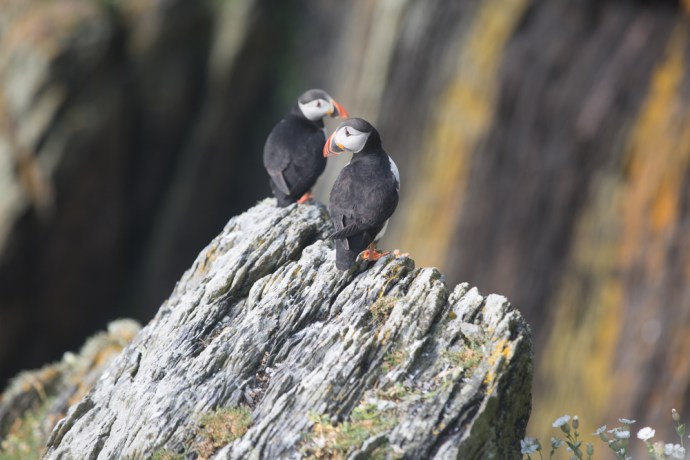
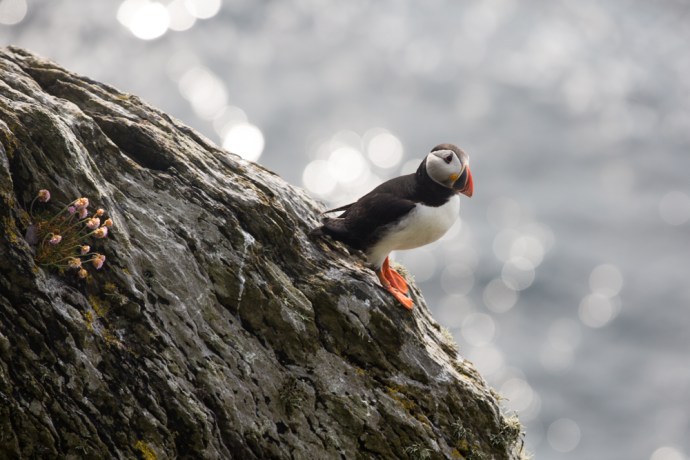
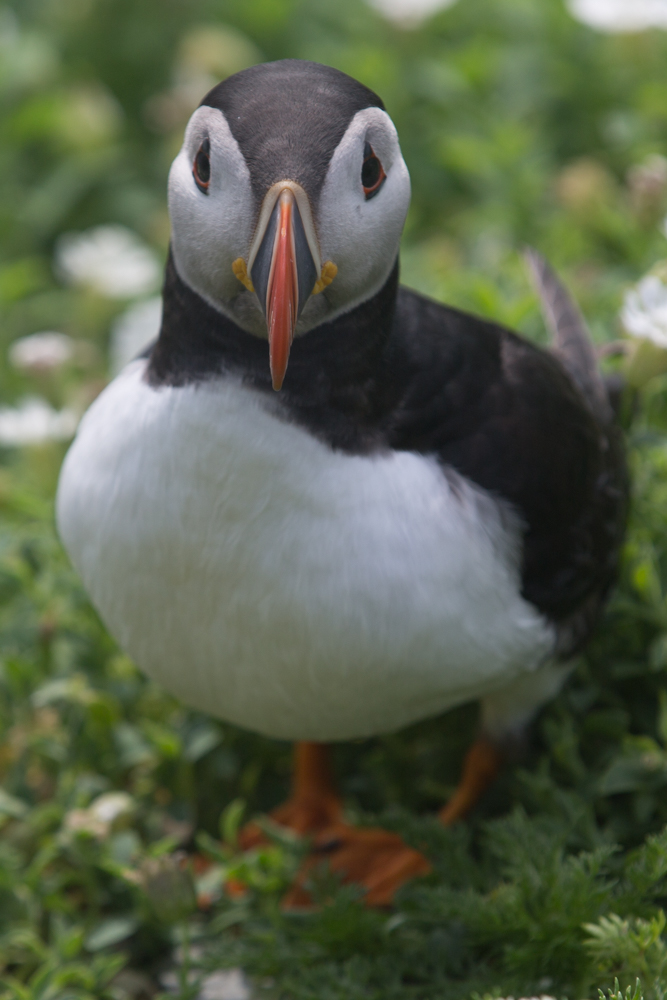
You gotta love puffins.

As I say you gotta love puffins.

Well they are cute and because they breed on offshore islands the difficulty of getting to see them adds to the mystique.   They are truly an aquatic beast, rarely seen on land spending most of their time in the water far out to sea when no breeding.  Ireland though is a great place to get close and personal.

You would think it would be easy.  After all the global population is over 10,000,000 which sounds healthy but in many places it is declining and considered vulnerable. But here are only a few places they can be seen.

I saw them during my visit to Skellig Michael in June (click here). While they breed at the Cliffs of Moher near my home base in Clare, it is hard to get a good viewing point so after four years I still hadn’t seen any.  Skellig Michael though is a different matter. You can’t avoid them at this time of the year.

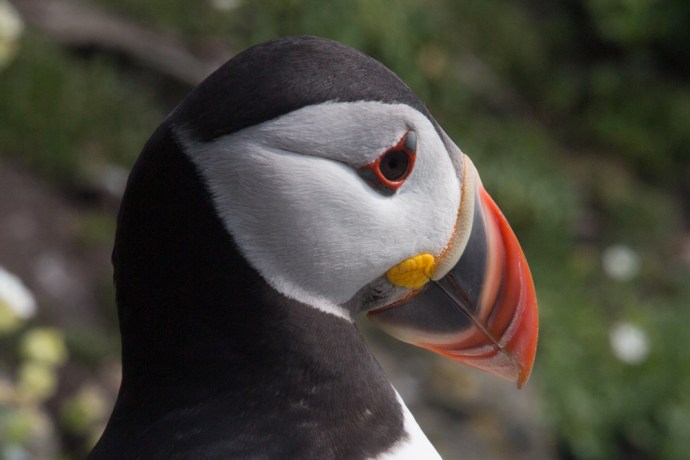
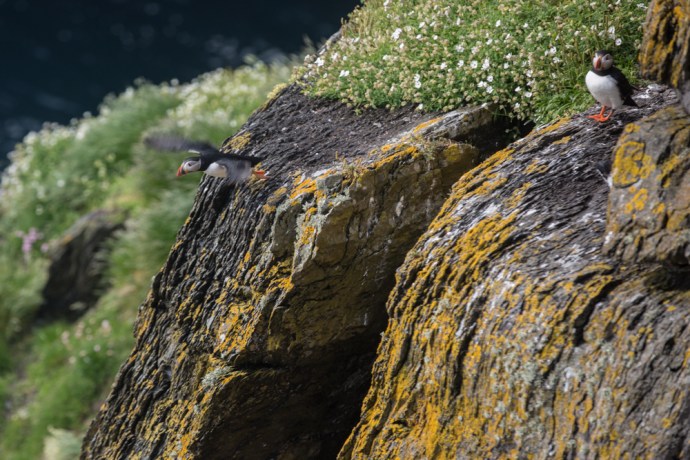
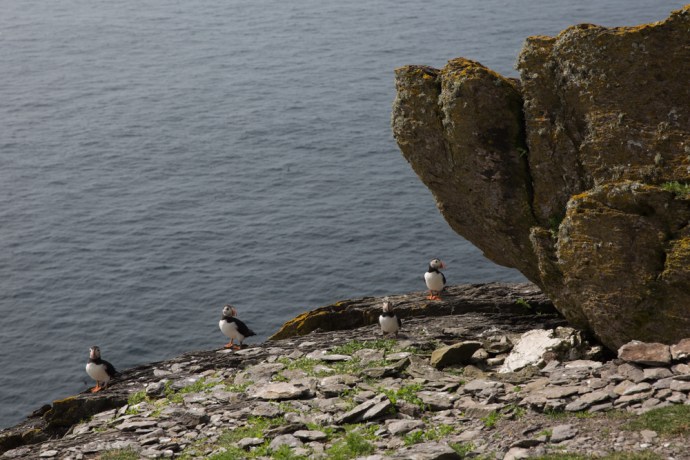
A small black and white bird, about 30 cm in length, a member of the Auk family which includes guillemots, razorbills and auks themselves. But the puffin fascinates because evolution has dealt it so many attractive features. A very distinctive beak which from the side is broad and triangular and becomes brightly patterned in orange and yellow during the breeding season, orange webbed feet and eye ornaments to match. Their upright stance and waddling gait is endearing.

IG3C8952IG3C9023

IG3C8975

Defying gravity

IG3C9104IG3C9108IG3C9012

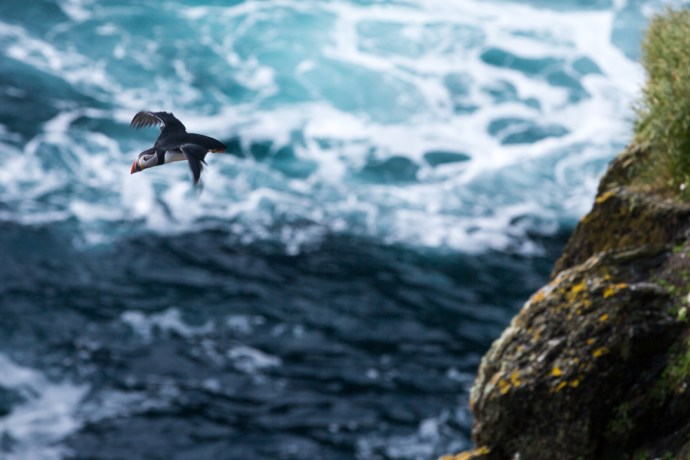
Their short wings seem to be more designed for moving in water than air and watching them in flight is hilarious. A running take off, madly flapping and you are sure they will crash into the cliff but a quick change of direction at the last minute saves them.  Landing is just as problematic and a crash landing is the rule.

IG3C8982

Taking flight

IG3C8984

Wheeeeee!

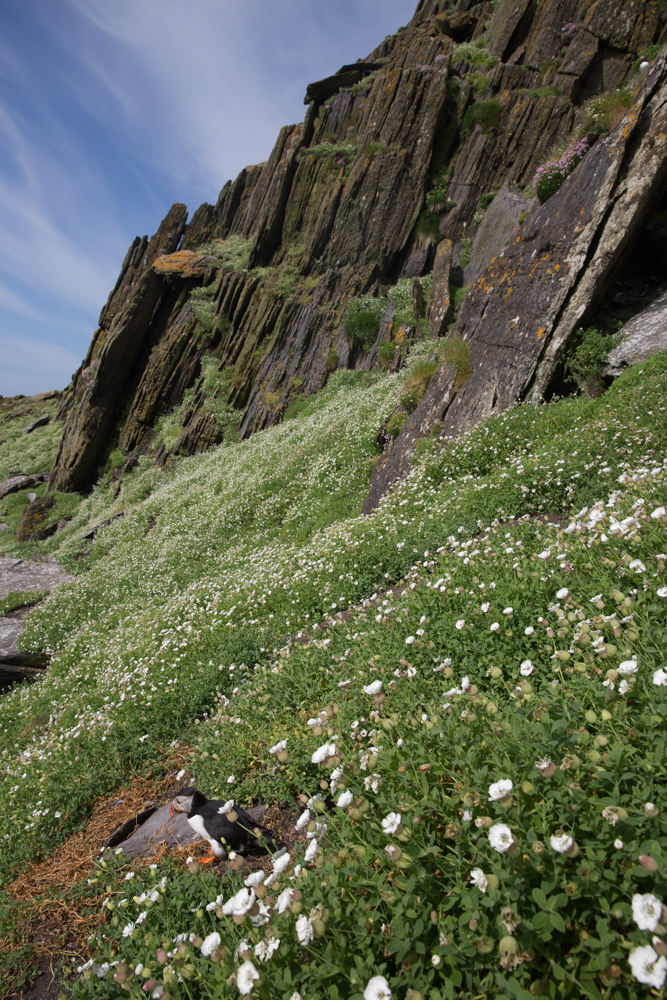
During the breeding season they live in burrows or in crevices and caves in the rocks and patrol during the day interacting with neighbours.  I could have watched them for hours.  Once the chicks (pufflings they are called) are hatched they head to the sea and don’t return to land for several years. They start breeding at about 5 years of age and then live til about 30.

IG3C9172

Perfect puffin territory

IG3C9179

Standing guard in front of a burrow

IG3C9122

Or nesting in a cave

I could ramble on about them for ever but there are plenty of sites that can tell you everything if you are interested in learning more so I would direct you there.

For the moment I will just let my pictures do the talking and use them to express my gratitude at having such a close encounter.

IG3C9060IG3C9335

Categories: My Journey, Real Ireland, Wild Ireland | Tags: , , , , , , , , , , , , , , | 8 Comments

Skellig Michael. Forget ‘Star Wars’. It’s more like ‘Close Encounters of the Bird Kind’.

Finally I got onto Skellig Michael after three tries over two years. The island is 12 km off the Kerry coast and to get there you need quite a bit of persistence and a lot of luck. Fortunately the monks were smiling on an unseasonably warm day in early June. In fact we were in the third week of a sunny spell like no one could remember. Day after day over 20 degrees.

I really was excited as 12 of us boarded the first ferry of the day out of Portmagee, one of 15 that have permits, Twelve of the lucky 12,000 a year to visit.  Leaving the calm, blue harbour of pretty Portmagee, its painted cottages reflected as if by a mirror, we headed towards the mystical island.

IG3C8568

Leaving the harbour at Portmagee

IG3C8565

The village of Portmagee.  Reflective calm

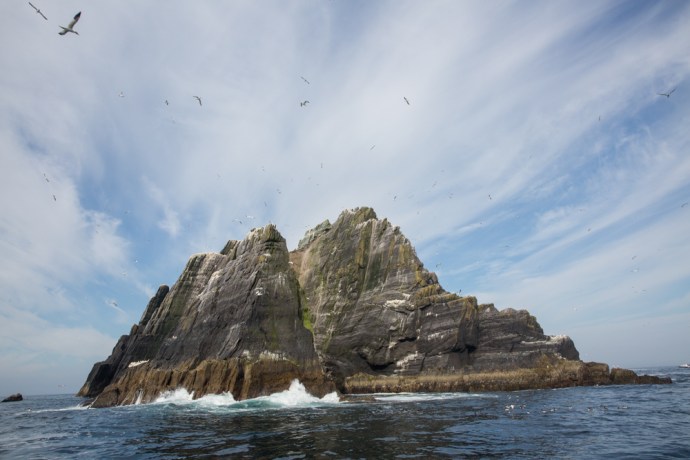
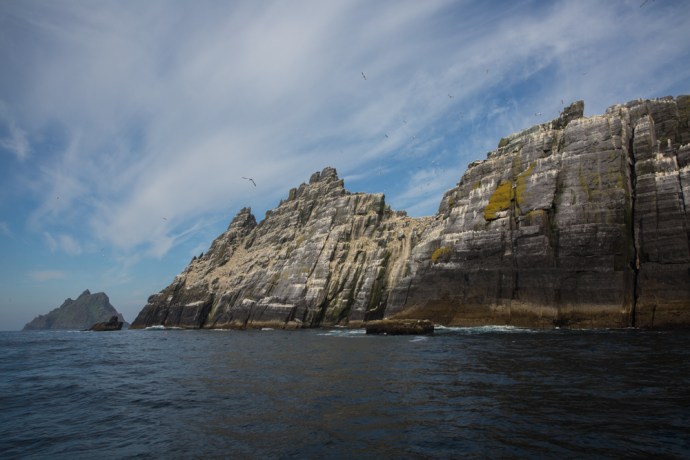
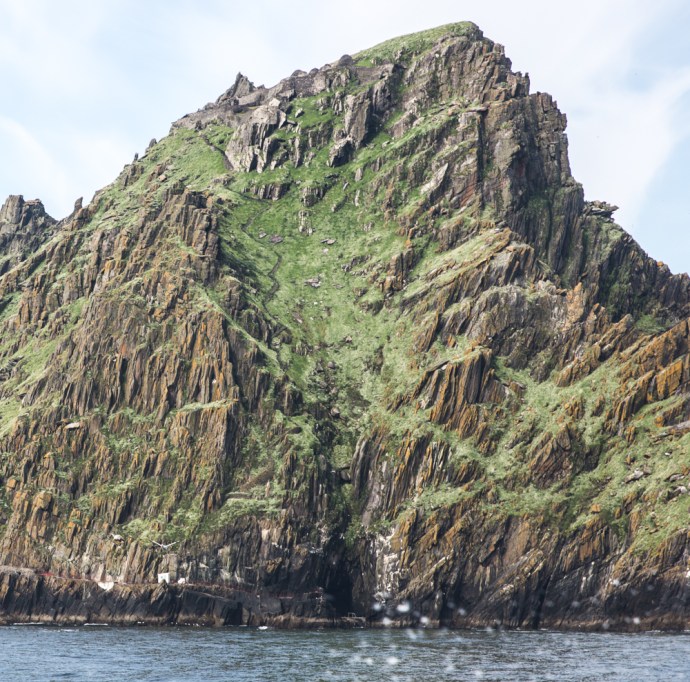
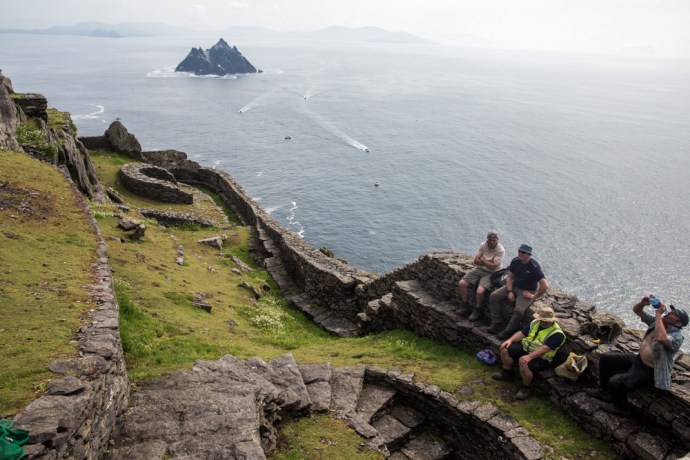
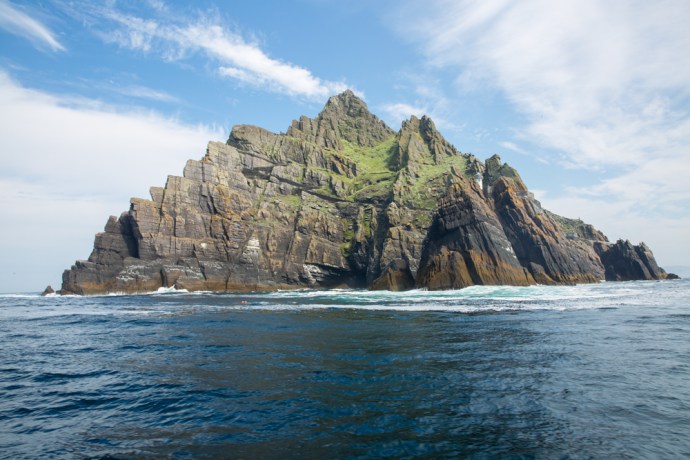
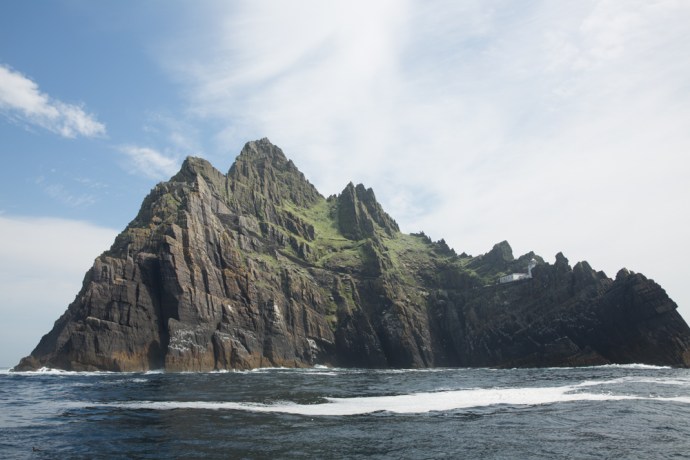
But first we sailed past the nearby Little Skellig, Skellig Michael’s twin rock. George Bernard Shaw said of Skelllig Michael following a visit in 1910, it was the most fantastic and impossible rock in the world”.  Like its big brother, Little Skellig is if anything more jagged and more precipitous and more impossible. As we sailed around the island constantly changing our view different faces were revealed.

IG3C8828

Little Skellig I

IG3C8833

Little Skellig II

IG3C8811

Little Skellig III.

These islands defy geological truth. The Devonian sandstone protrusions shouldn’t be there. It is easy to see how the ancients would have believed they got there by the hand of God. Jagged needles of stone, rocky barbs, thrown into the sea by an angry deity.  Piled one on the other. I can see little vegetative life. Useful to no man.

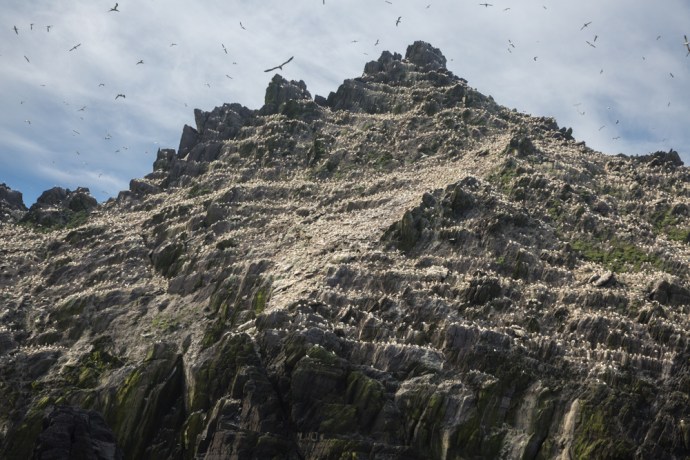
But useful to birds they are.  Little Skellig is painted white with birds and their droppings. Gannets, gannets and gannets.  Some say 50,000 of them. I can’t not think though of Monty Python and the Bookshop Sketch.  ‘Do you have Olsen’s Standard Book of British Birds? The Expurgated version. The one without the gannet.’

IG3C8720

Gannets on Little Skellig

IG3C8793

Did I mention gannets?

IG3C8785

Natural arch at the northern end of Little Skellig

This is the second largest such colony in the world. There doesn’t seem to be room for anything else as every rock ledge is crowded. A majestic sea bird, second in size only to the albatross, the sky is filled with their gliding forms as some soar effortlessly around our boat.

IG3C8777

Every surface is occupied by a gannet

IG3C8728

A gannet glides past our boat

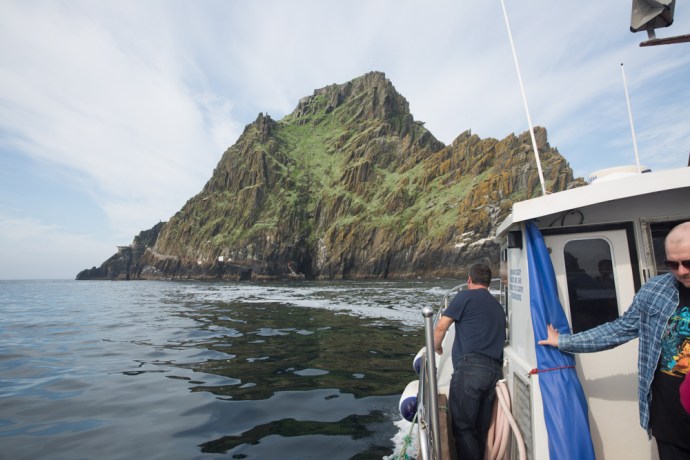
We head to the Big Skellig.  In much more comfort I should say than the monks who arrived in their curraghs in the 7th Century, or even George Bernard Shaw who in 1904 was rowed by 10 oarsmen who took 2½ hours for the trip. As the island loomed, its jagged peaks towering over us,  to me it seemed softer than the never-occupied Little. There were patches of seductive vivid green on its slopes.

IG3C8846

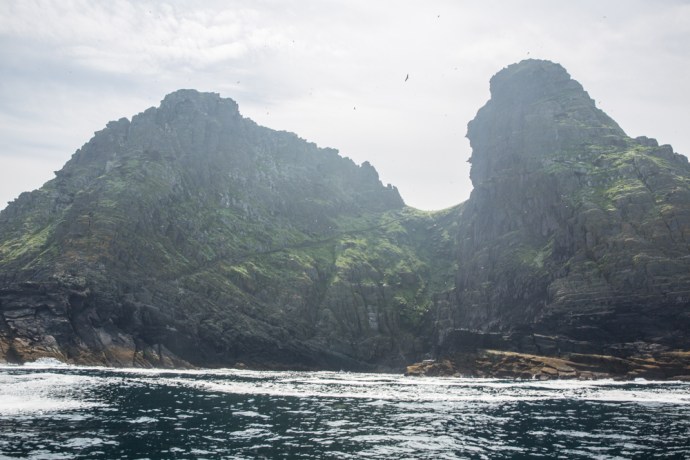
As we head to the south Skellig Michael is revealed

IG3C8873

Looking back northwards towards Little Skellig

IG3C8919

Skellig Michael looms.  Approaching from the north

We tied up temporarily against a set of concrete steps and you had to time your leap with the rising and sinking of the boat. They warned us about the steps to the monastery but no mention of this.  It would be impossible to land in any kind of swell. I have heard stories of visitors getting to the island but not being able to disembark.

This was not the first place the monks landed but one of three used over the centuries and the only one used today.  This choice  historically provided the opportunity to get ashore regardless of wind direction.  Above us winds a set of steps of stone heading straight up the mountain. This path is not now used.

IG3C8907

Steps rise to the monastery from the north landing place.  Currently not used.

Instead we follow a path that snakes south, clinging to the cliff edge past nesting sea birds on sheer cliffs to the start of another set of steps that is the current route up.

IG3C9392

The access road along the eastern face of the island.  The main steps to the monastery rise up the saddle between the two peaks.

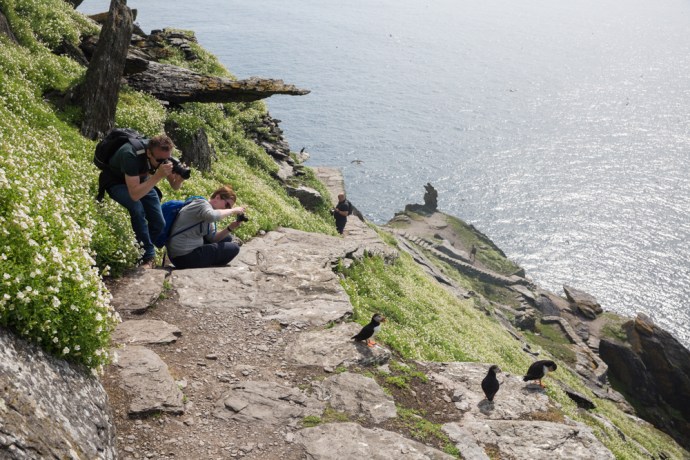
But then I see my first puffin and then another and then they are everywhere. These cute and protected birds are the stuff of legend and a reason alone to ensure your visit is in late Spring or early Summer. We all of us turn into expert wildlife photographers producing copy fit for National Geographic. It is impossible not to take a great photo.

IG3C9026

My first sighting of puffins

IG3C9104

Poser.

IG3C9154

Close Encounters of the Bird Kind.

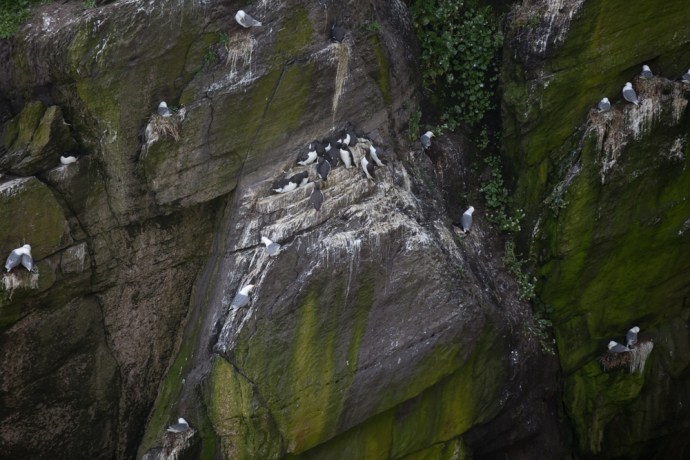
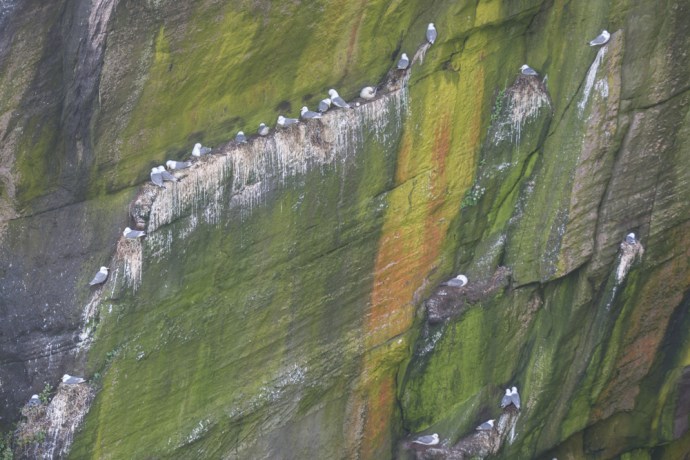
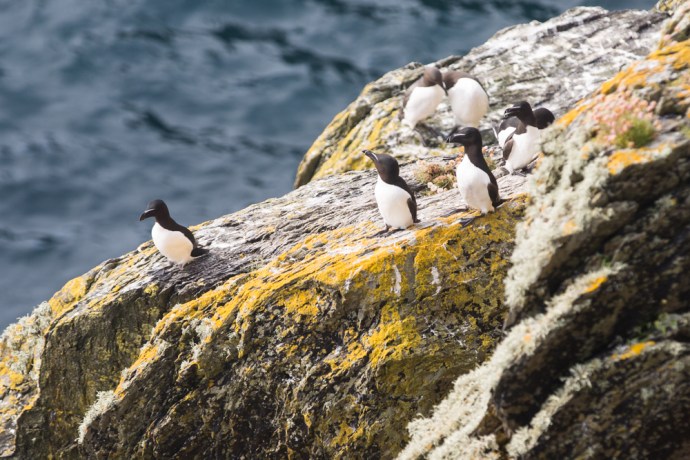
But I am going to pass on the puffins for the moment. I will have more to say about them in another place. It’s not just puffins though. They share the rocks and crevices with many others. Guillemots clustered together with a similar upright stance on the narrowest of ledges, looking for all the world like penguins. Kittiwakes with specially designed claws that enable them to cling on to their precarious piece of rock. Razorbills with their distinctive white streaks to the eyes. Gulls, terns and others such as shearwaters that I didn’t see. An aquatic avian paradise.

IG3C9032

Guillemots and kittiwakes nesting on the cliff

IG3C9038

Kittiwakes grab their spot wherever they can

IG3C8979

Razorbills

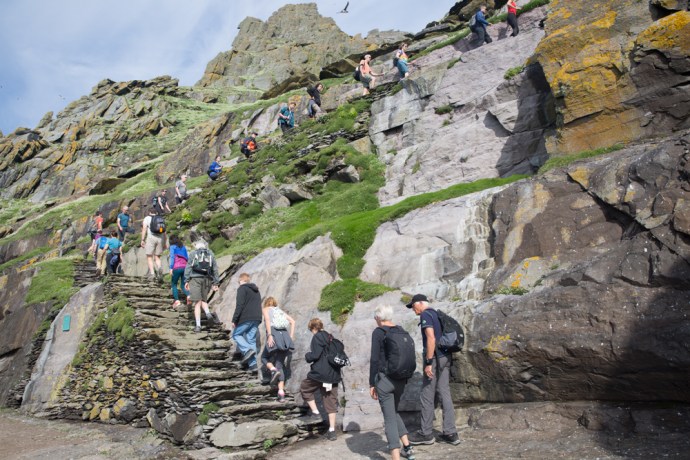
The main purpose of any visit to this place though is to see the monastery. Not tackling the 611 steps to the stone structures atop the northern peak would be like visiting the Guinness factory and not having a pint. The journey up is spectacular but so is the reward.

IG3C9054

Visitors start the climb

IG3C9065

In the footsteps of the monks

IG3C9182

The final leg heads up from Christ’s Saddle, the area between the two peaks

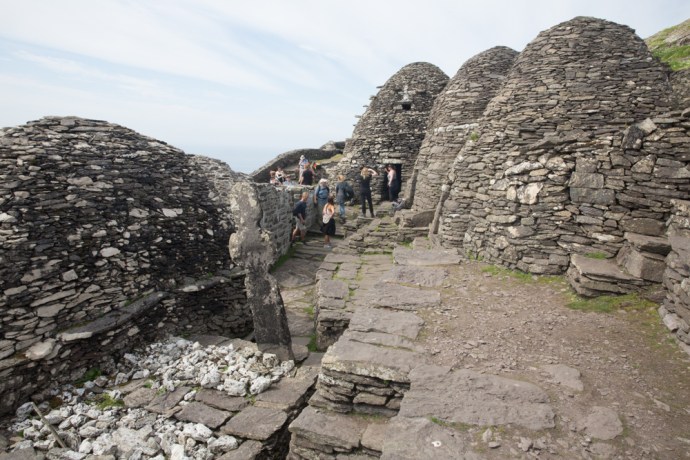
It is considered the best example of an early monastery in Ireland and is of world significance. Developed between the sixth and eighth centuries it is truly remarkable for its preservation.  A series of terraces contains six ‘clochán’-type beehive cells, two oratories, stone crosses, slabs and a later medieval church.   The cells and oratories are all of dry-built corbel construction. This unique method of overlapping stones giving an igloo shape to the outer wall but more regularly rectangular inside is very efficient at keeping out wind and water and have been doing so for 1,500 years.  Other terraces housed gardens. Vegetables were believed to have been grown but their main source of food was fish, birds and eggs. The monks led a simple life of foraging and prayer and sought out remote places such as this, as the hardship and sacrifice proved their devotion, until the island was abandoned in the 12th or 13th century.

IG3C9221

IG3C9289

Rich archaeological heritage including beehive huts and a high cross

IG3C9245

Inside a beehive hut

IG3C9259

View through the window of the church

While regaining our breath, one of the OPW guides Catherine, who has been doing this for 18 years gave us the benefit of her wisdom. And cheerfully took my photo as I and countless others posed for the de rigeur ‘selfie’ shot with Little Skellig in the background. Funny how small Ireland is.  I had met Catherine at a music festival, two years ago.

IG3C9286

Proof I was there

For some monks sharing this isolation with other monks was still not enough. On the higher south peak there is an hermitage, where a monk is believed to have led a solitary life. You can’t reach it now but just getting there involve huge risk and athleticism, No steps in places just toe holds cut into the rock face. And squeezing through the notorious Eye of the Needle. In the accompanying photo you can just see the terraces across the valley near the very top of the South Peak.

IG3C9201

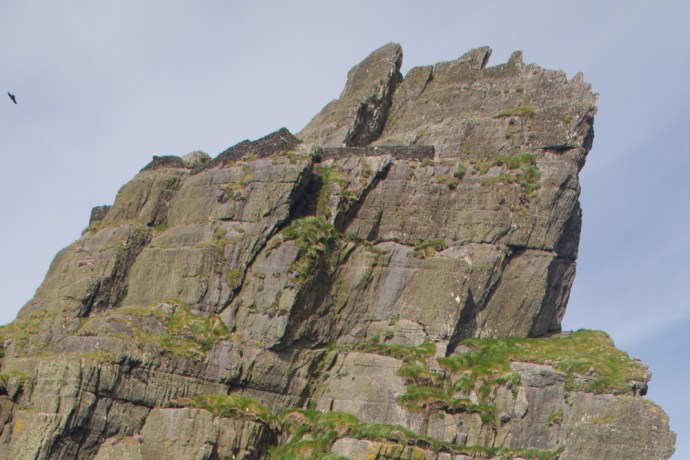
The South Peak.  You can just see the stone walls of the Hermitage near the peak.

IG3C9200

A close up of the terraces at the Hermitage site.

I can but wonder at the devotion and sacrifice of these people. Their zeal to be closer to God seemed almost to have given them super powers.

Our time at the top though was all too short. Conscious all the time of getting back to the boat I returned down the mountain gingerly negotiating the steps to the bottom. Just a little quicker I have to say than the way up. I surprised myself actually at how doable the climb was and though I saw many struggling I saw no one give up.

IG3C9400

The southern shore of the island.  One lighthouse is visible on the right

IG3C9407

view of the south peak and the road to the second lighthouse

IG3C9452

The main landing spot for the monks with the ancient steps up the valley

You can’t get everywhere on the island though.  The road to the lighthouses (there are two of them) is closed and they can only be seen from the ocean.  In fact on the way home our helpful skipper from Casey’s took us around the southern shore where aside from the lighthouse you can see the other landing points I mentioned.

I met Christina, a fellow Aussie, who was lucky enough to get onto the boat during her short visit to Ireland.  It was impossible not to be infected by simply being on this ‘impossible rock’.  The joy on her face was real as it was on the faces of the others that were privileged enough to get there on such a warm sunny day.

This will be a lifelong treasured memory for us all.

IG3C9345

IG3C9476


Categories: My Journey, Real Ireland, Wild Ireland | Tags: , , , , , , , , , , , , , , , , , , , , , , , | 6 Comments

Blog at WordPress.com.