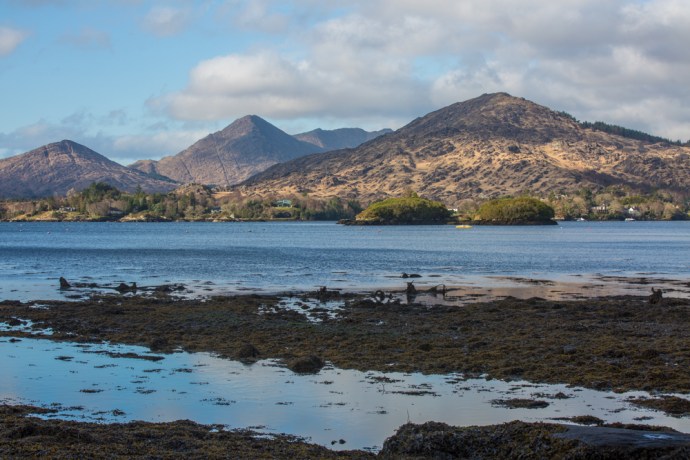
My Journey

Oh no! Not more pictures of the Cliffs of Moher.

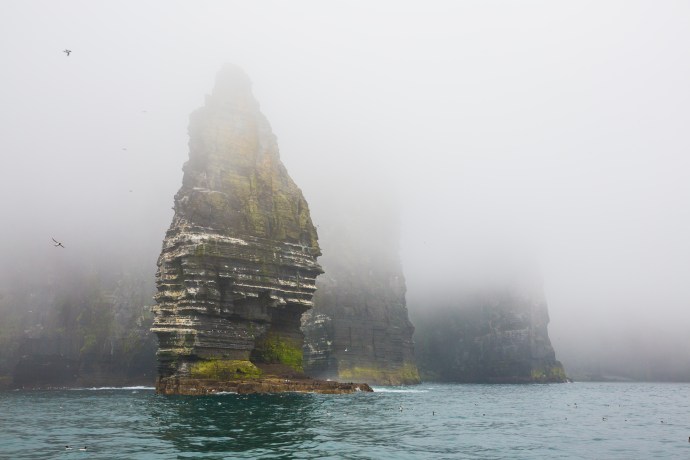
With all this fabulous weather in West Clare recently I decided to take the cruise from Doolin to visit the cliffs. I’ve been to the Cliffs of Moher many times but never before have I seen them from the water.  I checked the forecast. Fine for the next couple of days.  Brilliant.  So I booked the late boat for the following day as I dreamed of perfect photos lit by the late evening glow.

The morning dawns and I open the window to the bay at Caherush shrouded in thick fog. I wasn’t worried and smugly congratulated myself at my foresight in booking the late boat. The fog will lift of course by midday and there will be blue skies. My optimism was rewarded as it did lift and by mid afternoon some blue sky appeared. A perfect plan?

So I drive the 40 minutes to Doolin.  Around Lahinch the fog starts to roll back in, getting heavier as I drive across the bog and down the hill to Doolin until by the time I reach the Pier visibility is just a few tens of metres. My heart sunk.  Visions returned of a trip to Jungfrau in the Swiss Alps many years ago.  Up the cog railway in a total wipeout.  I saw nothing of the roof of the world.

We set off nevertheless with, in my case, no real expectation.  So much for all those dramatic photos I was going to take of walls of rock framed by skies of blue.

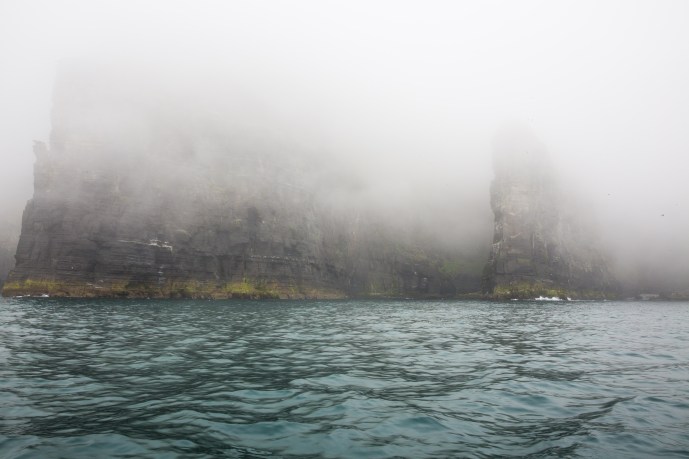
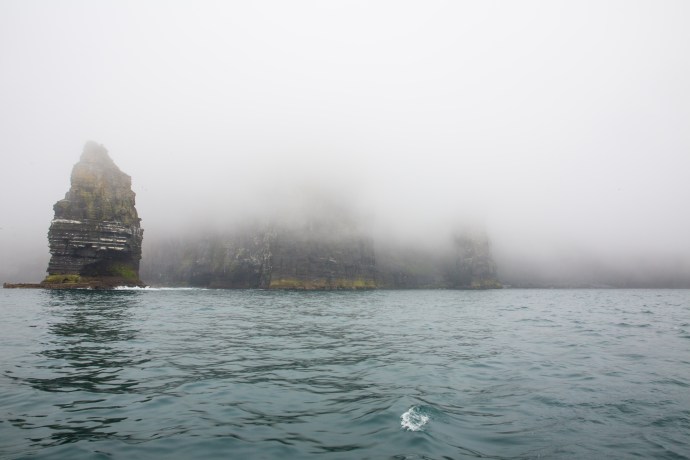
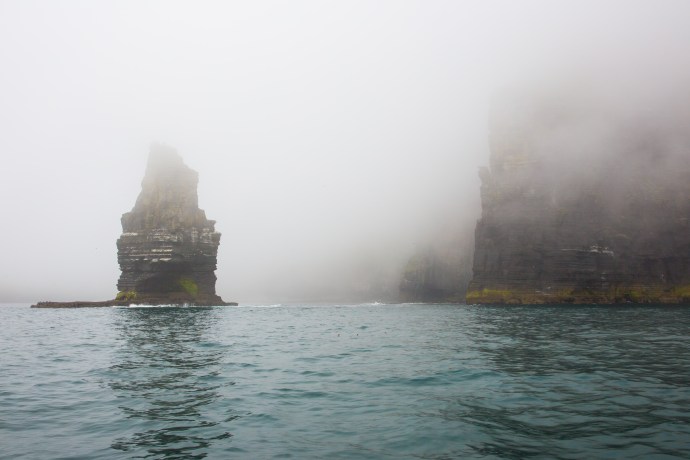
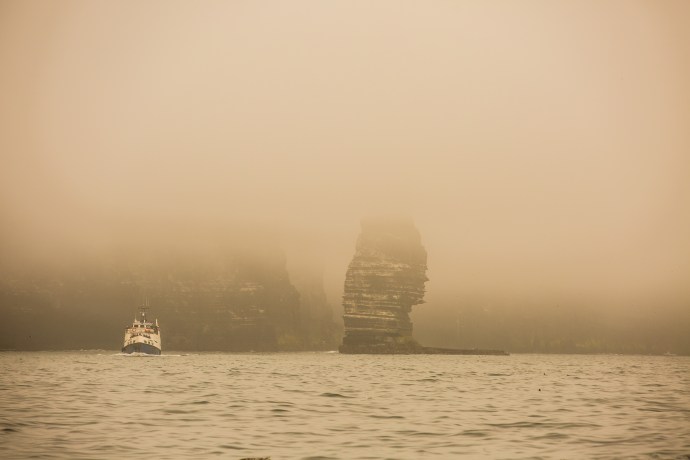
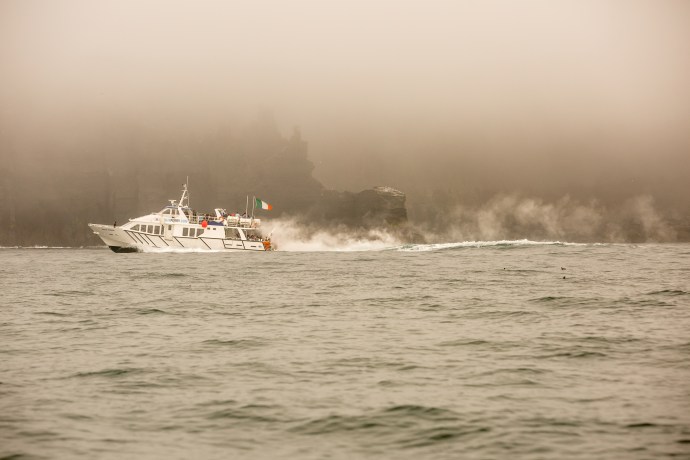
But for fleeting moments as we approached closer the fog would shift and you would get glimpses of green through the grey.  You got a real sense of the powerful presence of these cliffs though you never saw them in their totality and could only imagine how high they actually were.  The changing  views were tantalising and somehow seductive.  As the boat rocked and shifted, the angles changed and I snapped away but with no real hope of capturing this feeling.

I’ve stopped looking for explanations of the Irish version of the way of the world.  An hour later the fog lifted. But never was the expression ‘go with the flow’ more apposite. Taking advantage of the extended daylight in June I spent the remaining hours exploring the rocky coast north of Doolin, in total thrall of the wonderful rock garden that is the Burren in spring.  I forgot about the the Cliffs.

But when I got home that evening (early next morning I should say, after tunes in Doolin and Ennistymon) and looked at the photos and I was surprised and happy at what I had captured.  I still have a lot to learn about photography but I think the images say just as much or perhaps more than if we were seeing every minute and vivid detail.  Sometimes showing just a little reveals a lot.

Turns out that fog was a lucky break.

IG3C6009

IG3C6032IG3C6135IG3C6154IG3C6049IG3C6012IG3C6182IG3C5917

Categories: My Journey, Wild Ireland | Tags: , , , , , , , , , , | Leave a comment

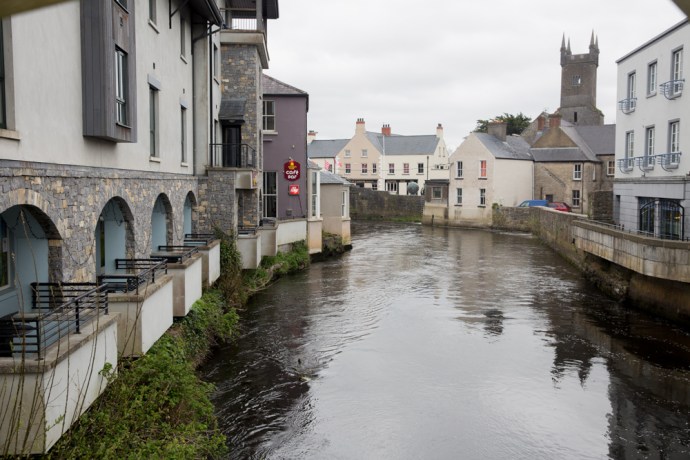
The Fergus. Ennis’ Forgotten River.

Many Irish towns are built on a river. This had obvious logistical, transport and strategic benefits and of course is not unique to Ireland.  Ennis’ name pays homage to this and derives from Inis Cluana Rámhfhada, an island formed by two forks of the river.  That river is the Fergus.  It rises west of Corofin and enters the Shannon Estuary after a journey of 60 km.

One dull April day, with spring making a late attempt to burst through, while I waited for my car brakes to be fixed yet again (one of the prices you pay for being shrouded in salt spray on the edge of Ireland), I decided to walk the Fergus River.  This proved to be more difficult than I thought.

IG3C1240

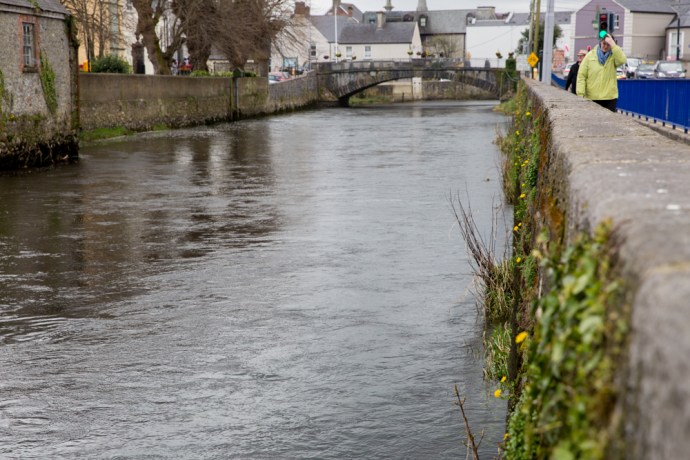
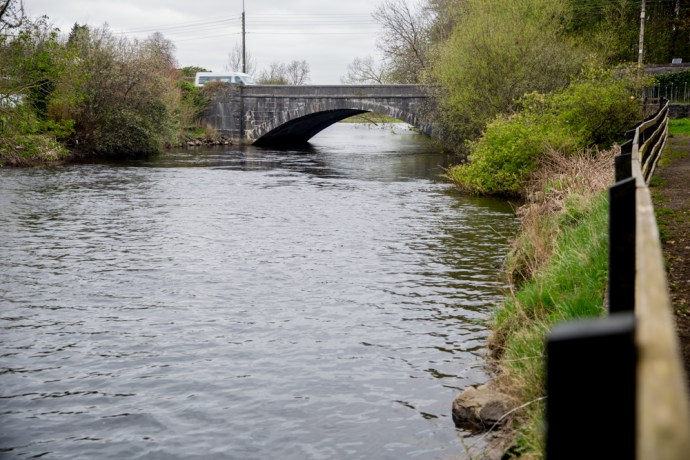
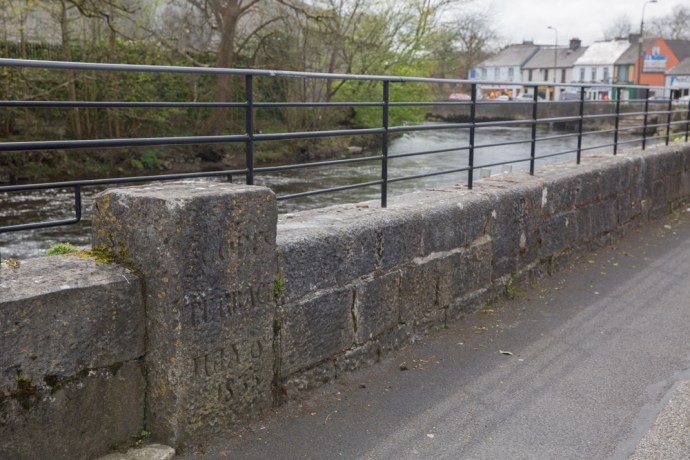
Fergus River looking south to the bridge at Abbey Street

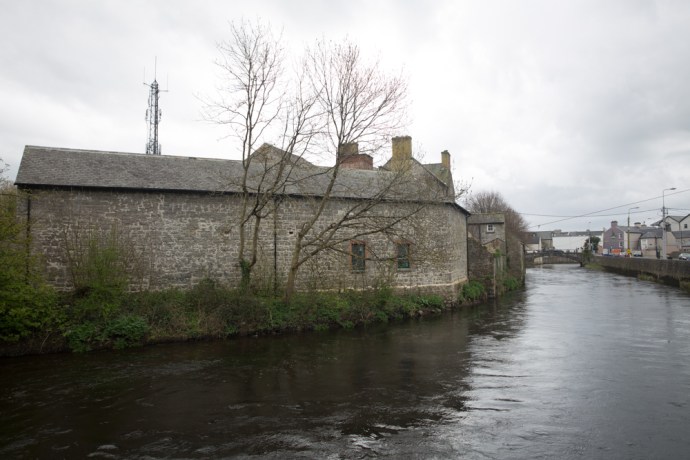
While the river twists its way through the town, for most of its length it is well hidden.  It struck me that maybe Ennis doesn’t regard it as something to utilise or promote,  just an obstacle to be crossed.  Indeed six bridges cross it and the layout of the town is very much controlled by the loops of the river.

IG3C1535

Bridge at Bank Place looking west.

IG3C1480

Footbridge over River Fergus

IG3C1372

Clon Bridge

IG3C1655

Victoria Bridge

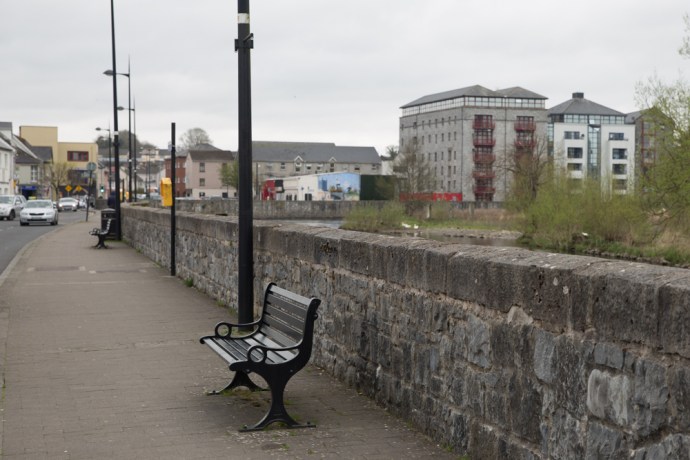
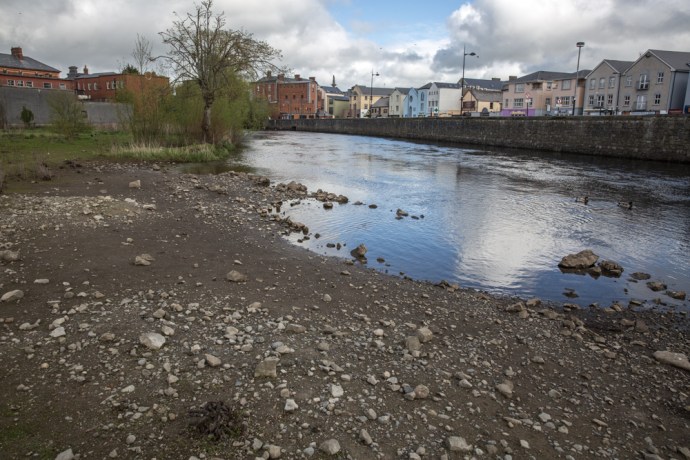
Where you can find it, the banks of the river either have a high stone wall that restricts view and access or are hideously overgrown and littered. Yes I know the river floods but surely space could be found for a park or a bit of open space where you can sit. And if there are seats they are facing the other way or you stare at a wall. You can’t even get to the river at the historic Steele;s Rock.

IG3C1255

Steele’s Rock on River Fergus

IG3C1311

Building on the banks

IG3C1317

River edge on New Street

IG3C1539

Riverside seating.  You need eyes in the back of your head.  Converted cornstores in the distance

In the town proper only very short bits of the river can be approached.  The one exception is the River Walk a part of which is a designated Sculpture Trail.  The walk runs from a car park near the town centre (unfortunately much of the river edge is used for car parking) to the Old Mill and then the short distance to Victoria Bridge. There is quite a bit of interest along the way in addition to the sculptures, including apartments converted from old cornstores, sluice gates and the remains of the Old Mill. But it’s all too short.

IG3C1560

Sculpture ‘Fishy Tale’ by Carmel Doherty on the Sculpture Trail

IG3C1605

Sluice Gates on Fergus.

IG3C1689

Sluice Gates.  Another view.

IG3C1588

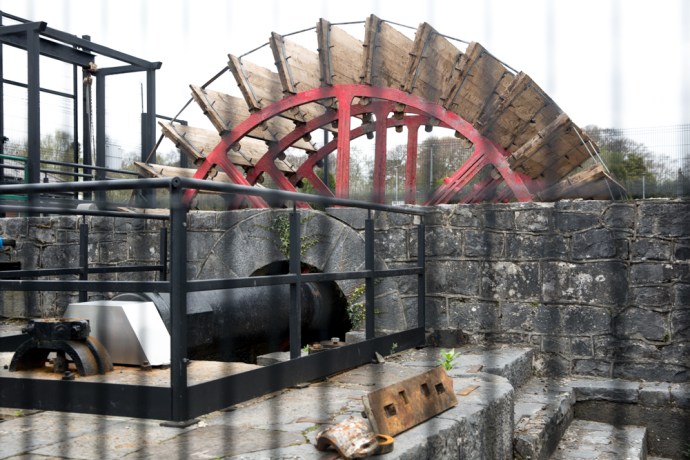
Remains of the Old Mill.

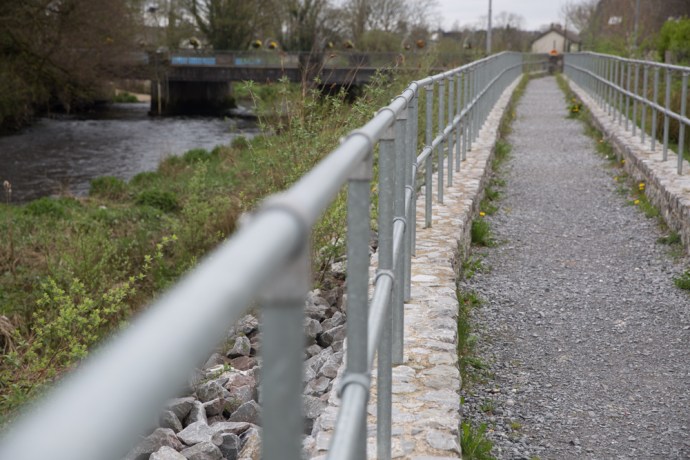
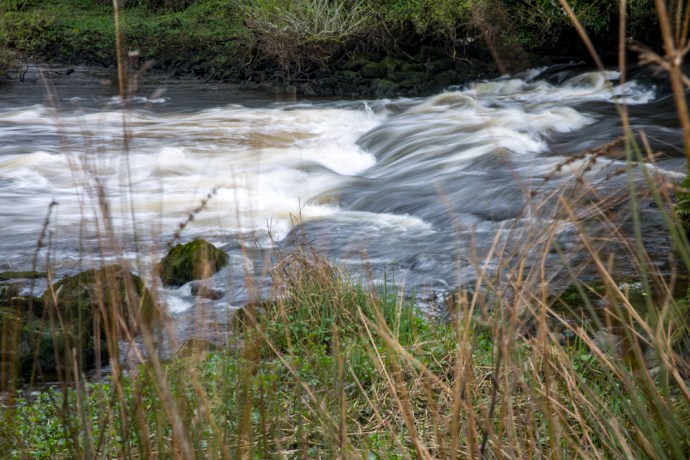
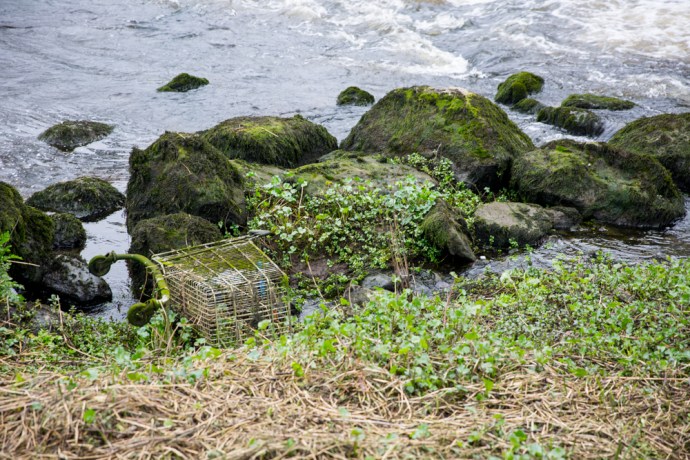
If you try and follow the river the other way (to the east), you soon lose access.  It is built up all the way to the Clon Bridge.  Beyond this a small walkway runs parallel to a set of rapids but the weed covered banks seem only useful as a repository for abandoned shopping trolleys.

IG3C1429

Walkway on the Fergus near Clon Bridge.

IG3C1420

Cascades on the Fergus near Clon Bridge.

IG3C1427

Weeds and lost trolleys

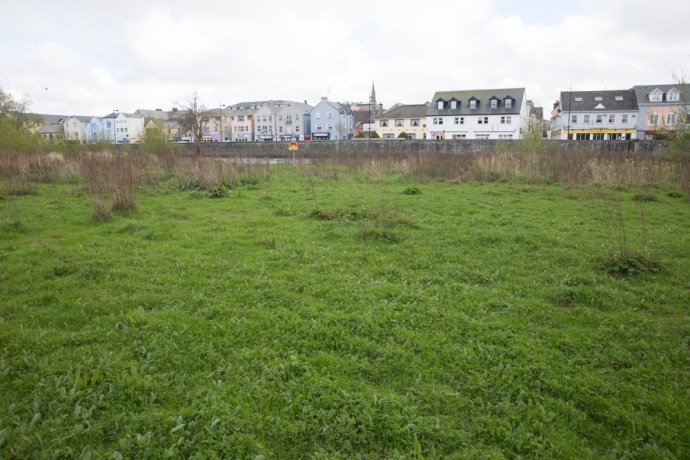
I couldn’t help but notice one large area of apparent wasteland between St Coulmba’s Church and the river. There is direct river frontage,  and the geese and ducks seem to be the only inhabitants this time of the year. This would make a perfect Riverside Park. I asked a young traveler lad I met along the path why it wasn’t. “Too boggy” he said dismissively.  Maybe; but if there was a will I’m sure it could be overcome.

Unfortunately I found only one spot in Ennis, near Clon Bridge,  which you could loosely call a park and even it was walled off and paved with gravel.   Anyway just saying. It’s what this town needs.

IG3C1543

Suitable for a Riverside Park?

IG3C2601

A wide area of open land

IG3C2568

with direct access to the river… paddle boats?

IG3C2541

and with a beautiful backdrop


IG3C1437

Open space on the river edge near Clon Bridge.

Lastly there is hardly anywhere to eat or enjoy a coffee on the river bank except The Rowan Tree which is a wonderful exception and maybe O’Briens Cafe.  But again there is a wall. I hear it everywhere though.  ‘Ah, yes but what about the weather?’  but, hey, when the sun shines where do you go?

C’mon Ennis.  Embrace your river.

IG3C1487

The Rowan Tree Cafe.  Riverside dining.


Categories: My Journey, Real Ireland | Tags: , , , , , , , , , , , , , , , , | Leave a comment

Scattery Island, Co Clare. An Irish Time Capsule.

At the southern end of West Clare, on an island just off the coast near the town of Kilrush, lies one of country’s best kept secrets.  But that’s changing. The word is out. Last year it was awarded a prestigious European Destination of Excellence award for Ireland for offering a ‘tangible cultural experience’ and visitor numbers are dramatically increasing.  In 2016 870 people visited the island.  This year they are expecting up to 6,000 people.

Before 2016 visiting the island was unpredictable.  If there was enough interest then a boat trip was organised.  That changed with the setting up of Scattery Island Tours two years ago.   They have just commissioned a spanking new ferry that comfortably accommodates 70 against the old one, which took 12, and this is certainly helping  but don’t let that put you off.  I spoke to Irene Hamilton, one of the principals of the company, about the her desire to open the island to a larger audience and at the same time preserve what it is that makes it special.  The island has so much to offer and you can tailor the experience to your own needs.  Join a guided tour and have the stories of the island explained or explore on your own.

Irene comes from a line of island residents.  Her father was born on the island and was a sea pilot as was his father.  This link and the remarkable foresight of the people of Kilrush has put the Company at the forefront of placing Scattery  as one of the must-see destinations of Clare.  Her vision is that visitors don’t just zip past on the way to Loop Head but stop overnight in Kilrush and explore the place at leisure.

So why is it special?  There’s actually nothing else like it.  A now uninhabited island with a continuous occupation that started over 1,500 years ago, beautifully preserved, easily accessed and in a spectacular location.

I had been trying on and off for a while to get onto the island but it just never happened. During an unusual warm spell in late May I tried again. The Gods were smiling this time and on a bright blue Thursday I boarded the An Breandàn for the short trip across the channel from Kilrush.  Irene told me that the boat was named for her father and it is no coincidence that Breandàn is also the patron saint of the sea.

IG3C6864

Boarding the ferry to Scattery

Actually the most time consuming part of the journey was in the lock at the entrance to the Marina. It was fascinating to see the water rush in as the gates opened to maintain the level in the Marina

IG3C7484

Water enters the lock

IG3C6919

Irene Hamilton, owner of the ferry company chats to patrons.

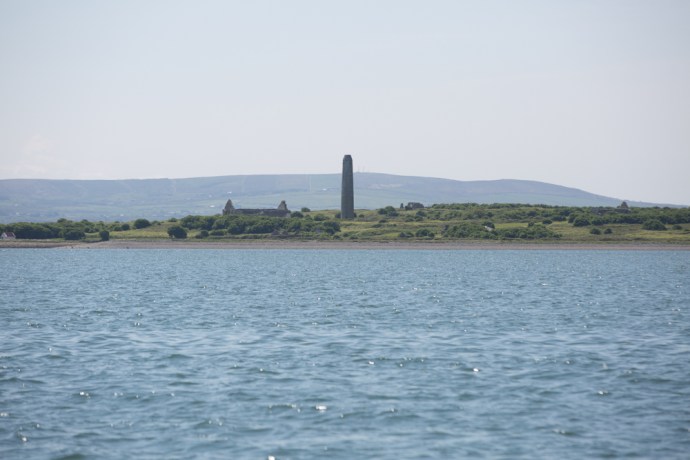
Once through the lock you see the island and its signature Round Tower rapidly approach you and in less than 15 minutes you are there. We were well looked after by  the efficient and friendly crew which included Irene’s sister Martina.  Irene was a mavellous host spending much of the time, when she wasn’t performing seafaring duties, chatting with patrons and and answering questions or helping with family photos or making cups of tea.
IG3C6922

Approaching the island.  The Round Tower dominates.

IG3C6968

The view from the pier,   The white cottage on the left is the Visitor Centre, Keane’s Castle is in the centre and the Round Tower can be seen in the distance.

When we arrived we were handed over to  Michael who acted as our guide. The guides are provided by OPW who manage the island.  They also maintain a small visitor centre.  The tour is roughly an hour and you visit all the monastic and archaeological sites with the exception of the lighthouse and the Battery.  This was certainly worth it as Michael has a wealth of background knowledge that fleshed out the story.   Next time however I will explore it on my own but I would certainly recommend the tour as a first time experience.  And anyway it’s included in the price of the ticket.

IG3C7004

The guided tour begins

The story of Scattery starts with the birth of St Senan, in 488AD in Molougha, a townland about 5 km from Kilrush in Co Clare. After a life of religious study including time in Rome he set up a monastery on Inis Cathaig in 532AD.  This is the original Irish name and over time it became anglicised as Scattery.  The name relates to the presence of a monster known as the  “The Cathach” which was said to inhabit the island.  On Senan’s arrival he apparently faced the monster and ordered it, in the name of the Trinity, to depart. Such was Senan’s power that The Cathach obeyed and retreated to Doolough Lake at the foot of Mount Callan.

Little is known of Senan’s life or life under him in the monastery.  Many miracles are attributed to him however and his grave has continued to hold a sacred place among the people of West Clare and beyond. The grave is supposed to be the site of miraculous cures.  Stones from St. Senan’s Bed were regarded as relics and a protection against diseases and especially drowning.  Water from St Senan’s Well had restorative powers.

We do know his rule on the monastery was austere and women were banned from even setting foot on the island.  St Senan died in 544, but it would appear that the monastery continued unimpeded until the arrival of the Vikings in Ireland in 795.  Scattery which lay on their route to Limerick was sacked between 816 and 835, being severely damaged. In 968 the Vikings were expelled from Limerick by Brian Boru and retreated to Scattery. Boru however pursued them and three years later the island was raided with up to 800 people being slaughtered.

In 1057 the Vikings had another go with the Dublin Danes plundering the island. Then again in 1101 Magnus, king of Norway attacked. The Normans arrived in 1176 and this led to an attack by William Howell, not even sparing the churches.  By 1189 the last Bishop of Scattery had died and the Diocese of Scattery was abolished. The English  now took possession of the island.  The end came however following the 1537 introduction of  the Suppression of the Monastries Act by Henry VIII.

Phew! That is some story.  It seems to have been touched by every major historical event that Ireland experienced.  There are many reminders of this tortured time in the ruins that can be seen on Scattery.  Churches that date back as far as the 8th century, the round tower built between 10th and 12th century,  St Senan’s well,  St Senan’s Bed.  I found this all totally absorbing.  Come with me on a virtual tour.

IG3C7082

St Mary’s Cathedral and Oratory.  Built in 8th Century and added to until the 15th century. The Round Tower in the distance.

IG3C7085

The eastern window of the Cathedral.  The carved stone head is said to be St Senan.

IG3C7104

View of the Cathedral from the west.

IG3C7165

Western doorway of the cathedral.  Note the tapered shape of the door under the heavy lintel.  The stone to the left is thought to be a balaun stone.
IG3C7217

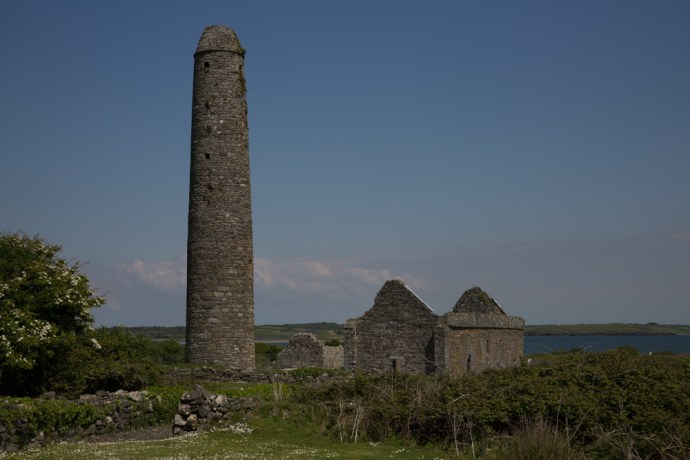
A distant view of the Round Tower and the Cathedral.
IG3C7096

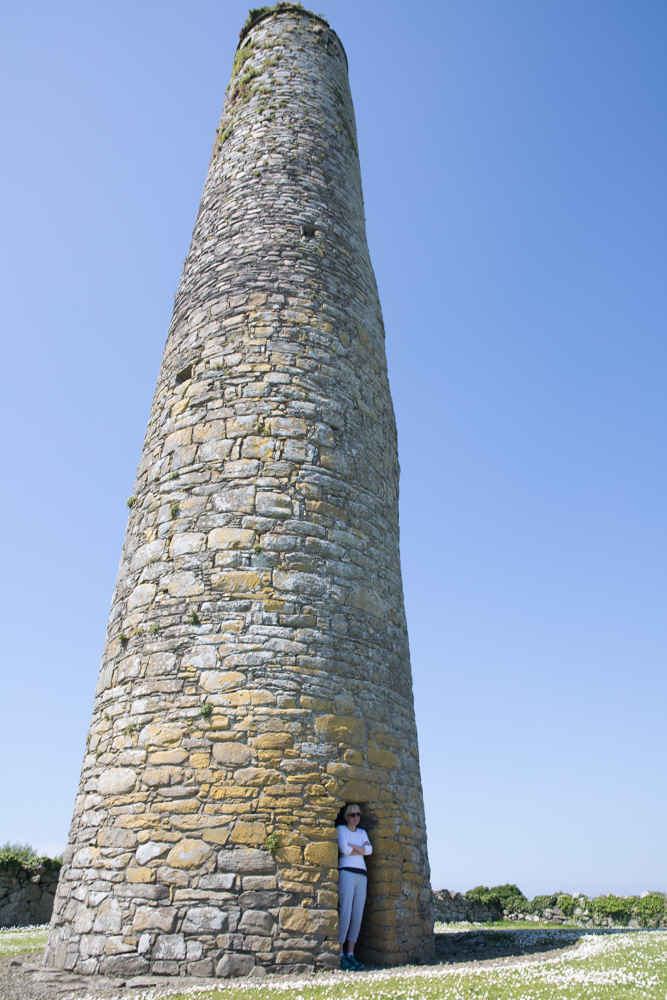
The Round Tower built between 8th and 10th Century. Note the unique doorway at ground level
IG3C7141

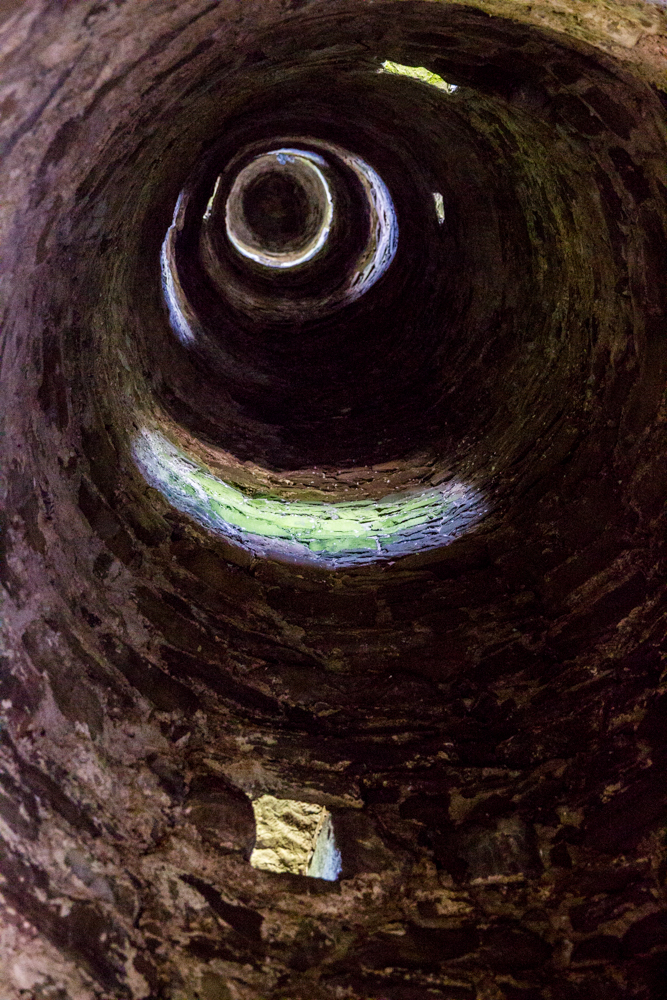
View from inside the Round Tower

IG3C7146

The Round Tower doorway.  Note the thick walls; over 1 metre.

IG3C7237

St Senan’s Well. During a drought St Senan prayed for water and an angel guided him to this spot.  The Sanit plunged his staff into the ground and water sprung forth.  


IG3C7166

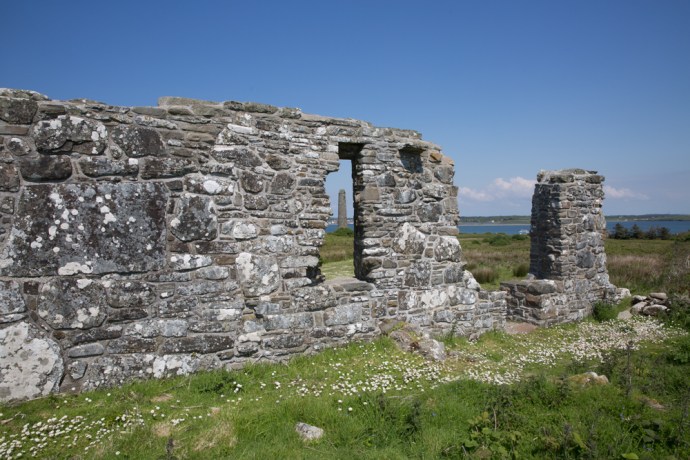
Distant view of Cnoc an Aingeal (Hill of the Angel), One of the earliest surviving churches built on the site where Senan set foot on the island.
 

IG3C7188

Remaining early wall of the church on Cnoc an Aingeal.
IG3C7257

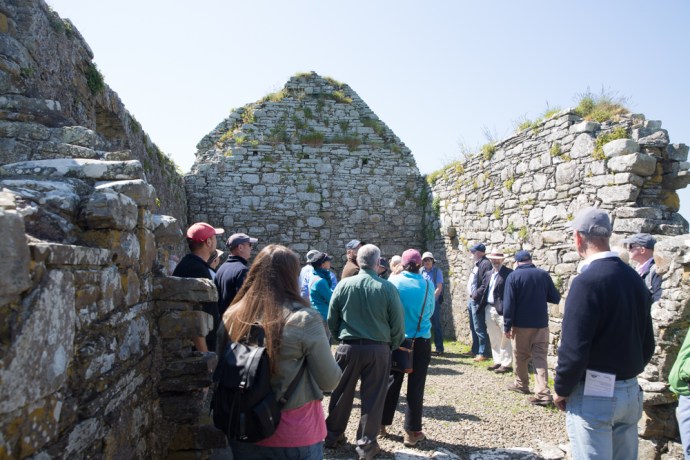
St Senan’s Church.  12th Century Romanesque style
IG3C7292

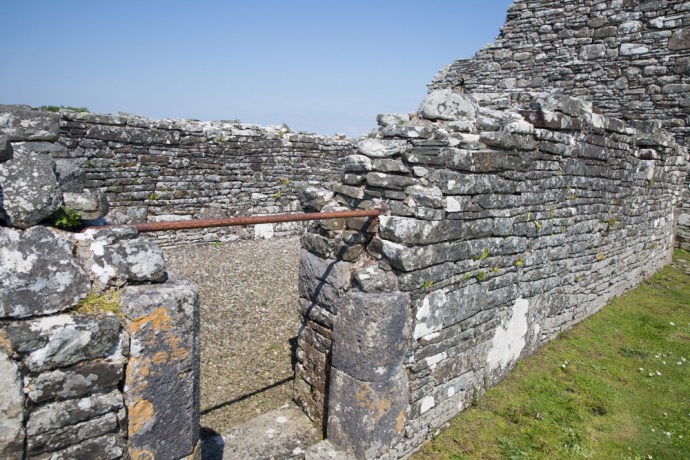
St Senan’s Bed, a small church built over the grave of St Senan.  The iron bar is supposedly designed to keep women from walking in.  Women who entered according to tradition will be cursed
IG3C7262

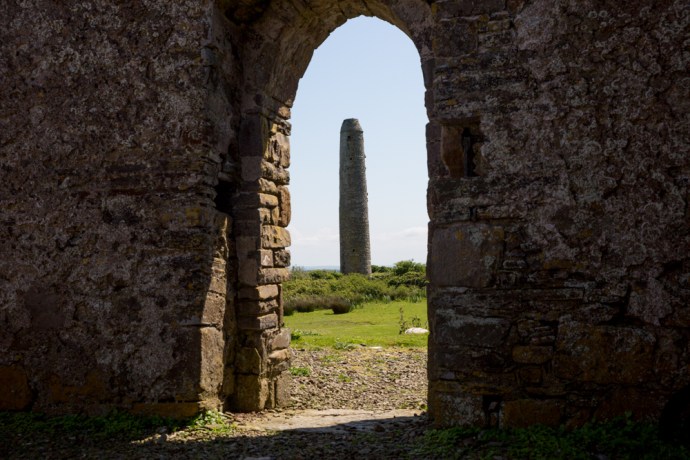
View of the Round Tower from the entrance to St Senans Church
IG3C7280

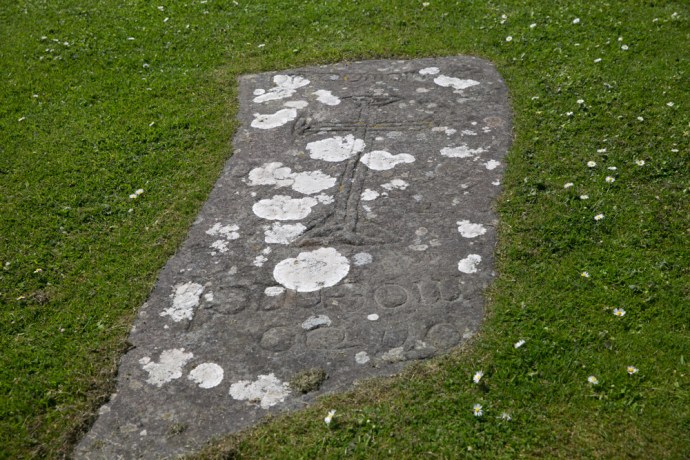
A stone table found near St Senans Church.  Thought to be a medieval grave slab carved with a beautiful celtic cross and with an inscription saying Or Do Moenach Aite Mogroin. (Pray to Moenach the teacher of Mogroin).

IG3C6999

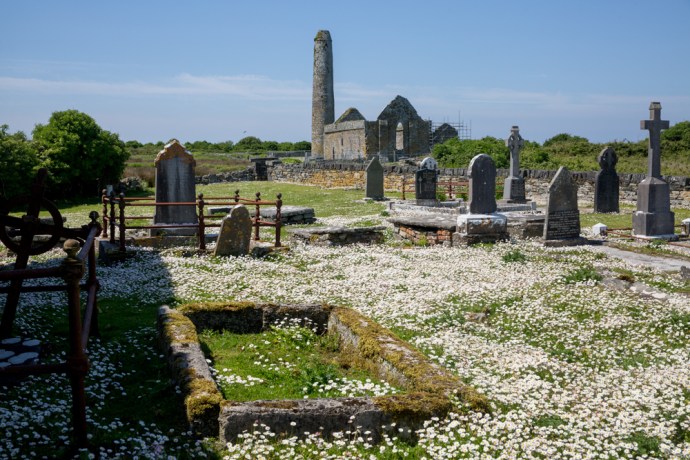
Teampall Na Marbh (Church of the Dead). Built 14th and 15th Century.
IG3C7037

View across the graveyard of the Church of the Dead towards Cathedral and Tower

IG3C7032

Modern graves at the Church of the Dead

IG3C7449

The graveyard at the Church of the Dead continues to be used for burials.

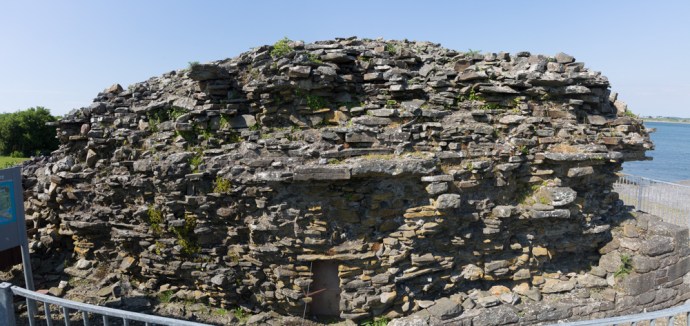
But the island’s story did not end with Henry.  Its strategic position meant it was always in the centre of events.  The ruins of Keane’s Castle, a tower house constructed in the late 1500s can be seen at the pier.  The driver at this time was the invasion by the Spanish Armada and the Irish Rebellions which threatened English rule. Remains of gun installations are evident.
IG3C7477-Pano

The ruins of Keane’s Castle, a Tower House built in the late 1500s

The next phase of activity on Scattery though did not begin until the end of the 18th century. The French supported the Irish Rebellion in 1798 and in 1814 the impressive Artillery Battery was built by the English as part of the extensive defenses erected on the west coast of Ireland. Unfortunately I did not get to visit this time.  Or the lighthouse which was built later in the 19th Century.
IG3C7176

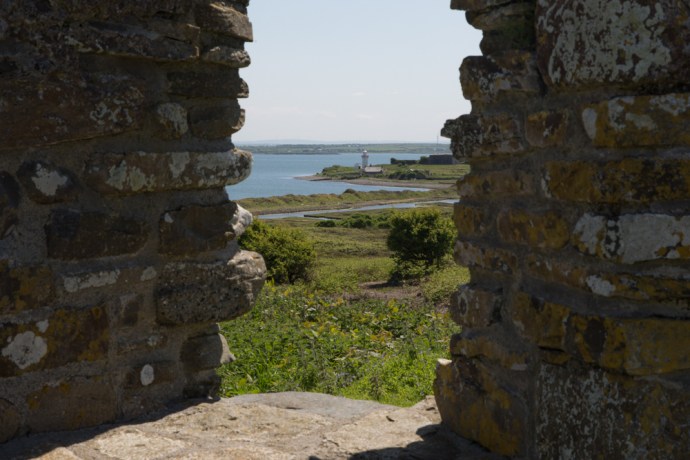
View of the lighthouse and Arillery Battery from Cnoc an Aingeal

In the early part of the 19th century secular settlement of the island picked up with the construction of a village to house families of river pilots who were based there.  This was when Irene’s descendants came.  The island replaced Kilbaha as the pilots base.  Considerably less rowing of the currachs was required now to reach the ships.

By 1881 the population had reached its maximum of 140 people.  Most of the residents lived in a small area known as ‘The Street’.   Many of these structures still remain and though boarded off  from visitors the closely spaced buildings give us a real feel for what was a comfortable and prosperous community until its eventual demise.

IG3C7342

The Street.  The village that housed pilots and their families from the early 1800s

IG3C7362

The Street.  Another view

Through the 20th century the population continued to decline especially after the pilots were transferred to the mainland in 1954. The last two residents eventually left the island in 1978.  This fact somehow puts the whole story of the island into context.  Its settlement is still in living memory.

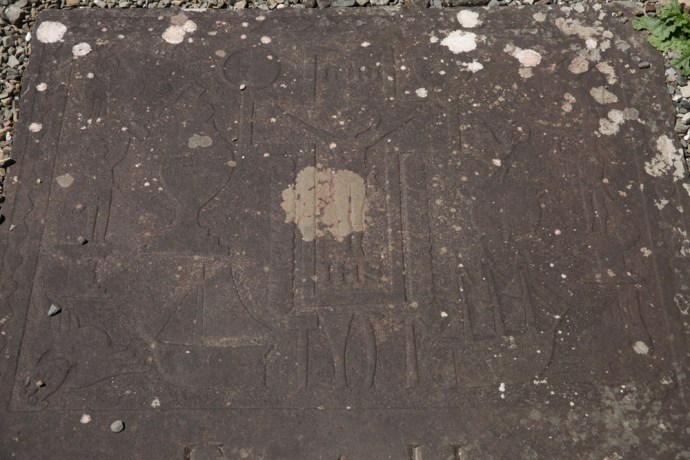
There are many reminders of this time aside from the ruins of  The Street and elsewhere.  Many of the gravestones at Tempall Na Marbh, which although being  the youngest of the churches on the island  (14th or 15th century), are beautifully preserved.  Many date from pre-famine time and contain symbolic representations that not only represent religious iconography but tell the story of residents lives.  Though the church ceased to be operative centuries ago many descendants chose to be buried there and they still do today.

IG3C7438

Beautifully engraved gravestone at Church of the Dead.  Dating from 1828
IG3C7058

Engraved symbolic representations on a grave stone including images of a three masted ship and a hooker and perhaps shipwright’s tools.  Presumably the deceased was a mariner.

Following the end of settlement the island lay empty for many years,  This could have been the end of the story as the island eventually passed into the hands of a developer with grand plans for a marina.  Luckily this came to naught and the island was eventually sold to a Belgian group. We owe an enormous debt of gratitude to a group of Kilrush residents who pushed hard to regain ownership and ultimately bought the island back.  These residents still own the island and they ceded management to the State.

That is a great outcome.  It is not hard to imagine that in years to come Scattery will become one the essential Irish monastery sites to visit; right up there with Glendalough and Clonmacnoise.

Put it on your agenda for your next visit.
Categories: My Journey, Real Ireland | Tags: , , , , , , , , , , , , , , , , , , , , , | 3 Comments

Backyard archaeology. Right under our feet. Caherush, Co Clare.

I have spent a lot of my time traipsing around the country exploring archaeological treasures. Ring forts, portal tombs, standing stones, castles, sile-na-gigs, you name it.   I have photographed them and blogged about them. In all that time though I completely forgot to document the archaeology of my own back yard. And I mean literally my own backyard.

In January 2014 Clare, along with much of the west coast of Ireland, was struck with a number of ferocious storm that destroyed beaches and did massive damage to seaside communities. This happened four months before I arrived but the effects can still be seen today.   Hardest hit were places like Lahinch, White Strand, Spanish Point, Quilty, Seafield Pier, Doonbeg, Kilkeee, Kilbaha and Carrigaholt.

In fact the house at Caherush, that was to become mine, was hit hard and inundated, with the then occupants having to be evacuated.

The massive high tides and waves, while doing such obvious damage also uncovered some really interesting things that were previously unknown. For example near Spiddal a ‘petrified’ forest of ancient bog oak was laid bare and, closer to home, a peat layer now covered again was exposed in the bay at Caherush.

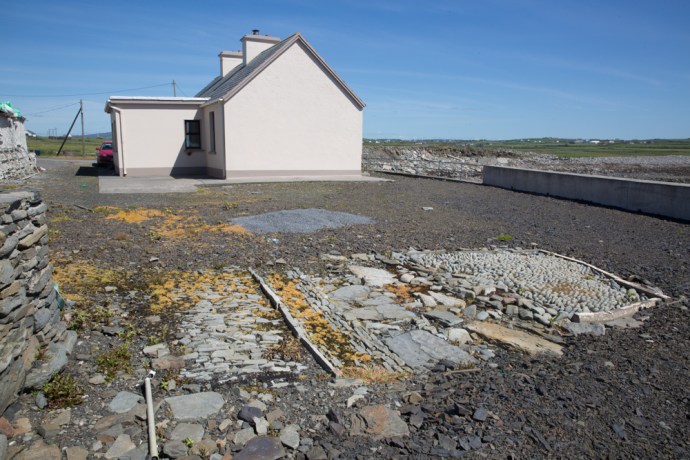
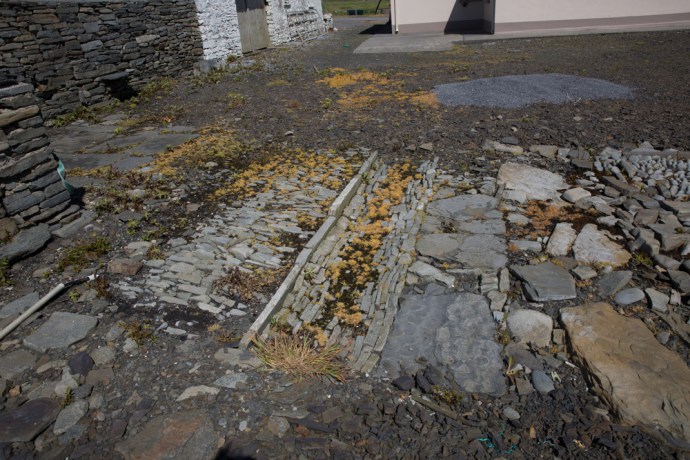
This blog is about what was found in the backyard of my cottage after the gravel was stripped away by the waves.  Evidence of long since gone farm buildings was uncovered. A number of different types of paving in close proximity were revealed and these appear to represent the floors of old farm buildings. The site covers 10m x 4m.

IG3C5846

Paving of old farm buildings in the backyard of the cottage at Caherush.

There are cobblestones, setts and flagging, each belonging to a building with a different function.  The original buildings would have been aligned north south. At the southern end an area of cobblestone paving was revealed.

IG3C5852

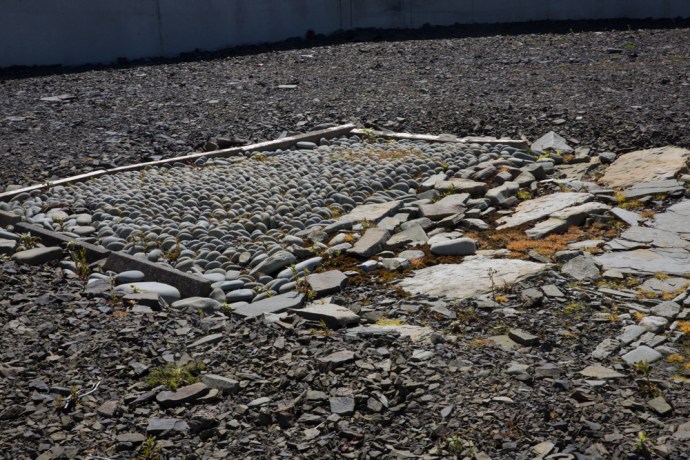
Cobblestone floor of an old stable.

Cobblestones are one of the earliest forms of paving, the term first being used for roadways in the 15th century in England. The use of cobbles though actually started with the Romans around 250AD. True cobblestones, are small, natural stones with edges smoothed by water, either by the ocean or rivers.  These undressed stones, or cobbles, are often of a flattened egg-shape and were used in their natural state without being worked in any way.  The stones are carefully selected and laid in sand pointy end down and were packed tightly together to provide a relatively smooth and durable surface. This construction has excellent drainage and so they were much longer lasting than the alternative of the time which was dirt. They would also have been used frequently in stables which it is believed was the case here.  A lot of thought went into selecting stones of similar size and shape and in aligning them. It is amazing that it has survived.

IG3C5863

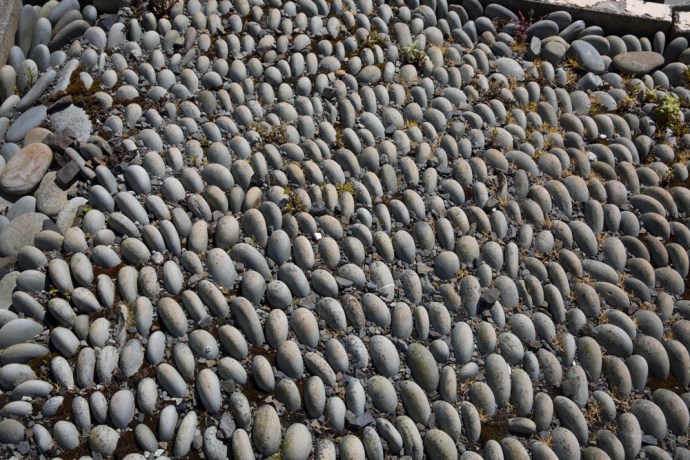
Detail view of the cobblestone paving

IG3C5872

Typical cobblestones selected to be of similar shape and dimensions

Cobblestones went out of favour in the early 1700s and were replaced with setts which are worked into rectangular shapes but still laid the same way. These are actually what people would be most likely to refer to as cobblestone paving now.

So, there is no way of knowing how old this floor is as the tradition of using cobbles may have continued on farms much longer than their use in roadways, especially near the sea. But it could conceivably be pre 18th century,

Next to the cobbles is an area of large irregular slate flagging probably much more recent and representing an access way between the stable and the building to the north. Adjacent to this slate is a beautifully preserved shallow drainage trough made from sandstone setts aligned east west in the direction of drainage. Immediately north of this is a level area of setts in the same rock type and apparently of the same vintage, aligned north south. This area is believed to have housed cattle who would have stood on the level area facing north, which would have enabled the trough to catch their effluent and drain it away. Clever really.

IG3C5883

Cattle shed floor looking from the west.  The drainage trough is in the centre and the area where the cattle stood on the left

IG3C5887

View of cattle shed site from the east.

And then north of this is an area of large flags of Liscannor stone. Mikey Talty who was born in the cottage 80-odd years ago remembers this as a piggery, though he had no recollection of other structures where the cobbles and setts are. The north wall of the piggery had a doorway and this can be seen now filled in in the same style as the surrounding stone wall beneath a lovely stone lintel.

IG3C5854

Piggery floor.  Infilled doorway can be seen.

IG3C5856

Close up of infilled doorway

So there was continued usage of this site to house animals with evidence suggesting the possibility that it may go back over three hundred years.

I think that’s cool. And in my back yard too.

Disclaimer: These conclusions are my own and based on my own observations as well as the recollections of the Talty family. I am not an archaeologist but if anyone out there has specific knowledge of the use of cobbles in farm buildings and their age I would love to hear from you.

Categories: My Journey, Real Ireland | Tags: , , , , , , , , , , , , , , , , , , , , , , , , | 4 Comments

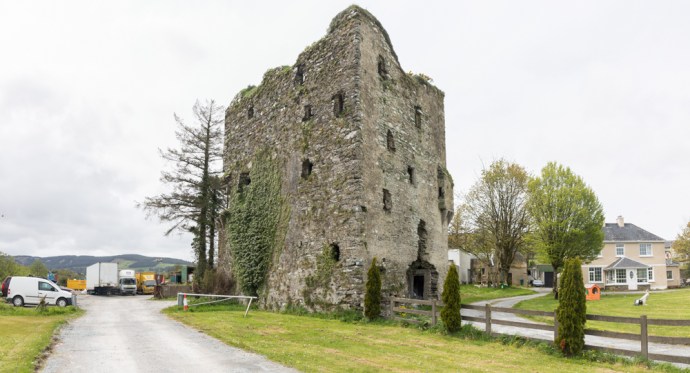
Castle Gan Ainm. A castle in your front yard? Only in Ireland.

How would you like a castle in your front yard?  Well in Ireland you can have one.  They say a man’s home is his castle.  Or should that be a man’s castle is in his home.

IG3C5311-Pano

Just imagine the things you could do with your very own castle.  Like, use it to store your ride-on mower or maybe as a cubby-house for the kids.

IG3C5346

A home for the ride-on


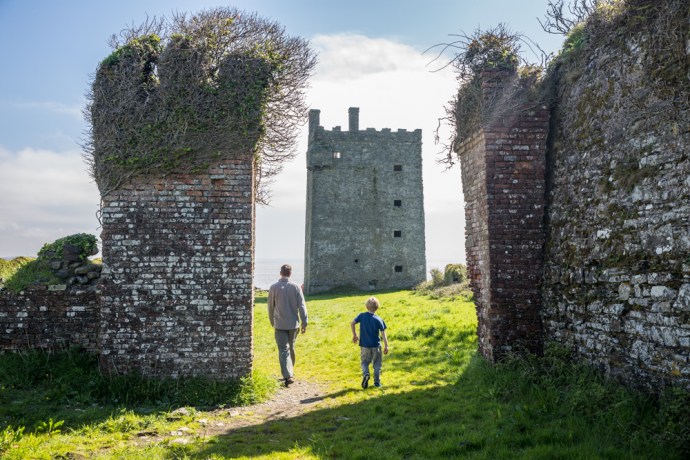
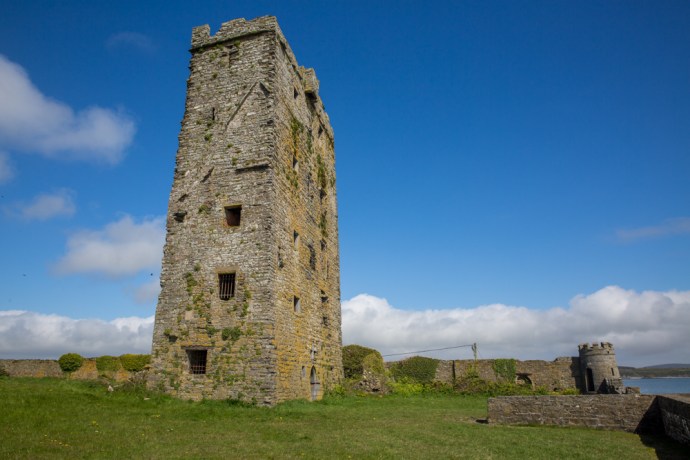
I came across this one recently.  It is just on the outskirts of Liscarroll in Co Cork, which of course has its own Castle that dominates the village.  I could not find a name for this one though, so hence I have christened it Castle Gan Ainm, but it is just like the many hundreds of Tower Houses you find all over Ireland.

This one though is literally in the front yard of a farmer’s house.

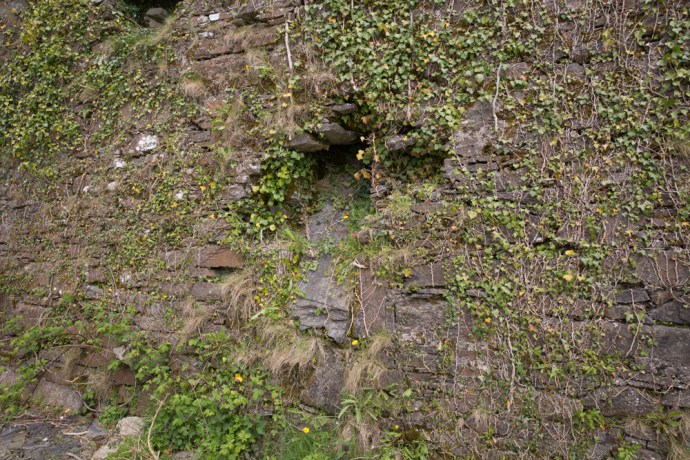
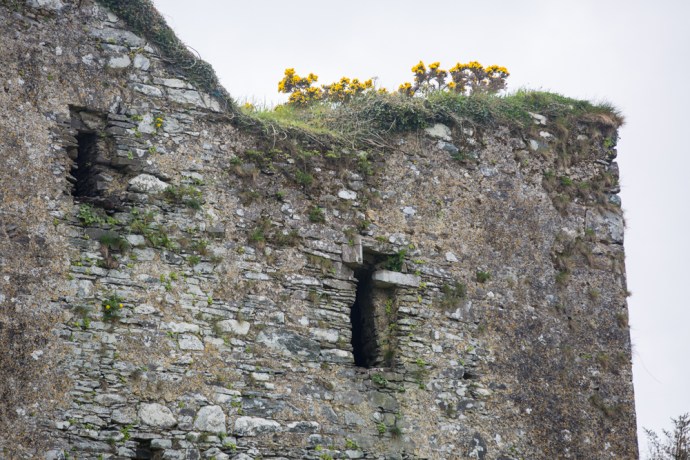
It is in surprisingly good condition really and many of the features of such houses are preserved.  For example there is a chute from what would have been the garderobe (fancy name for medieval toilet – comes from the cry ‘garde robe’ made as a warning to those below, before effluent was unceremoniously tipped onto the street).  There are also a few modern additions such as the ‘rooftop garden’ comprising, at this time of the year, gorse in full bloom.

IG3C5368

IG3C5326

Chute for waste products from the ‘gardebrobe’

IG3C5343

A rooftop garden

And of course the resident border collie. The Keeper of the Keep?

IG3C5352

The Keeper of the Keep


Categories: My Journey, Real Ireland | Tags: , , , , , , , , | Leave a comment

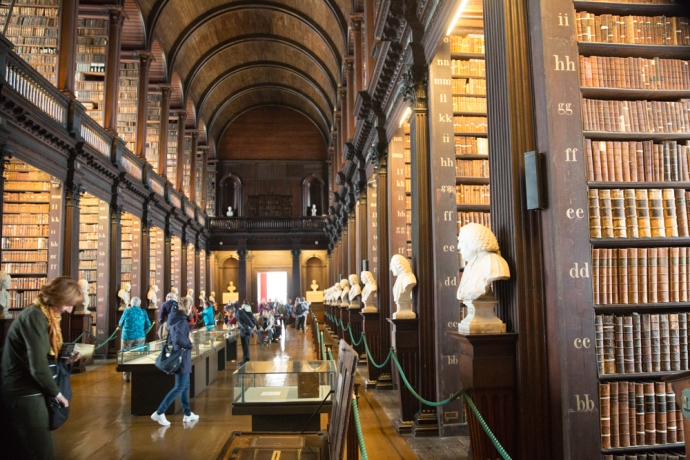
The Long Room, Trinity College Library. A Bibliophile’s Heaven.

Most of my readers will not be aware that aside from Irish music and photography which I combine in my blog, another of my other passions is old books. That makes me a bibliophile. If you are on the same wavelength as me then you can understand the feeling that you get when you visit the Old Library at Trinity College in Dublin.  It’s like you have been given early access to the Pearly Gates. Even if you aren’t into books it remains one of the most beautiful rooms in the world and you should see it anyway.

IG3C4151

The Long Room, Old Library.

The Trinity College library is huge, located in a number of buildings both on and off campus. The Old Library is located in Thomas Burgh’s architectural masterpiece ,a building which dominates the Trinity landscape.

IG3C4106

The grounds of Trinity College.  The Old Library is on the right.

It was founded along with the University in 1592 and 70 years later was presented by Vice Chancellor and benefactor, Henry Jones, with its most famous accession, the Book of Kells. In 1656 the Archbishop of Armagh, James Ussher, bequeathed his valuable library, comprising several thousand printed books and manuscripts, to the Library.  This forms the core of the remarkable collection of 200,000 of the oldest books now housed in what is known as the Long Room.

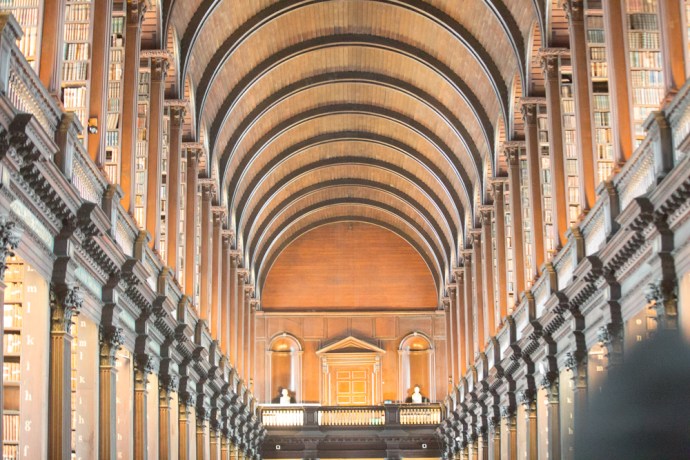
This 65 metre long chamber was built between 1712 and 1732. Initially it had a flat ceiling and books on only one level. In 1860 to accommodate the ever expanding collection the roof was raised and a second level of shelving added along with a stunning curved ceiling.

IG3C4132

Up until 1860 there was only one level with a flat ceiling

IG3C4246

The second level and curved ceiling

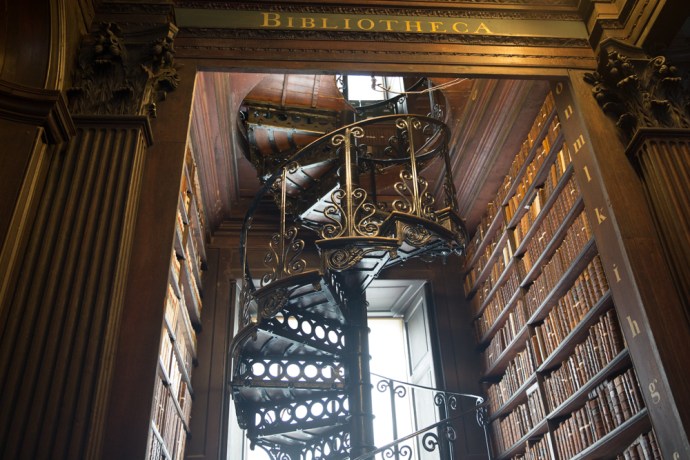
Rich wood paneling, wrought iron staircases, giant frosted windows providing a gorgeous filtered light that gives the books a golden glow all add to the ambiance of what is a very special place.

IG3C4127

A remarkable space

IG3C4266

Stairway to Upper Level

IG3C4272

Lots of natural light

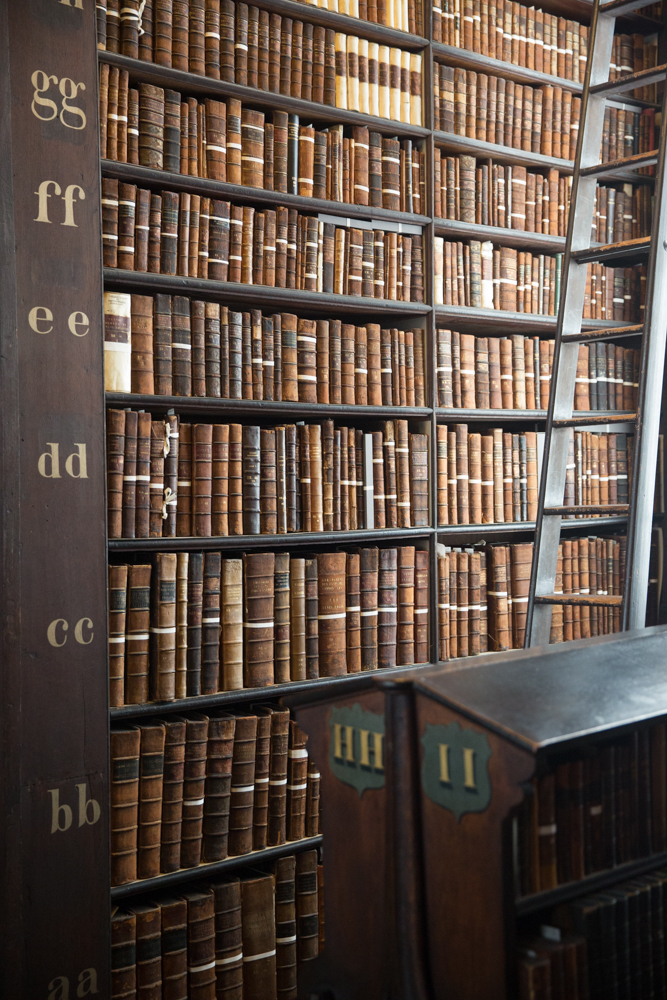
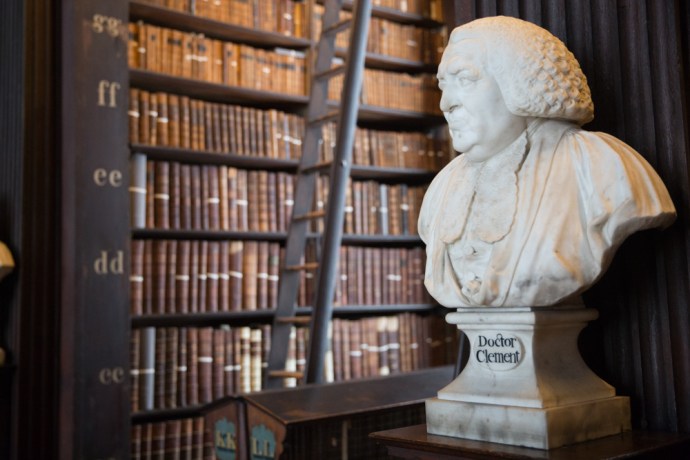
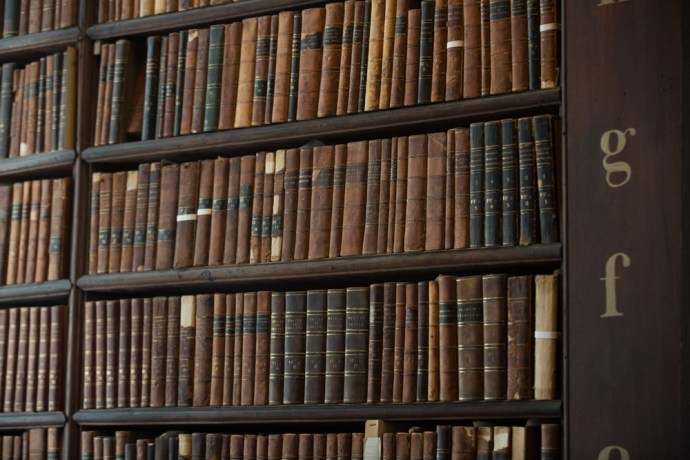
The books are housed in a series of double sided shelves labelled A to V on the right side and AA to VV on the left. Interestingly J and JJ are missing as this letter was only added to the English alphabet around 1630. The individual shelves are labelled a to o or aa to oo (again j missing) from the ground up and then individual books are numbered from 1 left to right. This gives each book a unique location number for example, DD m 5. A surprisingly effective pre Dewey-system ifor finding a book

IG3C4212

Cataloging system using letters and numbers

The Long Room is lined with marble busts of authors, philosophers and college benefactors. All white men by the way. Fourteen of the busts are by the famous sculptor Peter Scheemakers.

IG3C4243

Busts line the hall

IG3C4154

IG3C4209

Of course the Library is best known for the Book of Kells (of which two copies are on display) in the attached museum but other prized acquisitions are on display in the Long Room. There is one of the last remaining copies of the 1916 Proclamation of the Irish Republic, read by Patrick Pearse near the General Post Office on 24 April 1916. It was much bigger than I thought.

IG3C4341

A copy of the 1916 Proclamation

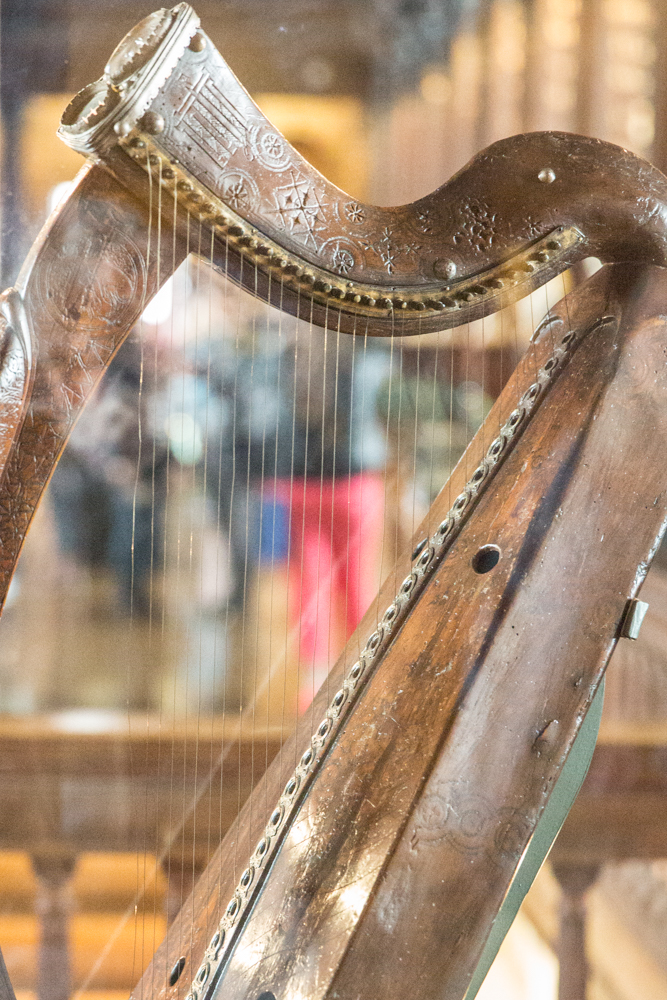
The beautiful “Brian Boru harp” is also housed here. This instrument is the oldest of its kind in Ireland dating back to the 15th century. The harp is made out of oak and willow, beautifully carved, and includes 29 brass strings (originally 30).

IG3C4167

The Brian Boru harp

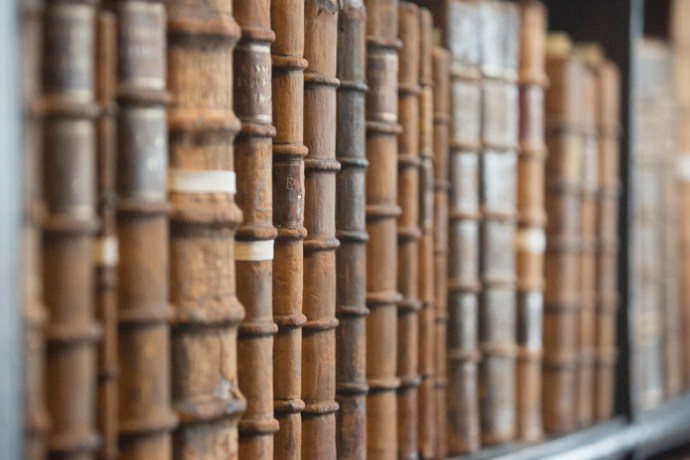
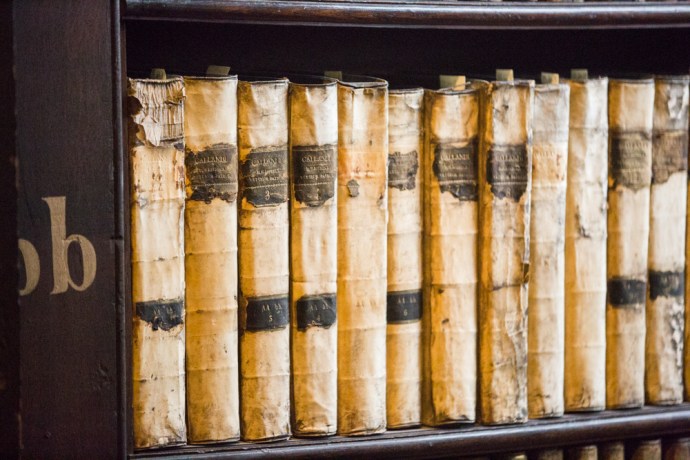
The books themselves are are of course the centerpiece. They are beautifully bound. Mostly of course leather and vellum. Sometimes bindings are works of art themselves. Many are tattered, reflecting years of loving use. Unfortunately you can’t get up close but most books that I could read the titles of are of course in Latin, the language of scholars of the day, and many are apparently religious tracts. But significant proportion I noticed were in English. Shelves full of books on medicine for example caught my attention.

IG3C4277

Books on medicine

IG3C4294

Sometimes a little tape is required

IG3C4330

Ridges characteristic of cord-bound books

IG3C4238

A well used vellum bound set of Works of Andrea Gallandi an Italian scholar who died in 1780

IG3C4326

Bindings of many colours display the bookbinder’s art on this early Bible

IG3C4235

Original editions of works by  Aldrovandus, an Italian naturalist, the father of Natural History, who died in 1605

As a collector, familiar with the value of rare books one can only speculate on the value of such a unique collection and I would suggest that many of the books would be unobtainable. The beauty of them being here and not in a private collection is of course that you could access it if you needed to.  Libraries have adapted to the digital age and surprisingly still remain very popular. The death of the book is wildly exaggerated. Long live the book.

Categories: My Journey, Real Ireland | Tags: , , , , , , , , , , , , , , , , , , , , , , , , | 4 Comments

Oysters and Trad Music. And sunshine. Sound like Ireland?

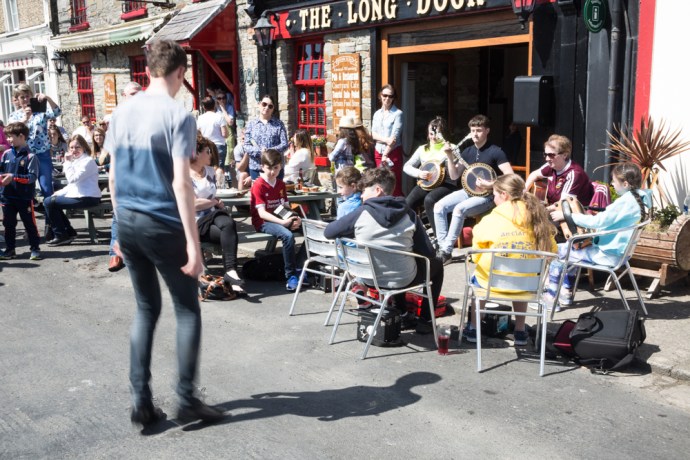
May Day weekend in Ireland is one of the busiest music weekends of the year. There is too much choice and if you live in the west you probably think of going to the Cuckoo Fleadh at Kinvara or the festival at Louisburgh. I am sure the Carrigaholt Oyster and Traditional Weekend does not come into your consideration. Well it should.

To be honest I didn’t even know it existed until I prepared the listing of Festivals, which you can find elsewhere on this blog (A Feast of Festivals) but I decided to eschew the larger festivals and the jam packed sessions and head south to this tiny village.

Carrigaholt is not a name that immediately springs to mind and, in fact, I suspect that many, even Clare, people only have a vague notion of where it is, tucked away in the very south west of the county.  Many visitors come to nearby Loop Head but most, indeed including myself, seem to miss Carrigaholt.

I was attracted by the mention of oysters among other things.  Just love fresh oysters.  Sunday arrived with a clear blue sky and a positively balmy 15 degrees so guess where I went.

Carrigaholt is located on the shores of the Shannon Estuary but is a struggling village, like many in the west of Ireland. Population of the village itself is down to 40 and I am told that of that there are only two children. There are four pubs, a small shop inside one of them, a restaurant with brilliant food and a gift shop. But not much else. Oh, and there is Carrigaholt Castle, one of the most elegant tower houses in Clare, which sits on the water’s edge, and a stunning coastal drive towards Kilbaha with some beautifully exposed geology as well.

IG3C4618

The imposing entrance gate to the Carrigaholt Castle

IG3C4676

Another view of Carrigaholt Castle ruin.  One of the most beautiful in Clare.

IG3C4816

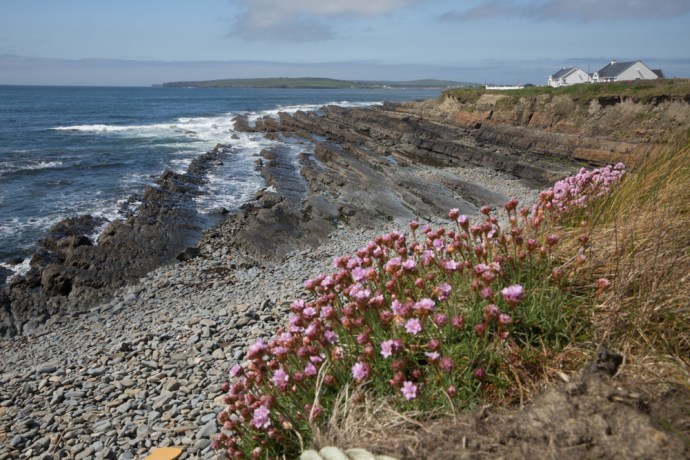
West of Carrigaholt on the Coast Road.  Pink Thrift in the foreground and Loop Head in the distance.

IG3C4825

Gently folded strata.  Looking across to Loop Head

IG3C4840

Stunning scenery on the Coast Road from Carrigaholt

Yet for this weekend the streets were jammed and the pubs crowded. Little local festivals like this are the heartbeat of the traditional scene and mean so much to these isolated villages and I love them. I found myself as possibly the only person in town who had traveled there specifically and who didn’t have some connection to the village. Most were either locals, former residents or family visitors. But I was welcomed fulsomely; like joining a family party as the long lost cousin from Australia.

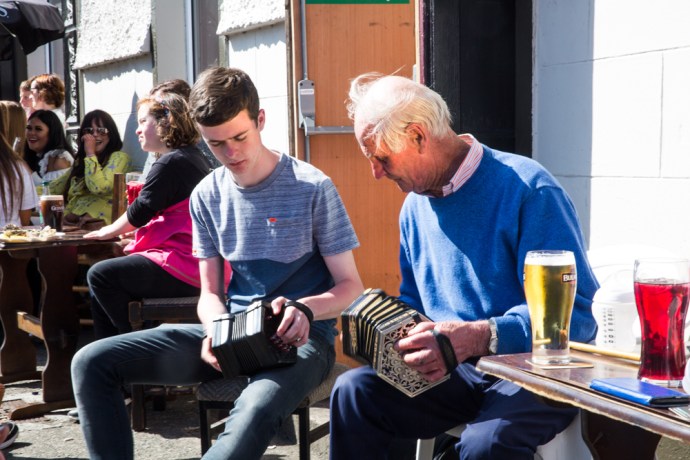
The weather helped of course. Everything was out on the street. An early so-called Junior Session was the first event of the day. ‘Junior’ is the wrong word. The session was led by members of the Maguire family from Wicklow and the music was anything but kid’s stuff. I was stopped in my tracks by Aiofe Maguire doing a concertina solo that showed a truly phenomenal mastery of the instrument. Playing with her were sister Emma on fiddle and Sean, still only 11, wowing all with his fiery bodhran playing. I had another chance to see them later in the day at the Long Dock.

IG3C4705

The ‘Junior Session’.  Some were more interested in other things

IG3C4697

Aoife and Sean Maguire on the street at  Carrigaholt

IG3C4998

The Maguires perform in front of the Long Dock

IG3C5008

The Maguires

IG3C5017

Robbie Walsh with Emma Maguire

The afternoon and evening was filled with sessions at all four pubs. Mainly local musicians from the district, including members of another talented family from west Clare, the Brownes, with some sensational sean nos dancing in the street from Colm Browne.

IG3C4852

In my element.  Thanks Pat Keating for the photo.

IG3C4861

Sean nos dancing on the street from Colm Browne

IG3C4952

Colm Browne with grandfather Tommy Browne.  A musical dynasty continues

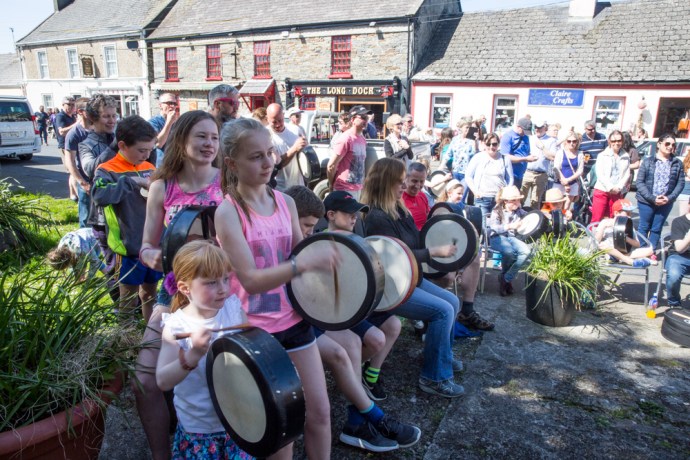
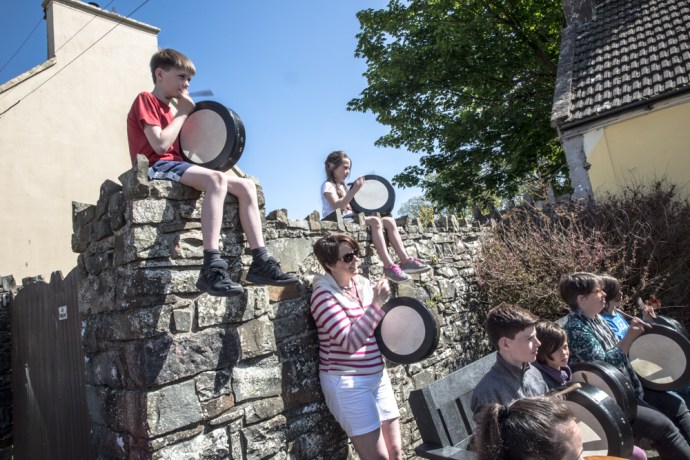
I watched a bodhran workshop on the street led by the renowned Robbie Walsh and his Bodhran Buzz. I had to fight mightily the temptation to grab one and have a go but I resisted.

IG3C4900

Joining in the Bodhran Buzz

IG3C4909

Wherever you can find a seat

And later I joined Clare musicians Geraldine and Eamonn Cotter and their extended family for a marvelous couple of hours of tunes and songs.

IG3C5095

The Cotter family plus

Everyone was clearly enjoying themselves in their own way but for some ice cream was the order of the day.

IG3C5036

Totally absorbed.  A family day out.

IG3C4883

I scream and you scream.

IG3C5158

Let out of the Convent for the day or a very Irish Hen’s Party?  Your call.

IG3C5188

Paparazzi.  Can’t escape.

 The party continued at Keane’s Pub well into the night but after 9 hours of playing I made a quiet exit and left them to it.
IG3C5163IG3C5167

Oh and by the way I got my free plate of delicious local oysters!

IG3C4846

Fiddling with oysters

Categories: Festivals, My Journey, Real Ireland | Tags: , , , , , , , , , , , , , , , , , , , , , , , , , | 3 Comments

The Cliffs of Moher Cycle Challenge. Never Refuse an Invitation

No I haven’t joined the lycra brigade.  Let me explain.

Never refuse an invitation has been one of the mantras that I have followed since I started living in Ireland and I know I have written before about some of the surprising encounters that have resulted.  This was demonstrated yet again one wet Saturday in early April.

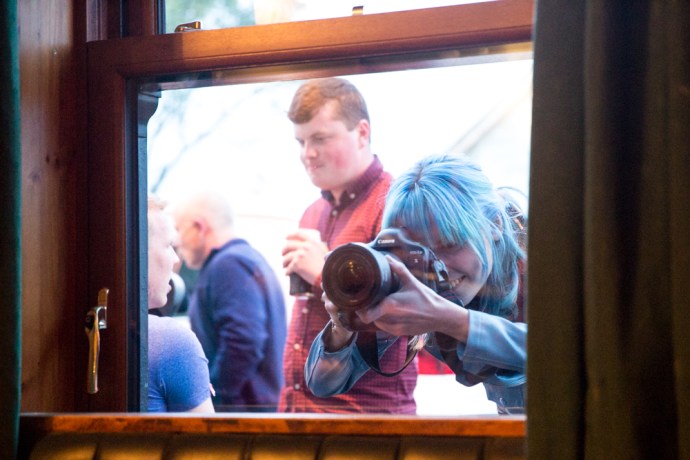
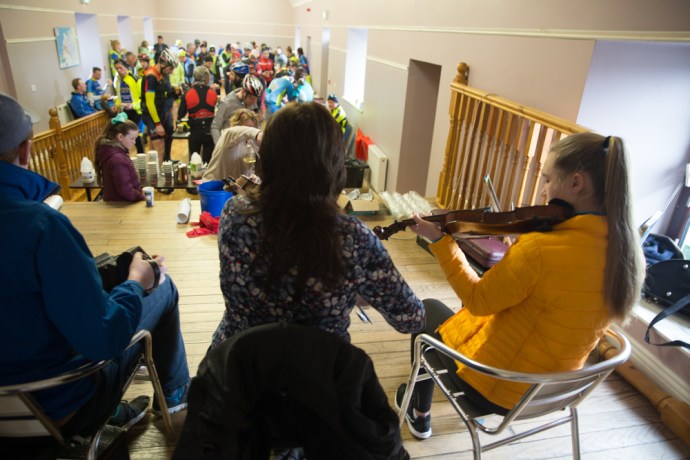
A couple of days previously I had received an email from a friend telling me that the organisers of the Cliffs of Moher Cycle Challenge were looking for musicians to entertain the riders during their lunch stop in the very north of Clare at Ballyvaughan.  Without knowing anything about the event of course I agreed.

The instructions were simple.  “Be at the Hall at 11.30”.  It’s about an hour’s drive from Spanish Point and as I headed north of course, sun turned to rain.

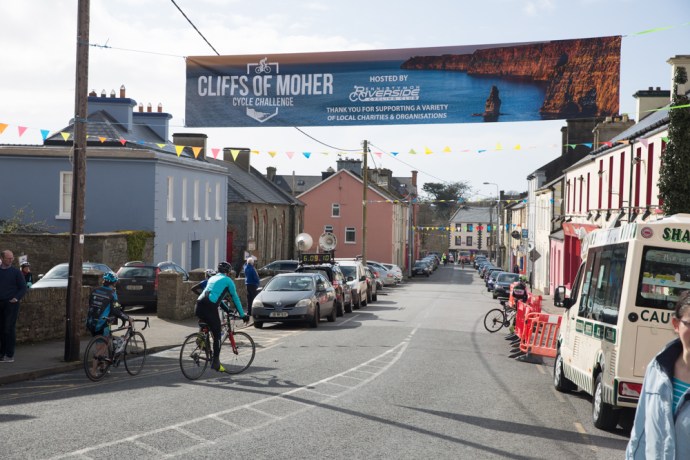
This event, hosted by the Riverside Cycling Club Ennistymon, is in its 6th year. It has built up to become an important part of the Clare cycling calendar with 630 participants this year.  The Burren and the Atlantic coast of Clare hosts some very popular cycle events such as the Tour de Burren, Ring of Clare, SRAC Atlantic Challenge and a ladies only ride Turas na mBan.

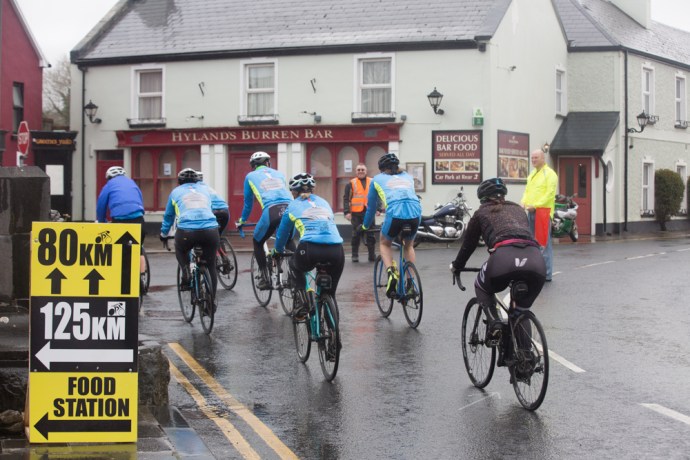
It’s not surprising really as the route is rated as one of the finest in Europe.  There were a number of shorter journeys of 40 and 80 km  but The full loop started and finished in Ennistymon and takes in the Cliffs of Moher (of course) and other iconic Clare sites such as Doolin, Fanore and Black Head on the spectacular Burren coast road, Ballyvaughan, Carran, the hairpin bends of Corkscrew Hill and spa-town Lisdoonvarna.

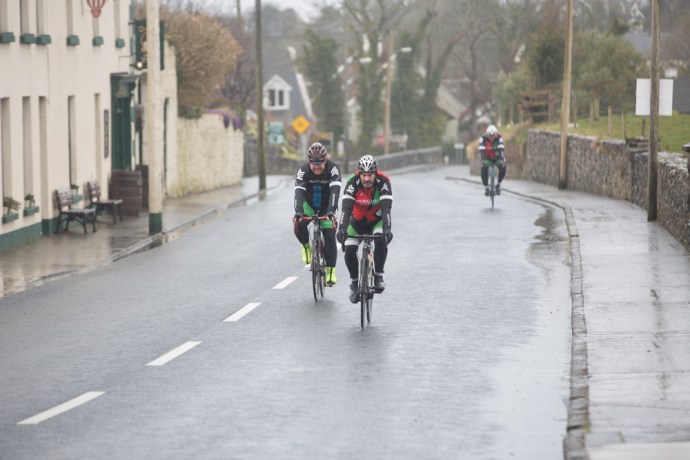
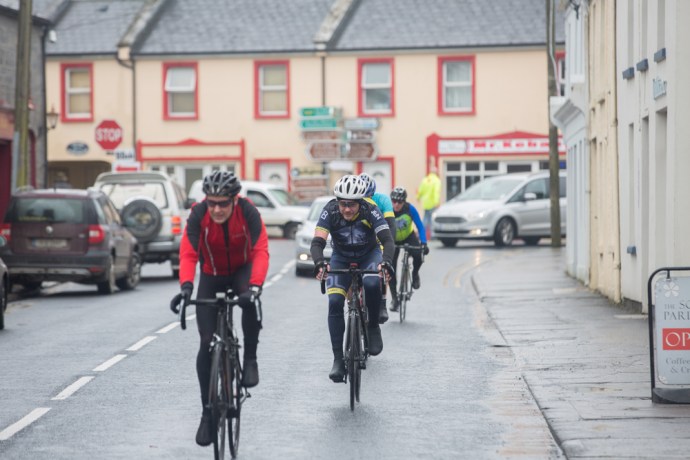
So I arrived in Ballyvaughan with the rain just in time to see the first riders arrive.

IG3C9667

The first riders enter Ballyvaughan

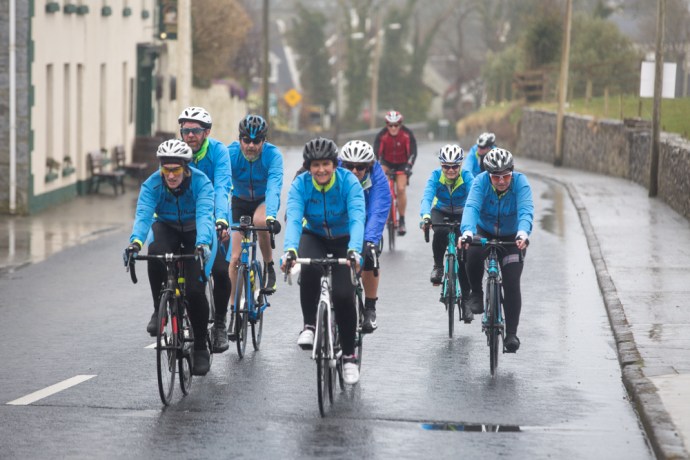
IG3C9700

Not far behind was this colour coordinated group

IG3C9811

Riders make their way through the town

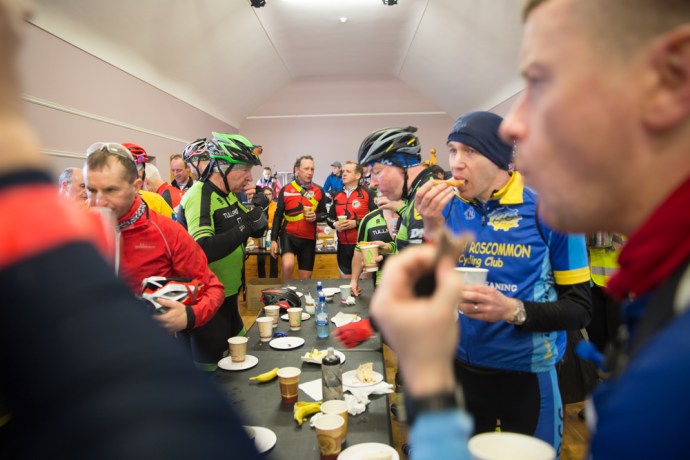
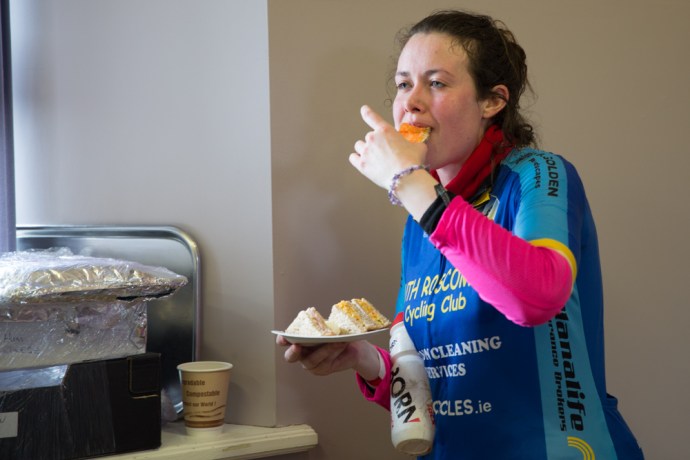
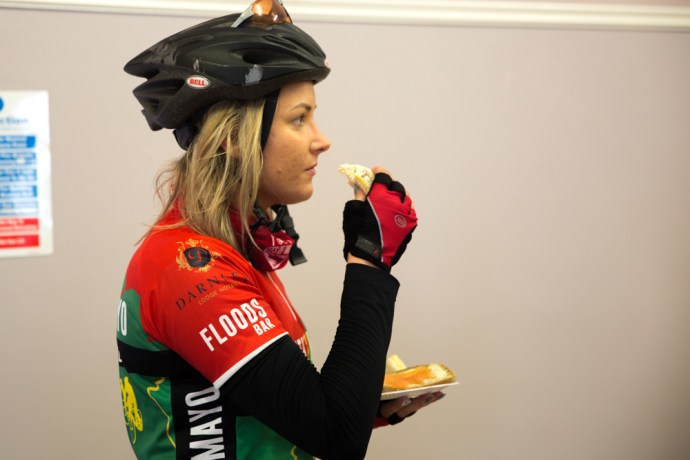
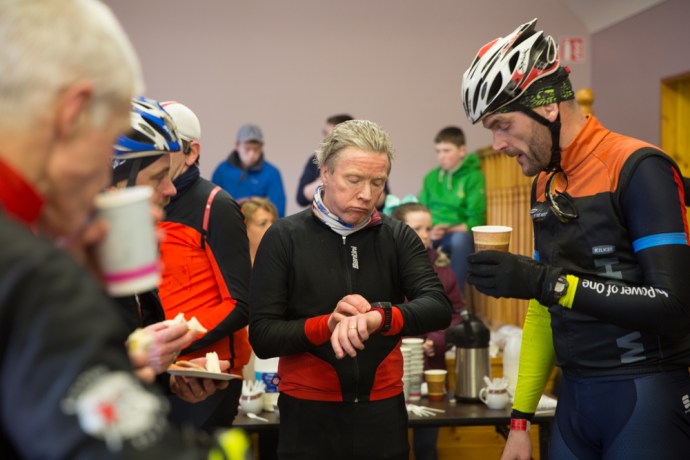
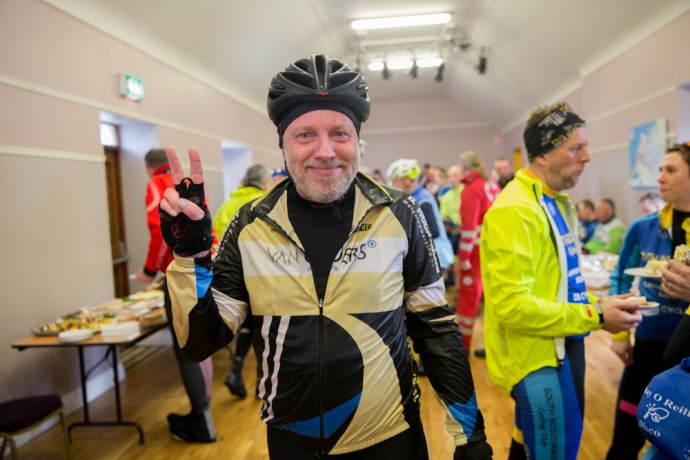
Some kept going, not bothering to take a break but most were diverted to the National School Hall for an inviting spread of sandwiches, fruit and warm tea.

IG3C9707

Decision time.  Most chose lunch.

And who could resist the local smoked salmon on soda bread and the piles of home made sandwiches.  It was also time to exchange stories, meet new friends and check progress.

IG3C9904IG3C9881IG3C9983IG3C9987

IG3C9873

IG3C9995

Time to show off the new bike.

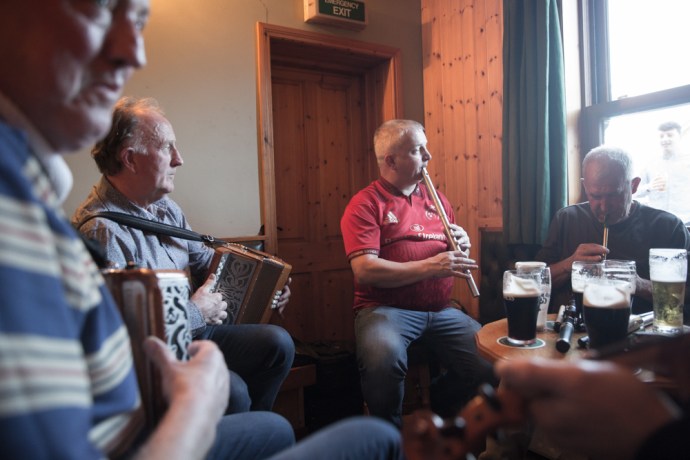
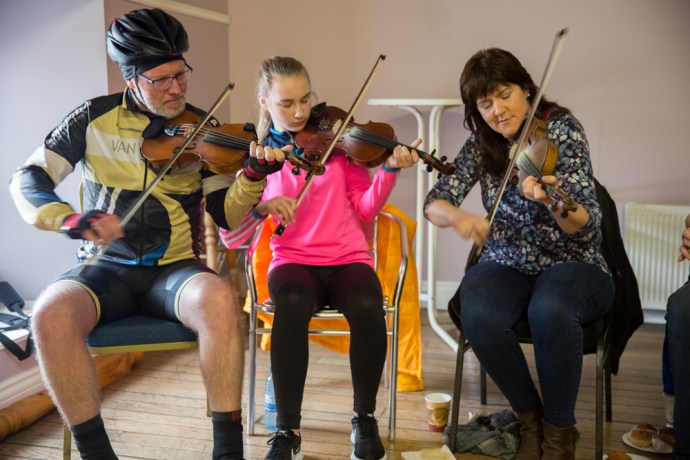
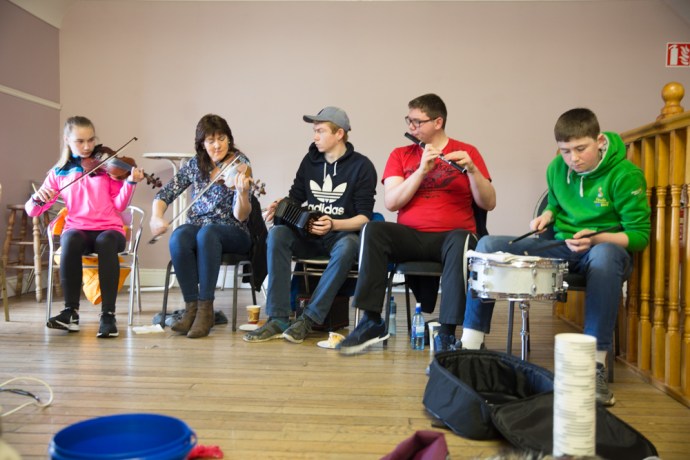
I joined a small group of musicians belting out jigs and reels with a mighty Kilfenora rhythm. How could it not be so with Anne Rynne (a member of the Kilfenora Ceili Band) and her family leading.  It was so much fun to be part of.  The riders seemed to enjoy it though I am not sure they  realised that despite the youth of  a number of the players , the music was world class.

IG3C9856IG3C0002

It is a surprisingly small country Ireland, and the music world which I am part of has strong links across other activities. I think of it this way.  Traditional music  is like a strong thread in a patchwork quilt that seems to stitch everything together. From farming to football. To illustrate, there in the crowd was my friend Thierry, a keen cyclist and fiddler, who, still clad in riding gear, helmet and gloves,  just couldn’t resist the temptation to borrow my fiddle and play a few tunes. Best of both worlds.

IG3C9888IG3C9958

A great cross section from all over Ireland turned up.  Even the Mayor of Clare was there, wearing not his official garb, but riding colours.  This was a charitable event and a community event.  There were no winners and everyone was a winner.  Oh God.  Did I write that!
IG3C9976

A Mayor from Clare

IG3C9945

Everyone wanted to be in the picture

I headed back home, but not after a little bit of drama leaving my fiddle behind in the hall.  Retrieved it eventually.

I ran into the cyclists again on my way back (figuratively speaking that is) as the sun dramatically re appeared occasionally.  I stopped at the beautiful Carran Church on the roof of the Burren to watch them ride past. You have to admire cyclists’ dedication.  Still plugging away, only 40 km to go, I wonder how many were in the frame of mind to take a look at the stunning scenery or was their mind focused on the formidable Corkscrew Hill just a few kilometers ahead.

IG3C0038

IG3C0197IG3C0304

IG3C0144

Ruins of Carran Church

IG3C0141

View towards Mt Callan.

I finally ended up back in Ennistymon around 4pm as the last riders were triumphantly ending their 125 kilometer journey.   6 hours and 12 minutes is a long time to be peddling a bicycle.

These events take quite a lot of organising.  Route marking,  food and drink stops, publicity, traffic management and a host of volunteers contribute in all kinds of ways.

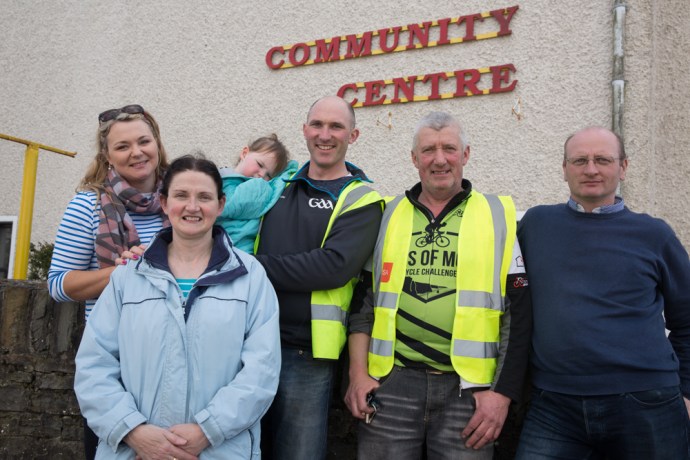
A very pleased Committee posed for me outside the Community Hall.

IG3C0328IG3C0340IG3C0335

I hope the cyclists had as good a time as I did. Like I say, never refuse an invitation.


Categories: My Journey, Real Ireland | Tags: , , , , , , , , , , , , | Leave a comment

Springboard Fiddle Retreat 2018. A Dive into the Unknown.

I had high expectations. An intensive four days of workshops from Caoimhin O Railleagh, Four nights of ‘luxury’ on the shores of Bantry Bay. Meals. All the ingredients were there. Food, fellowship and fiddle.

Would my expectations be met?

I am a bit of a workshop junkie and I am guessing that over the past four years I have had instruction from well over forty different fiddlers while living in Ireland. But Springboard Fiddle Retreat sounded different. Workshops in Ireland generally follow a set pattern, in place since the Willie Clancy Festival started nearly fifty years ago. Bring in a name fiddler, for up to a week. Three hours a day; usually a mixed class of fiddlers or wanna-be’s of all ages and stages. The teaching is based around learning new tunes but there is rarely time for individual instruction or to gain a deeper understanding of the instrument.

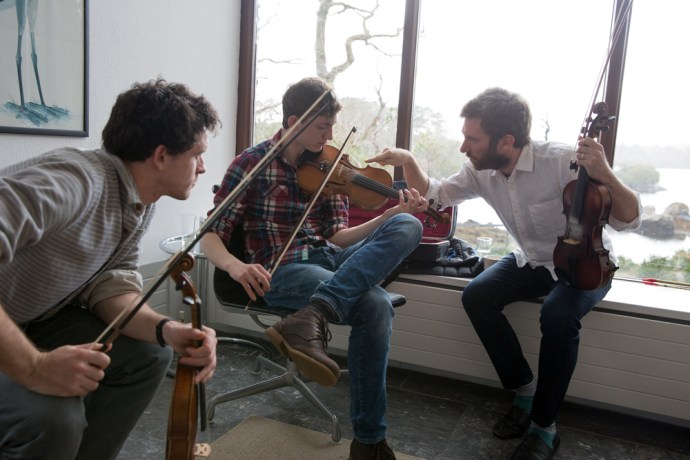
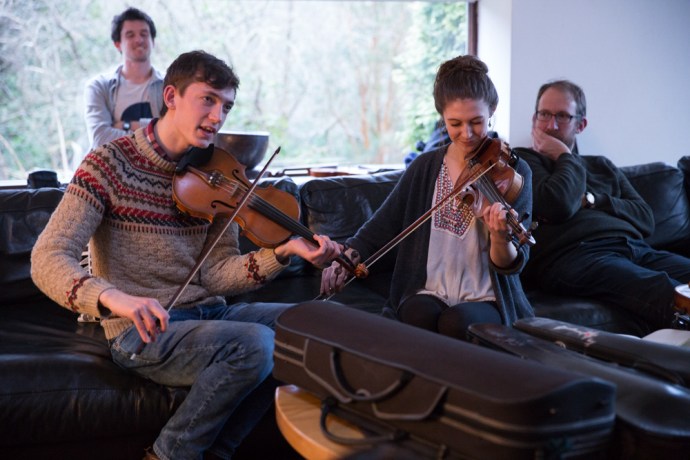
But Springboard did not follow this formula.  As I said it is residential and there were only a dozen of us.  It was a Thursday afternoon and fiddlers from all over Ireland, a couple from Scotland and from the  US and a couple of ex-pat Aussies joined others at Linden House on the shores of Bantry Bay in West Cork.  The location was hard to find but stunning.   I have separately blogged on this little corner of Ireland and the beauty of Glengariff and the surrounding forest, so you can see more HERE.

IG3C9187

The calm waters of Bantry Bay at Glengariff

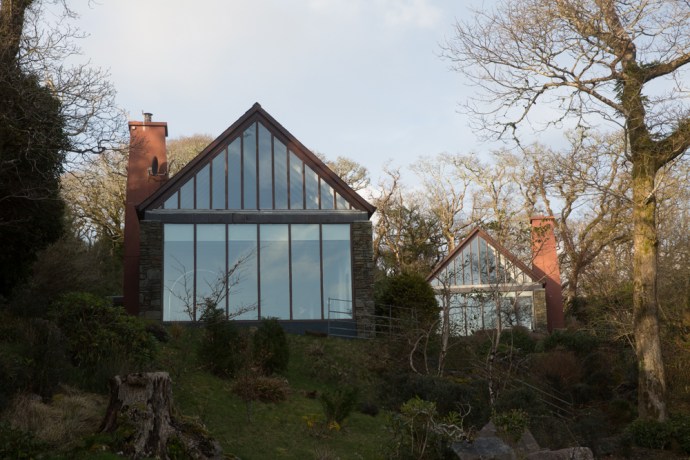
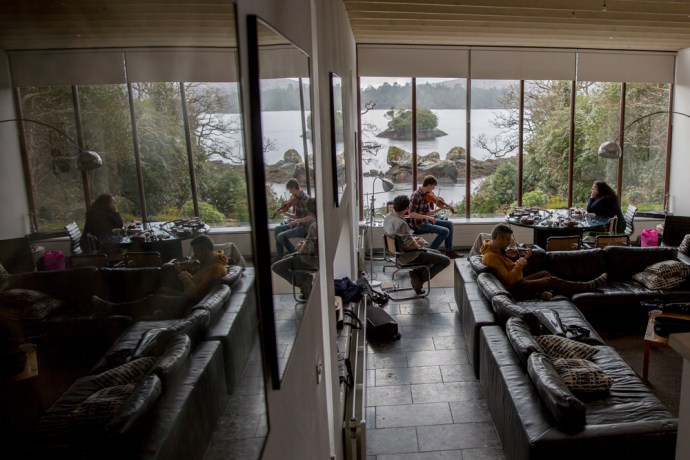
But it wasn’t just the location. The house was purpose designed to accommodate up to 20 people. There were two wings and multiple stories and it made a beautiful architectural statement as it stepped its way down the contours of the land melding into the forest and surrounded by beautifully tended gardens and tall gaunt oaks.  There were a number of large living spaces with giant picture windows taking in the vista and plenty of nooks to meet and play fiddle in small groups or withdraw for some quiet time. Everything was provided for a wonderful livable escape.

IG3C9115

Linden House.  The venue for the retreat

IG3C9260

The view from the main living area

IG3C9336

A perfect place to think, read, and play.

Then there was the food. Oh dear. Expectations regarding this weren’t that high when I read it was vegetarian. Nothing against vegetarianism, but I will be honest, I do enjoy the  meat-and-three-veg world . But as it turned out absolutely nothing to worry about here. We were incredibly well looked after by chef Jenny and her assistant Anda. The food was truly a marvel. It was prepared with great thought and obvious love. A riot of colour and flavours with some ingredients I have never even heard of and others used in ways you wouldn’t have imagined.  All combined with skill and originality. The food was indeed part of what was a total experience We were constantly reminded of the parallels between our explorations with music and the eating experience. Each day one ingredient was chosen as a theme and dishes reflected different and sometimes surprising approaches to the use of this. Just as we would choose a theme for the day on our journey with the fiddle.

Speaking of the fiddle that’s what we were there for, so let me talk about that.

Caoimhin is an accomplished and widely respected traditional Irish fiddler. His collaborations are many and include musicians from wide backgrounds such as piper Mick O’Connor, West Kerry box player, Breandan Begley,  sean nos singer Iarla Ó Lionáird, Clare fiddler Martin Hayes and musician/physicist, Dan Trueman.  He plays with The Gloaming.  His music is rooted in the traditional world of piping and Sliabh Luachra but he has explored Norwegian and Icelandic music, the Hardanger fiddle and plays in various cross tunings.  He has always been seeking new ways of voicing the fiddle.  As a result he has developed a unique and recognisable playing style.

IG3C0271

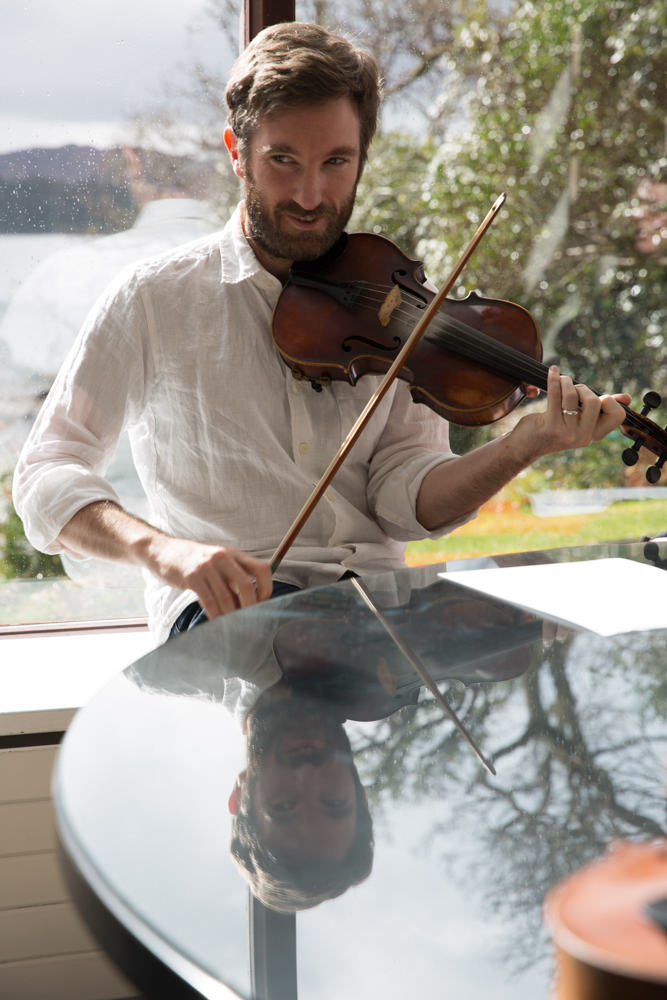
Instructor Caoimhin O’Railleagh as a snow shower passes through

IG3C9380

A reflective moment

IG3C0453

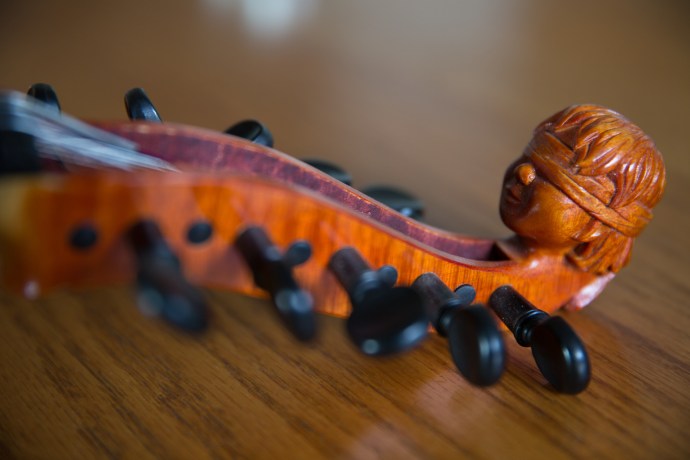
The beautifully carved scroll of Caoimhin O’Railleagh’s Hardanger violin

IG3C0432

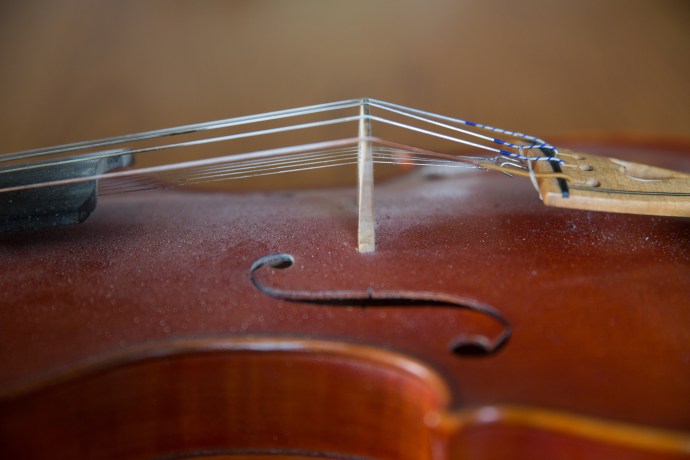
Caoimhin O’Railleagh’s violin.  Five strings are just not enough.

Very quickly I realised this fiddle workshop would be different. Caoimhin is a brilliant, relaxed and engaging teacher with an innovative approach. The time available and the ambience allowed plenty of space to explore concepts that were very new, to me at least. We spent little time actually playing. But always new concepts were put in the context of playing traditional music. We spent a day on cross tuning. For myself I stuck with GDGD but others went off in all directions. Indeed people were playing together with wildly different tunings producing surprising outcomes. There were no boundaries. We were encouraged to play tunes we knew opening up new possibilities and to then try our hand at composing melodies.

IG3C9359

Caoimhin O’Railleagh makes a point.

Another day we looked at tempo and the concept of expanding and contracting time. We were introduced to the Cyclotron, software by Daniel Trueman, that enables you to vary the space between notes within a tune and ultimately the rhythm and feel. We looked at discovering amazing sounds by exploring the real estate of the fiddle and the bow. We looked at difference tones – notes that only exist in the mind, and we looked at poly-rhythms.

IG3C9546IG3C0017

IG3C9521

Sounds heavy but it wasn’t. There was were five hours each day of classes, but it went so quickly.  And it wasn’t all work.

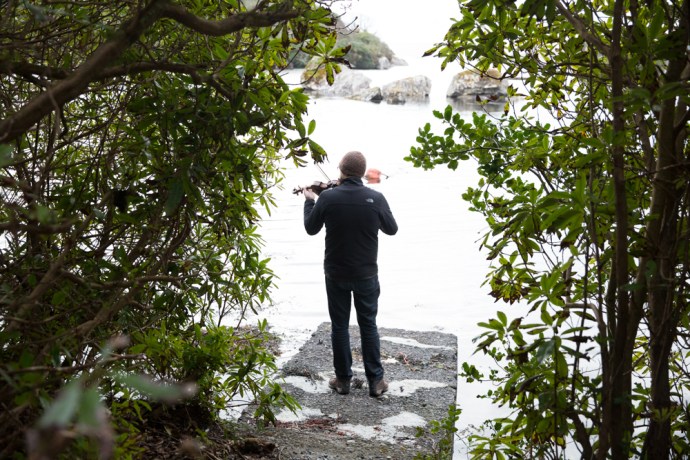
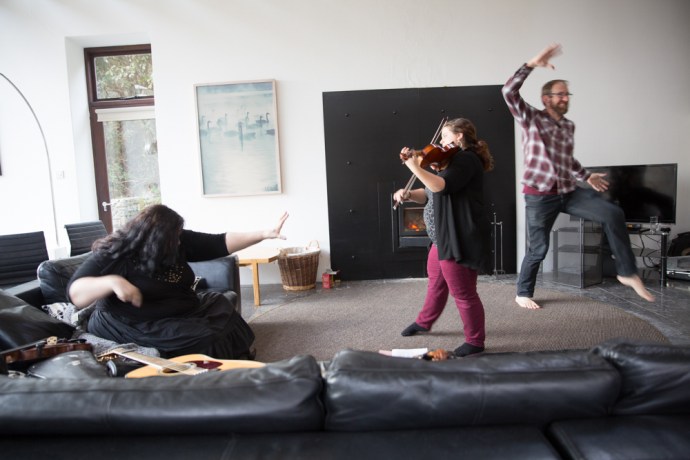
Afternoons were filled with activities; organised or less-organised. There were ad hoc workshops including ‘dalcroze eurythmics’, yoga, role play games or you could brave the cold (it actually snowed one day) for a swim with the seals. Or you could just go off and practice.

IG3C9771

A quiet place to play 1

IG3C9317

A quiet place to play 2


IG3C0521

A class in ‘dalcroze eurythmics’?

IG3C0430

Or time for a dip?

IG3C9511

Jotting down some wise words.

The evenings sometimes went in surprising directions; activities including table rugby and games that totally messed with the brain in quite different ways.

IG3C9493

Ireland vs the Wallabies in Table Rugby.

IG3C9757

A highlight was the Dining in the Dark experience. On this occasion we were treated to a wonderful five course degustation menu prepared and presented by Jenny and Anda, who were the only two ‘sighted’ residents of the house for the night. There were plenty of surprises with our taste buds made keener by the darkness.  A butter tasting. Who would have thought? Kale served three ways. A colcannon to die for. A sweet dish which baffled me but turned out to be carrageen pudding and a cheese plate highlighting how good Irish cheese actually is. The meal was interrupted at one point by a spellbinding soundscape of wild fiddle from Coaimhin the sound coming from everywhere as he strolled around the house. Then there was what seemed like an eternity of silence. This was brought to an end by tentative noises made by just one or two at first but then by the full ensemble with whatever came to hand, ultimately turning into an untamed cacophonous symphony of sound and noise of Dada-ist proportions rising out of the darkness.

It is hard to quantify what one gets out of such an experience. I didn’t learn any tunes. There were no sessions in the traditional sense. But I didn’t come for that. What I did get were immeasurable experiences of sharing music and musical thoughts, new ways of looking at timing, rhythm and tone, An insight into new paradigms of playing music and lifetime friends.

A true springboard.  Definitely a dive into the unknown.

IG3C9516

IG3C9763


The Springboard Fiddle Retreat was held on 15th to 19th March 2018.  Check their site http://www.westcorkmusic.ie/retreats/springboard for info on 2019.


Categories: My Journey, The Fiddle, Trad Irish Music | Tags: , , , , , , , , , , , , , , , , , | 2 Comments

Glengarriff, West Cork. A Blissful Elysium.

IG3C9137-2

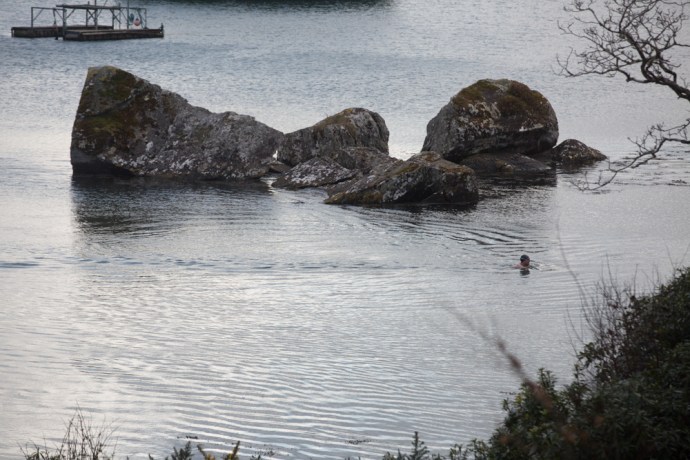
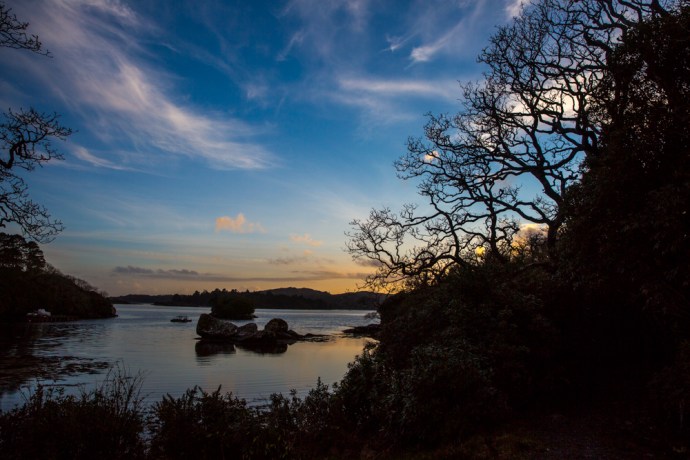
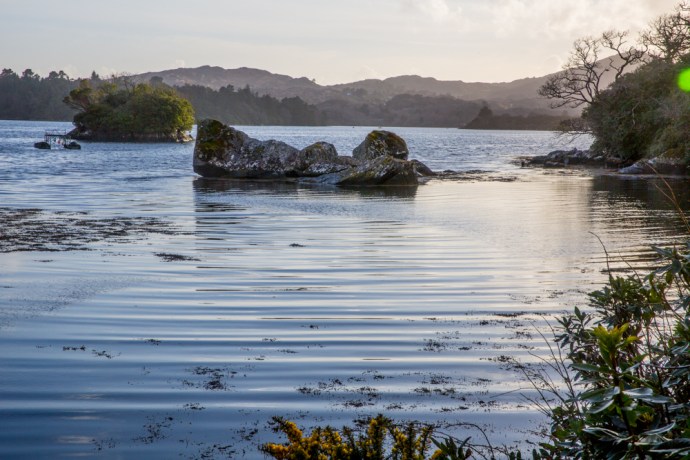
Glengarriff sits on the upper reaches of Bantry Bay in West Cork. I was lucky enough to spend five wonderful days there last week at a Fiddle Retreat and was able to closely observe the various moods of this sublime waterway. I never actually visited the village of Glenngarriff itself, as my accommodation was tucked away on its own private estate behind the golf course; so private and so quiet that in the time I was there encountered not another soul. other than my fellow residents.

Join me on a walk through this blissful elysium.

IG3C9187

Glengarriff waters I

IG3C9120

Glengarriff waters II

IG3C9119

Glengarriff waters III

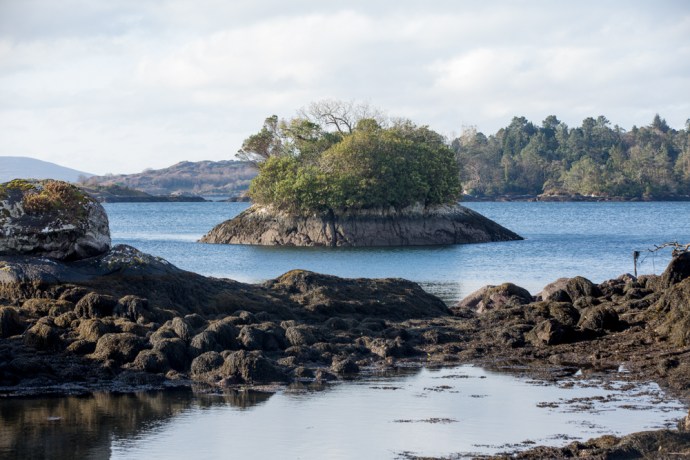
Bantry Bay is a drowned river valley (like Sydney Harbour), and its quiet, still protected waters are dotted with steep sided rocky islands sometimes capped with remnant, thick sub-tropical vegetation.

IG3C0033

A perched forest I

IG3C0098

A perched forest II

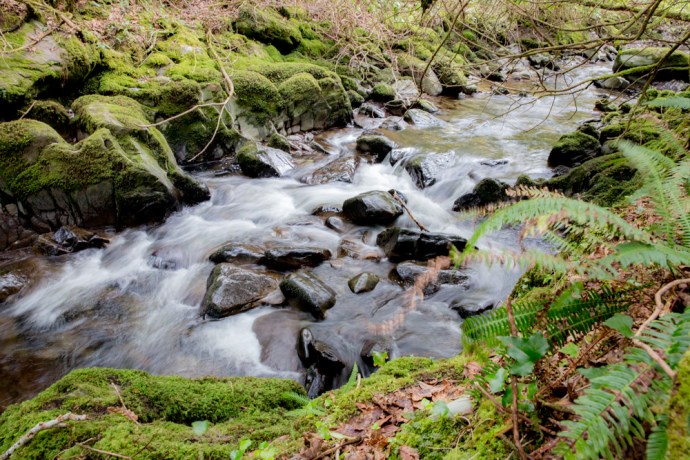
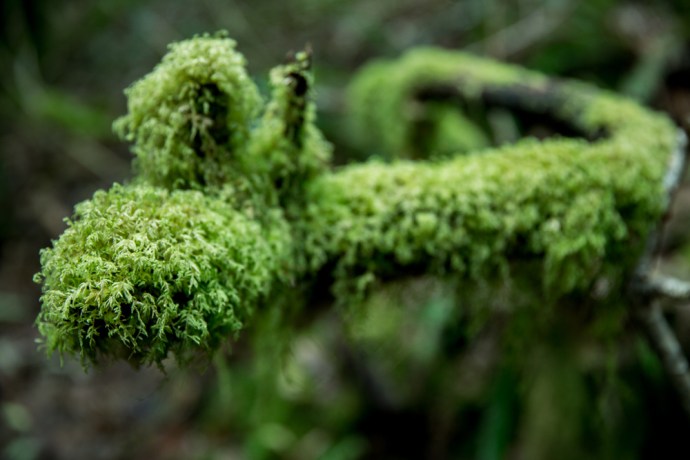
The surrounding forest of magnificent oaks birches and conifers has (where the rhododendron hasn’t taken over) a primeval under-story of forest detritus draped with mosses, lichens and ferns, in places forming a vivid green carpet.  There is a bubbling stream of crystal clear water that snakes its way down the steep slope into the Bay, cascading over the smoothed rocks and falling into occasional, inviting, pellucid pools.

IG3C9935

Moving water

IG3C9865

Still water

IG3C9834

Forest green I

IG3C9818

Forest green II

IG3C9839

Forest green III

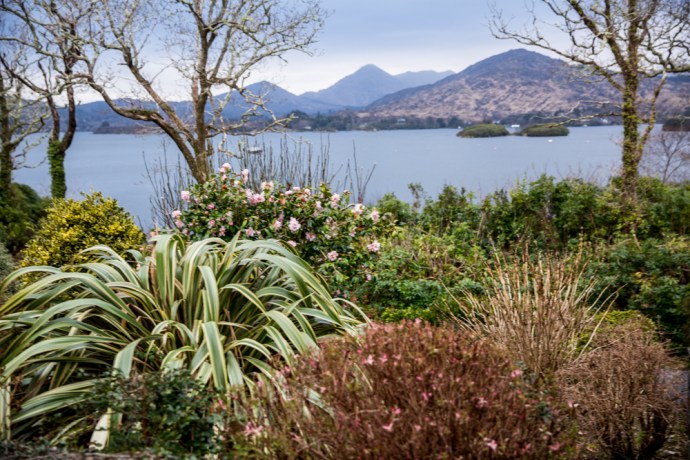
Azaleas and camellias add colour.  This is only March and the rhododendrons can’t be far away from joining in.

IG3C9972

Lush sub tropical gardens with flax, azaleas and camelias.

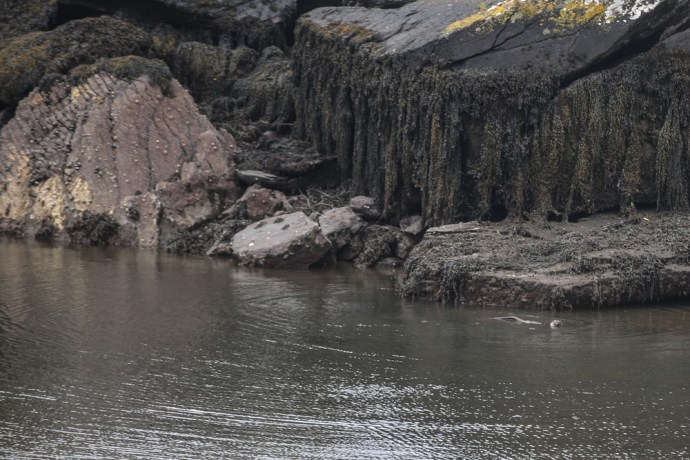
You regularly sight seals cavorting on the shore.

IG3C8241

A cavorting seal I

IG3C8247

A cavorting seal II

The scene was ever-changing. One moment bathed in brilliant sunshine, then heavy cloud.  Frigid weather brought some light flurries of snow flakes drifting to the ground but not settling and then blue skies brought out the singing birds.  A Great Tit in an oak tree near the house harmonising with the sweet sounds of the fiddle coming from inside.

IG3C0080

Sunshine one moment

IG3C0277

Snow the next

IG3C0102-2

The sun brings out the birds.  The Great Tit.

Another wonderful hidden gem in beautiful West Cork.

Categories: My Journey, Wild Ireland | Tags: , , , , , , , , , , , , , , , , | 1 Comment

Blog at WordPress.com.